
Restaurant Franchise Marketing Plan_ Strategies to Grow Brand Awareness & Sales

Restaurant Franchise Marketing Plan: Strategies to Grow Brand Awareness & Sales

Home / Blog /
Restaurant Franchise Marketing Plan: Strategies to Grow Brand Awareness & Sales

Read summarized version with

The restaurant franchise marketing plan is a documented strategy that connects your brand’s national image with local marketing that brings customers into each franchise. Marketing without a plan will be sporadic: some franchisees will do a lot for their local market, others will do nothing, and the brand reputation will vary drastically by market.

The franchise marketing strategy is what keeps this from happening. The marketing strategy outlines the marketing channels, budget, brand tone guidelines, performance indicators, and who is responsible for what in a franchise system. 

Effective audience segmentation allows franchises to tailor their marketing strategies to different customer needs, leading to higher engagement and conversion rates. Franchise systems that segment their audience report higher lead-to-application rates, often doubling conversion compared to generic messaging approaches.

Franchise marketing plans should include measurable objectives tied to business goals, allowing for the tracking of performance at both the system and location levels. This guide outlines how to develop the marketing strategy.

What You Will Learn

  • How to develop a restaurant franchise marketing plan that is effective at both the corporate and local level
  • The marketing techniques and media that effectively attract and retain customers for franchise businesses
  • How to ensure brand consistency while having flexibility in local marketing
  • How to track the effectiveness of marketing efforts and make improvements

Why Franchise Marketing Requires a Dedicated Marketing Plan

The term ‘franchise marketing’ refers to strategic marketing practices designed to build national brand recognition while attracting foot traffic and new customers to individual franchise locations. 

In essence, a dilemma exists: franchise owners need flexibility to respond to their local market environment, while franchise brands need consistency to protect the unique brand identity that gives every location an edge over competitors.

INDUSTRY INSIGHT

Consumer spending is expected to push restaurant industry sales to a projected $1.55 trillion nationwide in 2026, with real (inflation-adjusted) gains of 1.3%.

The quick-service franchise market is valued at $273 billion, with over 60% of transactions now occurring off-premises, driven by mobile apps and delivery platforms. Food delivery is a global market worth more than $150 billion, up more than 300% since 2017. These statistics show how important franchise marketing is.

Most franchises go wrong by taking one of these two paths to an extreme. Either they centralize too much, corporate marketing departments develop all marketing content and conduct all marketing campaigns, leaving the owners of individual franchises with no way of adjusting to their particular local markets, or they don’t centralize enough–owners conduct their own marketing activities without sufficient direction, resulting in poor brand image and reputation.

A restaurant franchise marketing plan solves this by clearly defining what corporate controls, what local franchise owners execute, what resources and marketing assets each has, and how performance is measured across the system.

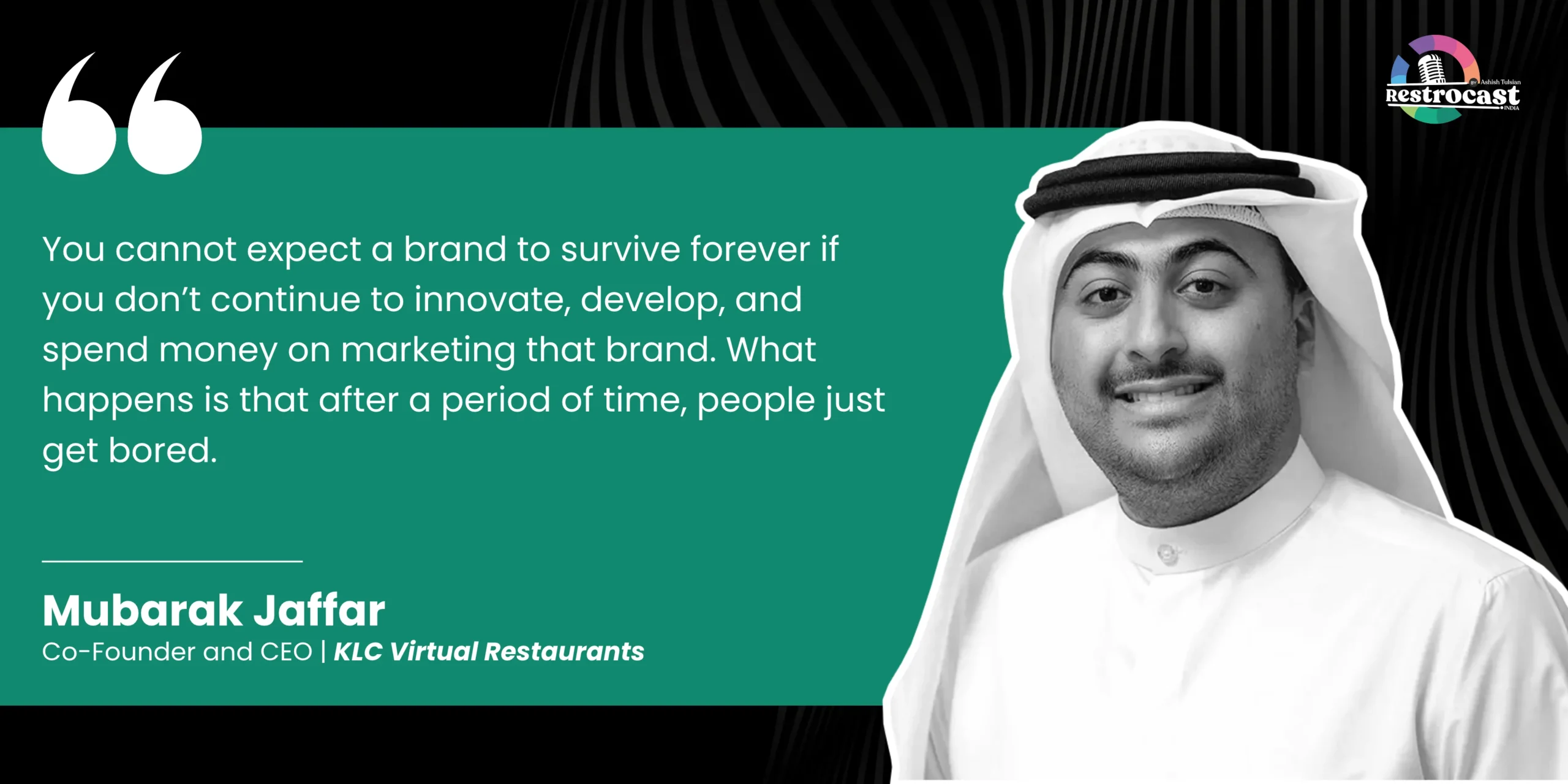
Mubarak Jaffar, Co-founder and CEO of KLC Virtual Restaurants, joined the Restrocast Podcast with Ashish Tulsian and emphasized the importance of marketing in helping a brand survive changing eras. 
Marketing Strategy: Building the Foundation of Your Franchise Brands’ Marketing Plan

A strong franchise marketing strategy begins with clarity about your franchise concept, your target audience, and the marketing channels that reach them most efficiently in your specific restaurant category. Effective franchise marketing requires continuous testing and optimization based on real performance data to adapt to changing market conditions. 

Effective franchise marketing combines national brand consistency with hyper-local tactics focused on digital precision and community engagement. 

Research on international restaurant chains shows that customizing the 7Ps of marketing is critical to making these strategic adjustments. In a franchise, that usually means standardizing some Ps across the system and adapting others locally:

The 7Ps What’s set nationally by the brand Adapted locally by franchise owners
Product Core menu and recipes Regional or limited-time offer menu items, where approved
Price Pricing strategy and value positioning Local price points and promotions
Place Store format, delivery and ordering platforms Delivery zones, local partnerships
Promotion National campaigns, brand messaging Local events, community and influencer marketing
People Service standards and training Local hiring and community involvement
Process Operating procedures and order flow Staffing and adjustments for local peak times
Physical Evidence Store design, packaging, signage Local décor touches and community displays

Defining Your Franchise Concept and Brand Position

Your franchise concept and brand position define how you compete, and that dictates every marketing move that follows.

A QSR franchising concept would compete based on convenience, speed, and cost-effectiveness. As such, a QSR franchising concept would focus on mobile, convenience-oriented, and price-focused marketing strategies. 

A full-service franchising concept would compete on experience, quality, and occasion-based visits. The marketing strategy would then focus on occasion-based campaigns, photography, and community engagement.

Before planning any of your marketing plans, ensure that you have documented your franchise concept, including the service concept, customer experience promises, the average order amount, and competitive positioning in relation to both direct and indirect competition in each market you serve.

Target Audience: Who You Are Marketing To

Your target audience is the specific group of diners your franchise is built to serve, defined not just by demographics but also by dining occasion, preferred ordering channel, and media habits.

A marketing plan for a restaurant franchise must clearly specify the target audience beyond demographics, including behavior and psychology, so franchise marketing efforts reach the right potential customers through the right channels. 

A franchise idea aimed at weekday lunch service around office buildings will need an entirely different marketing strategy than one targeting family dinners in suburban areas.

Specify your target audience by: age and income, occasion (weekday lunch, weekend family dinner, date night), channel (dine-in, delivery, take-out), and media consumption habits. The target audience definition should remain consistent across the franchise chain for core branding, while local marketing efforts may vary based on local specifics, even if the brand positioning remains the same.

Setting Your Marketing Budget

A franchise marketing budget has two parts:

  • The co-op marketing budget
  • The local marketing budget from each franchise owner

In your marketing plan, make sure you provide both the amounts clearly and how the co-op marketing budget will be split into national and local marketing campaigns.

Source: Small Business Trends
Funding source Who spends it What it pays for Typical range
Brand fund (Co-op budget) The franchisor, on behalf of the system National campaigns, creative assets, digital advertising, marketing technology 1% to 5% of gross sales, often around 3.5%
Local marketing budget Each franchise owner, in their own market Local ads, events, community and influencer marketing Often 0.5% to 2% of sales, set in the franchise agreement

As a real example, Toastique caps its brand fund at 2% and requires franchise owners to spend at least 2% of monthly gross sales on local marketing. In your marketing plan, make sure you state both amounts clearly and explain how the brand fund will be split between national and local marketing campaigns. 

Make sure to communicate the benefits of co-op marketing budget contribution with the franchise owners, including national marketing campaigns, a library of marketing materials, budget spent on their behalf for digital advertising, and the support they receive.

Franchise owners who know exactly what their contribution funds are likely to do may contribute more to voluntary local marketing.

A clear marketing strategy also helps franchise brands restart growth after a slowdown. The Melting Pot is a good example of that. 

After pausing franchise development during the pandemic to protect existing owners, The Melting Pot leveraged a comprehensive strategy combining public relations, content marketing, and digital advertising to relaunch growth. Mainland’s storytelling and awareness-building approach secured The Melting Pot a three-hour national television spot on Fox & Friends.

Franchise Disclosure Document and Marketing Obligations

The franchise disclosure document (FDD) is the document franchisors must provide to potential franchisees before any agreements are made, and it outlines the marketing obligations franchise owners must meet.

Prior to developing the functional components of your marketing plan, be sure that there is perfect alignment between your marketing needs and those stated in the FDD.

In the US, marketing obligations are disclosed mainly in Item 11 of the FDD, which covers the franchisor’s assistance, advertising, computer systems, and training. The marketing-related aspects include-

FDD marketing element What it covers
Marketing fund contribution The percentage of sales franchise owners must contribute to the marketing fund
Fund management and monitoring Who administers the fund, whether it is audited, and how the money was spent in the most recent fiscal year
Franchise sales spending What percentage of the fund, if any, is used mainly to attract new franchisees
Franchisor’s marketing obligations The marketing the franchisor commits to providing as a corporation
Minimum local marketing spend What each franchise owner must spend on marketing in their own market

Any marketing plan that deviates from or exceeds the FDD increases legal liability; therefore, consult a lawyer to review your FDD and ensure you set correct marketing requirements for franchise owners.

New franchise owners should receive proper marketing onboarding on-

  • Brand voice
  • Marketing assets
  • Local marketing guidelines
  • Digital account setup
  • Performance goals for the first 90 days of operations

Franchise marketing plans fail most often during onboarding; the plans have the documentation, but not the actual onboarding.

Brand Consistency: The Marketing Principle That Protects Every Location

Brand consistency protects every location because each franchise benefits from the brand recognition built by every other location in the network.

The more a customer encounters the franchise brand through marketing materials, the more recognizable and credible the brand becomes when consistency is maintained throughout the entire brand experience.

McDonald’s shows what a consistent brand can sustain at scale. In 2025, its 12,212 domestic franchised restaurants averaged $4.057 million in annual sales, with about 81% of them above $3 million, while company-run restaurants averaged $4.871 million. 

This shows that how your brand operates plays a major role in performance, and marketing gives that performance a further edge.

What Brand Consistency Covers in Practice

Consistency of brands in franchise marketing includes:

  • Visual identity (logo use, color scheme, typography, and photo style)
  • Voice of the brand (tone and language utilized in marketing and customer relations on all marketing platforms)
  • Messaging structure (claims and unique value proposition that separates the franchise from its competitors)
  • Customer experience expectations (how customers are greeted, served, and treated at each franchise site).

To ensure brand consistency, not everything has to be identical across all franchise locations. Instead, each piece of marketing, whether created by the corporation or an individual franchise owner, must unmistakably belong to one brand. 

Local marketing campaigns at the particular franchise site must be consistent with the national marketing campaign happening simultaneously.

Centralized Brand Control with Local Flexibility
Centralized Brand Control with Local Flexibility

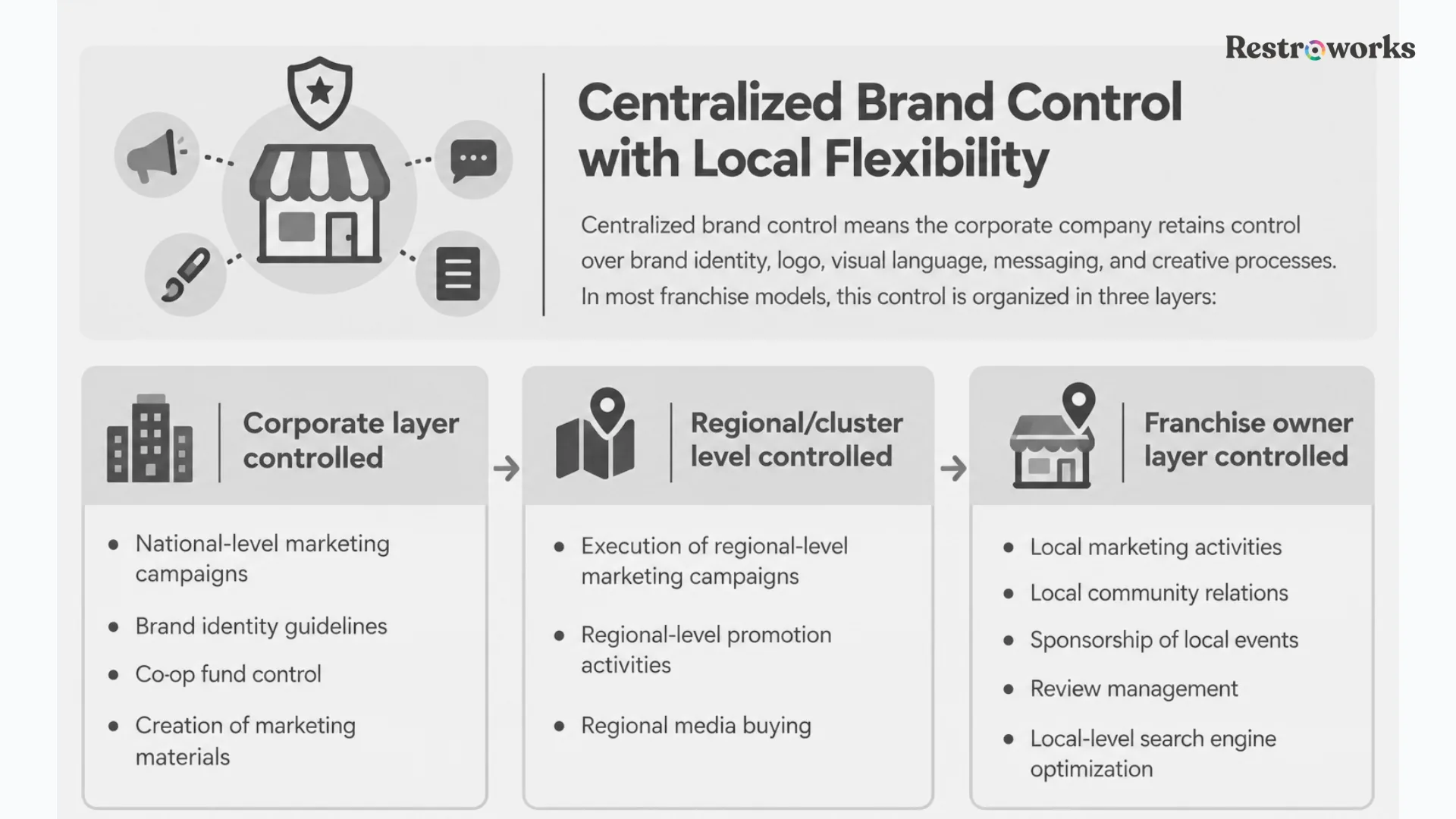
Centralized brand control means the corporate company retains control over brand identity, logo, visual language, messaging, and creative processes. Centralized brand control does not imply that the corporate company controls all marketing activities at each location. In most franchise models, there is an organization of brand control using three layers:

  • Corporate layer controlled: National-level marketing campaigns, brand identity guidelines, co-op fund control, creation of marketing materials
  • Regional/cluster level controlled: Execution of regional-level marketing campaigns, regional-level promotion activities, regional media buying
  • Franchise owner layer controlled: Local marketing activities, local community relations, sponsorship of local events, review management, and local-level search engine optimization.

In other words, it balances brand identity consistency with local marketing flexibility. Boilery NYC launched a postcard marketing campaign to build awareness and drive foot traffic. 

They distributed the direct mail pieces to targeted local households, with messaging designed to introduce the establishment and drive trial visits.

Local SEO: The Foundation of Local Franchise Visibility

Local SEO is the foundation of local franchise visibility because it puts each location in front of people who are already searching for a restaurant like yours nearby, which makes it one of the highest-ROI digital marketing channels for franchises.

Because local SEO taps into existing demand, it captures customers at the exact moment they’re deciding where to eat.

Hyper-local SEO optimizes each location’s online presence with accurate hours, location-specific keywords, and high-quality photos so it appears in local search results. According to Google, 76% of people who search for a local business on their phone visit one within a day, highlighting the critical role of local SEO in driving foot traffic to franchise locations. 

Google Business Profile Optimization

Each franchise should have its Google My Business profile completely optimized and maintained. That includes-

  • Consistent name
  • Address
  • Phone number (NAP) across all platforms 
  • Quality photos of the interior and menu dishes
  • Accurate, up-to-date business hours (including holidays)
  • Timely responses to reviews

Complete profile information matters more than ever. Google has discontinued the Q&A feature on Business Profiles and replaced it with Ask Maps, an AI-powered feature that answers customer questions using content from your profile, including reviews, descriptions, and photos. If that information is missing or outdated, the AI’s answers about your location will be too. 

Other Local SEO activities for franchise locations include creating local landing pages on the corporate site with local content, maintaining consistent NAP across all local listings (Yelp, TripAdvisor, Apple Maps), and building local links through partnerships with local businesses and organizations.

Review Management Across Franchise Locations

Review management is the process of requesting, responding to, and monitoring customer reviews at every franchise location. It directly affects both local search rankings and whether diners choose your restaurant.

Google reviews affect search rankings and conversions; a franchise site with 200 reviews will always outperform a competing site with only 40, no matter how good its menu is. 

That’s why a franchise marketing plan should consider the following: 

  • A process for requesting reviews from satisfied customers
  • An approach to responding to both positive and negative reviews
  • A process for reviewing trends across all franchises.

A franchise owner who responds to every negative review, shows responsiveness, and asks satisfied customers for reviews will build a local brand reputation that paid ads can never achieve.

Social Media Marketing: Building Local Community on Digital Platforms
Social Media Marketing

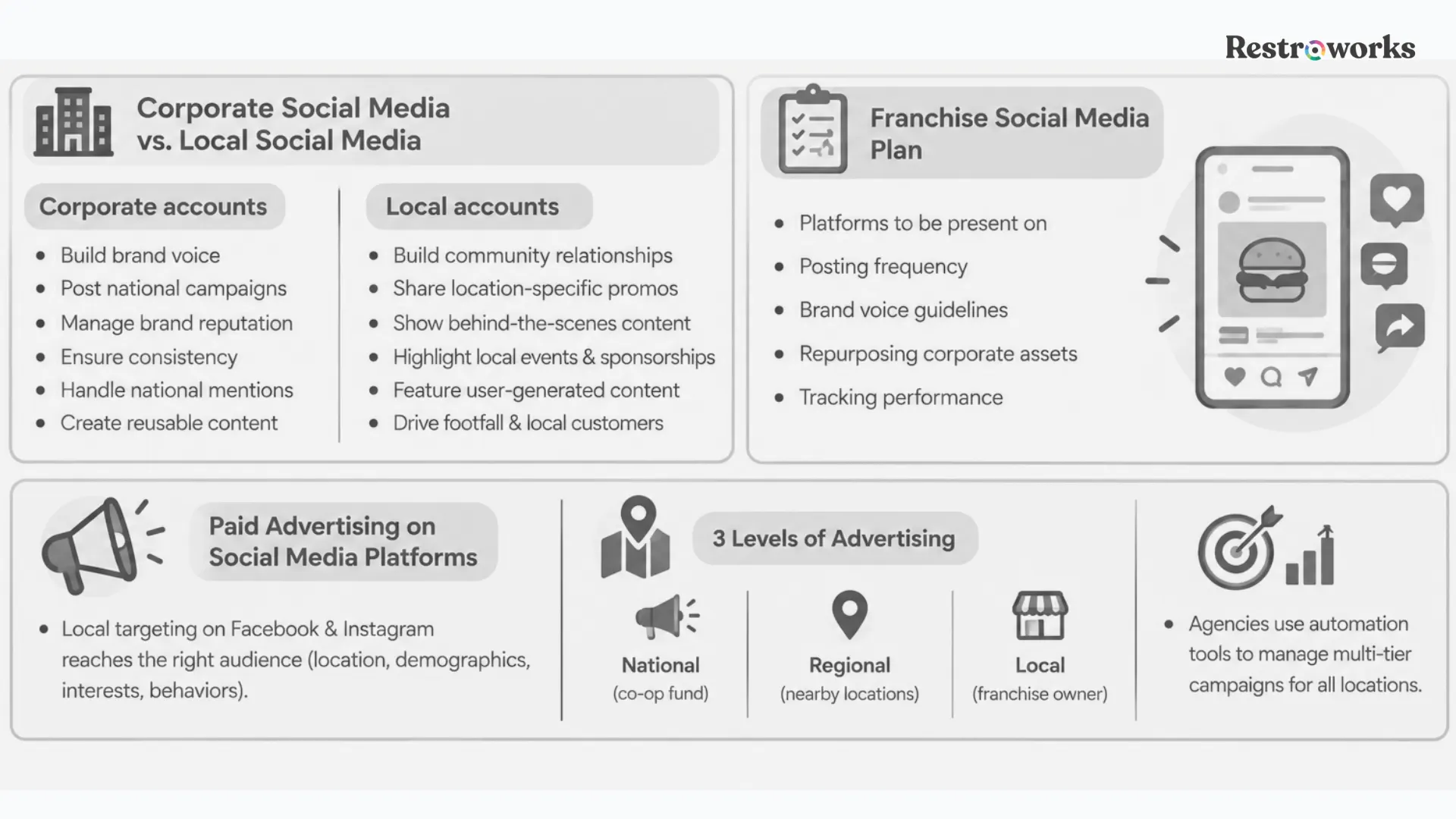
Social media marketing for a restaurant franchise system operates at two distinct levels: corporate-managed brand accounts that establish identity and drive national awareness, and locally managed franchise location accounts that build community relationships and drive local marketing in each specific market.

Corporate Social Media vs. Local Social Media


Differences Corporate social media Local franchise social media
Managed by Corporate social media manager Franchise owner or local team
Purpose Establish brand voice and national awareness Build community relationships and drive footfall
Content National campaign content and high-quality creative Location-specific promotions, behind-the-scenes team content, community involvement, local customer UGC
Responsibilities Consistency across brand accounts, national brand mentions, reputation management Local engagement, local events, and repurposing corporate assets

The corporate social media manager ensures consistency across these accounts, handles national brand mentions, and creates high-quality creative content that local accounts can repurpose.

Franchise social media content, in turn, includes community involvement such as sponsoring local sports teams and taking part in local events, along with user-generated content created by customers. 

So, a franchise marketing plan should specify-

  • Platforms: Which social media platforms each franchise location should be present on
  • Posting frequency: How often each location is expected to post
  • Brand voice guidelines: The tone and language rules local content must follow
  • Content repurposing guidelines: How locations use and adapt corporate marketing assets
  • Performance tracking: How social media performance is measured across all location accounts

Paid Advertising on Social Media Platforms

Paid social advertising lets franchises geo-target people near each restaurant on platforms like Facebook and Instagram, and it works best when run at three levels: national, regional, and local. 

Local targeting through paid advertisements on social media sites such as Facebook and Instagram is a strong tool for franchise restaurant marketing strategies. Geo-targeting lets you reach a specific audience near a franchise restaurant based on demographics, interests, and behaviors.

In Meta Ads Manager, you can drop a pin on a location and set a radius around it, and the same guide suggests restaurants typically see success with a 3–10 mile radius 

Social media advertising for franchises operates at three levels:

Level Funded and run by Goal
National Corporate, through the brand fund (co-op marketing budget) Brand recognition campaigns
Regional Regional co-ops or clusters of nearby franchises Reaching people across a group of nearby locations
Local Individual franchise owners Driving visits in each restaurant’s immediate area

Meta also offers tools designed for multi-location brands, including store sets and dynamic local ads that automatically insert details like the nearest store address and estimated travel time into the ad creative. 

EXPERT OPINION

“To expect a new franchisee in a startup franchise program to surpass the existing business owner’s financial performance is a dangerous strategy. In this case, the fledgling franchisor should identify why his business is not profitable and correct the situation before expecting a new franchisee to solve the problem. A flawed business used to develop a new franchise will end up creating a flawed franchise.”

Ed Teixeira, Former Franchisor Executive and Franchisee, Independent Franchise Consultant

Franchise Marketing Technology: The Infrastructure That Makes Scale Possible

Franchise marketing technology is the set of tools, mainly marketing automation, digital asset management, and performance analytics, that lets a franchise system run consistent, personalized marketing.

Modern franchise marketing cannot operate at scale without dedicated franchise marketing technology. Key trends defining food franchising in 2026 include-

  • Automation and AI integration
  • Delivery-focused operations
  • Health-conscious menu innovation

According to Deloitte, 70% of restaurant operators are either using or piloting AI to improve loyalty programs and employee workflows, and eight in ten restaurant executives plan to increase AI spending in the next fiscal year.

Technology also needs to support visibility in AI search, not just traditional search. BrightLocal’s 2026 survey found that AI search engines are now the third most-used tool for local business recommendations, behind Facebook and Google. 

Franchise brands that invest in AI search visibility alongside local SEO are better placed to capture high-intent “near me” searches in their category, while those that ignore it risk losing website traffic and foot traffic to competitors. 

Marketing Automation Platforms

Marketing automation platforms let a franchise system send personalized, triggered campaigns, such as birthday offers, win-back programs, and rewards notifications, to thousands of customers automatically, based on their behavior. 

Using customers’ behavioral data, franchisees can launch these campaigns without having to initiate each one manually. To work well, marketing automation software for restaurant franchise marketing should connect to four systems:

System What it provides
POS system Transactional data, such as order history and spend
Loyalty program Customer behavioral data, such as visit frequency and rewards activity
Email marketing platform Campaign execution
Analytics platform Measurement of marketing results

Franchise Marketing Assets and Digital Libraries

A franchise marketing asset library is a central collection of approved brand materials that every franchise owner can access and customize for local use while maintaining brand consistency.

These include marketing tools such as-

  • Logo images
  • Photographs
  • Social media templates
  • Email templates
  • Promotional graphics
  • Direct mail templates

Without such a library, marketing assets are developed ad hoc, creating inconsistencies in brand voice and identity that defeat the purpose of being part of the franchise.

A digital asset management system that keeps together all franchise marketing assets, manages versioning, and provides access only to approved assets is one of the most fundamental franchise marketing technologies. Without these systems, franchise owners end up developing their own marketing assets.

Marketing Performance Tracking and Analytics

Franchise marketing measurement should be tracked at two levels: franchise location-level performance (how is marketing performing at this particular location?) and system performance (how is franchise marketing performing at the system level?). Both perspectives matter, but serve different needs.

Franchise owners need access to the first level of data-

  • Customer acquisition cost
  • Conversion by marketing channel
  • Local search position
  • Review volume and trends
  • Campaign ROI

The second is necessary for corporate marketing teams to know which franchise marketing approaches perform best, which local marketing efforts drive results, and where to allocate more marketing investment.

Additionally, key performance indicators every franchise marketing strategy should track are-

  • Customer acquisition cost by channel: What it costs to win a new customer through each channel
  • Customer retention rate: How many customers keep coming back
  • Average check by marketing channel: How much customers from each channel spend
  • Review volume and trends: Reputation and customer sentiment over time
  • Local search ranking for priority keywords: Visibility for priority keywords in each market
  • Email open and conversion rates: How well email campaigns engage and convert
  • ROI for paid campaigns: The return on paid advertising spend

Paid Search in Franchise Systems: Capturing Demand at the Local Level

Paid search captures local demand by placing a franchise location at the top of Google results the moment someone searches for a restaurant in your category nearby.

It typically involves Google Ads campaigns targeting local search queries and works because it reaches customers who are actively looking for a dining option right now. It’s also relatively efficient for restaurants compared with other industries:

  • Google Ads click-through rate is at 6.83% for restaurants compared to the all-industry average of 6.64%.
  • Cost per lead for restaurants and food is $30.57 vs. the $66.69 all-industry average

Most franchise systems allocate 5 to 10% of gross revenue to marketing, split between a corporate brand fund and local marketing spend.

EXPERT OPINION


“The National Restaurant Association also reports that Americans spend $799 billion a year on restaurants. Beyond clothing, restaurants are the most searched type of business online. 

Clearly, competition is fierce, and branding is more important than ever before. Whether yours is a franchise or independent restaurant, it takes more than great food and service to lure customers and build loyalty and repeat business. It takes a well-defined brand that resonates emotionally with your customers.”

— Jennifer Williams, Founding Partner, The Watsons (New York City branding firm)


Local Paid Search Strategy for Franchise Locations

A local paid search strategy for franchises combines 3 campaign types: brand keyword campaigns (whereby your franchise locations show up when people are searching for your brand name), category keyword campaigns (to catch “pizza near me,” “sandwich delivery,” or any other category keyword that fits your franchise model), and competitor conquest campaigns (showing up when someone searches for a competitor).

Paid search ad budget should focus on franchises with highly competitive local search environments, where it takes longer to get good results through organic local SEO efforts. 

New franchise owners, those still building their Google Business Profile and review presence, benefit most from paid search in the first six to twelve months.

Integrating Paid Search with Local SEO

Paid search and local SEO work best when they work together rather than separately. Local search engine optimization builds brand presence in organic searches, while paid search provides instant visibility. Together, they ensure franchises appear in both organic and paid search, so customers searching for something related to your category can find and choose your business.

Franchise marketing agencies handle both approaches and can coordinate them, delivering better results than managing them separately.

Local Marketing: Driving Foot Traffic at the Individual Franchise Level
Local marketing

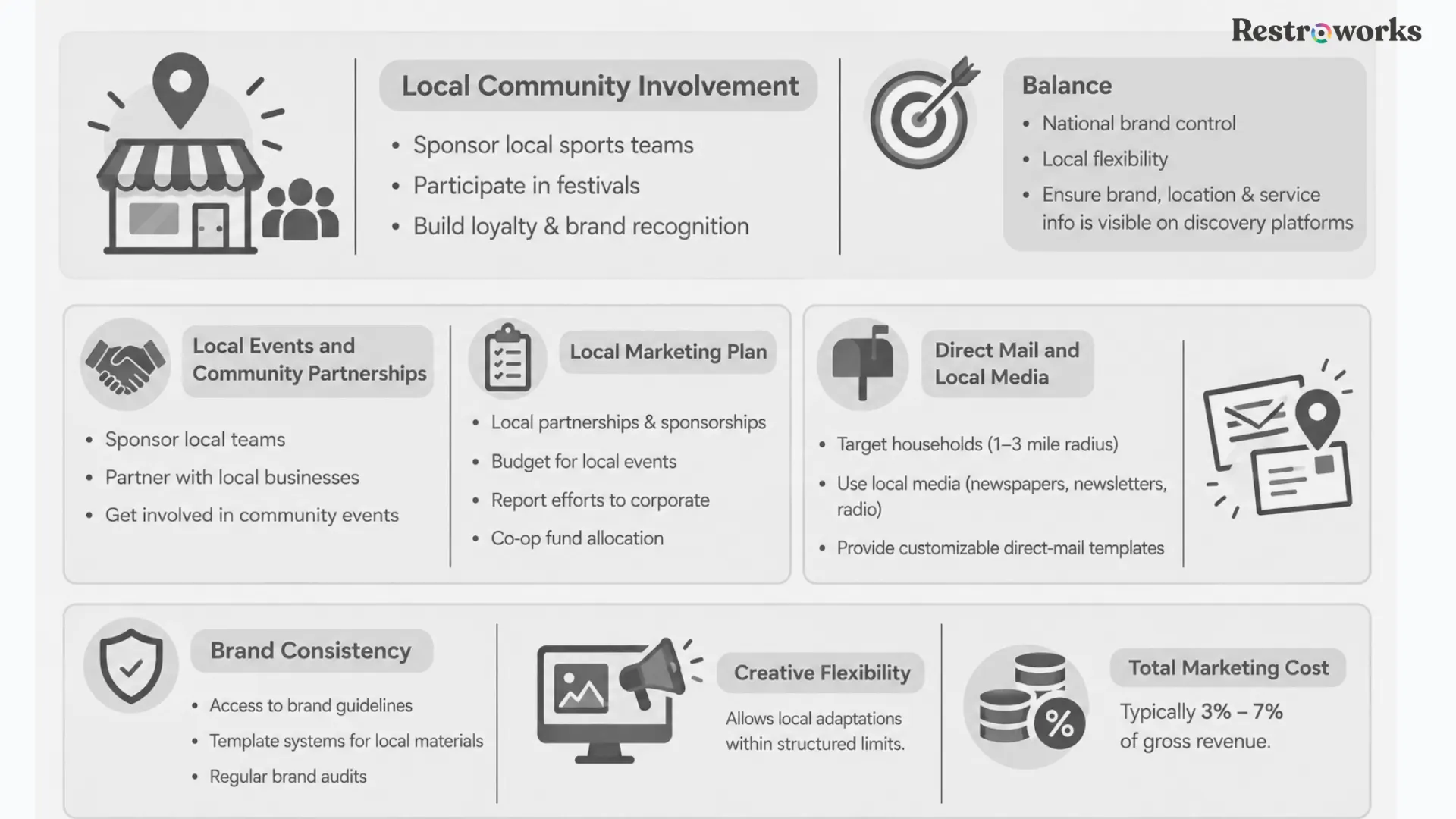
Local marketing drives foot traffic at the individual franchise level through community involvement, local events and partnerships, direct mail campaigns, and local media. These tactics build relationships and recognition in each neighborhood that national advertising alone can’t. 

Local community involvement, such as sponsoring local sports teams and participating in festivals, builds brand loyalty. Effective franchise marketing combines national brand consistency with hyper-local tactics focused on digital precision and community engagement.

Local Events and Community Partnerships

Franchise owners who actively market through local events, sponsor local sports teams, collaborate with local businesses, and become part of the local community invariably perform better than those who rely only on corporate advertising strategies. 

These local marketing strategies build relationships and brand recognition within the local community that advertising alone cannot achieve.

A local marketing strategy needs to be included in the franchise marketing strategy and must include the following:

  • Types of local partnerships and sponsorships that franchise owners can consider, which are consistent with the brand
  • Budget for sponsoring and promoting local events
  • Documentation and reporting of local marketing efforts to corporate teams
  • Brand fund (co-op marketing budget) allocation for local community marketing

Direct Mail and Local Media

A direct mail campaign targeting households within a defined radius of each franchise location remains effective for restaurant franchise marketing, especially for launching new franchises, new menus, and seasonal promotions. 

According to the ANA’s 2024 Response Rate Report, direct mail is the top-performing offline channel for response: 

  • Response rate, house lists (existing customers) is at 5% to 9%
  • Response rate, prospect lists (new audiences) is at 4% to 5%
  • Median ROI for direct mail is 112% as compared to paid search at 93% and online display at 89%

Local media outlets such as community newspapers, neighborhood newsletters, and local radio broadcasts continue to reach audiences that online media cannot.

You should include a set of direct-mail letter templates that individual franchise owners can tailor using the location address and a promotional offer for the local audience. The best direct-mail targeting is geo-targeting within a 1- to 3-mile radius around each franchise location.

Maintaining brand consistency requires comprehensive brand guidelines that are accessible and enforceable, template systems for local marketing materials, and regular brand audits across all locations. 

The most effective franchise marketing strategies give franchisees creative flexibility within structured limits, allowing for local adaptations while maintaining overall brand integrity. The total franchise marketing cost for most systems falls between 3% and 7% of gross revenue when combining both brand marketing fund contributions and local marketing spend requirements. 

Email Marketing: Building Long-Term Customer Relationships

Email marketing is by far the most cost-effective retention channel for franchise marketing, but it is underinvested relative to its impact on customer lifetime value.

Email marketing for franchises should be implemented at two levels-

  • Corporate brand emails (new product launches, national promotions, loyalty program updates
  • Franchise-level emails (birthday promotions, announcements of local promotions, surveys of new customers).

Personalizing emails with customer transaction information greatly boosts email marketing performance. Birthday emails are the clearest example: Experian’s analysis of more than 50 brands found that birthday emails deliver 481% higher transaction rates, 342% higher revenue per email, and 179% higher unique click rates than standard promotional emails. 

Technological capabilities in franchise marketing that link POS transaction information with email marketing automation enable this personalization without manual handling of information at the location level. Creating such technological infrastructure is a valuable investment for franchise marketing.

Measuring Franchise Marketing Performance

Your restaurant franchise marketing plan will only be as effective as the performance measurement framework used to measure its success.

Identify the metrics used to measure success prior to executing your marketing plans. Measure the performance of marketing campaigns on a weekly and monthly basis.

Marketing campaign performance reports should give franchise owners insights into their individual locations and help corporate marketing departments measure overall franchise performance.

Franchise marketing agencies serving restaurants will be able to provide you both of these: individual dashboards for franchise owners and system performance reports for corporate marketing departments.

The most important signal for improvement will be the disparity in key metrics between franchise locations that perform well and those that do not. Whenever there are huge disparities between franchise locations in terms of customer acquisition costs, review volume, or local search rankings, try to identify why those franchise locations perform so much better.

Those marketing actions will apply to other locations as well; sharing best practices across the franchise network will be the most important task for corporate marketing departments.

KEY TAKEAWAYS


  • A franchise marketing plan defines what corporate controls, what local franchise owners execute, and the channels and budget for each.
  • Consistent visuals, tone, messaging, and customer experience let every location benefit from the marketing of all the others.
  • Local SEO strategies, social media, paid search, email, and direct mail are the core channels in restaurant franchise marketing.
  • These channels deliver the best results when integrated into one cohesive strategy, not run independently.
  • Tracking performance for each location and across the whole system shows which strategies work.
  • Comparing locations reveals where to invest more and which successes to share across the network.

Frequently Asked Questions

1. What should be included in a restaurant franchise marketing plan?

A restaurant franchise marketing plan should include target audience research, brand positioning, marketing budget, local-store marketing, digital marketing efforts, promotions, franchisee recruitment, and metrics.

2. How much does it cost to market a restaurant franchise?

It depends on the brand’s size, location, and objectives. Franchisees can contribute around 2% to 5% of total gross sales as a marketing fund contribution, but this depends on the franchise agreement.

3. How do you attract franchisees to your restaurant concept?

To attract franchisees, you should show a proven business model, operational support, brand demand, investment information, and franchise opportunities.

4. How do you maintain brand consistency across franchise locations?

Achieve consistency through brand guidelines, consistent menus and recipes, training, marketing materials, digital assets, audits, and quality control processes.

5. What local marketing support should franchisors provide?

Franchisors should offer franchisees local marketing templates, opening-day marketing plans, social media content, local SEO support, a promotional calendar, and advertising assistance, among other things.

6. What digital marketing strategies work for restaurant franchises?

Successful tactics include local SEO and Google Business Profile optimization, location-specific social media campaigns, paid search and social ads, and email and SMS marketing, among others.


Newsletter subscription banner

Talk to a restaurant expert today and learn how Restroworks can help your business.

Request Demo >

Share

Discover More Insights to Power Your Journey

Rethinking Restaurant IT: Todd Kaufman on Technology as a Business Driver

Some of the most influential leaders in restaurant technology never set out to work in it, and Todd Kaufman, Chief…

POS
Best cloud-based restaurant POS
9 Best Cloud-Based Restaurant POS Systems in 2026

The best cloud-based restaurant POS system depends on how many locations you operate and how fast you plan to scale. Today,…

7 Best Cloud Kitchen Management Software in 2026

Whichever platform I (or anyone, for that matter) proclaim as the best cloud kitchen management software out there depends on…

Sharing the Love, One Taco at a Time: Eric Knott on Scaling TikiTaco the Right Way

Ask Eric Knott, CEO of TikiTaco, what business restaurants are really in, and you’ll get an answer that has evolved…

POS
Best Restaurant POS Software in Qatar
Best Restaurant POS Software in Qatar for Every Type of Restaurant

During a Friday dinner rush in Doha, the Talabat tablet at the pass is often where service breaks down: orders…

How to Start an Ice Cream Truck Business in the US

No other business out there can combine nostalgia with profit as well as an ice cream truck does. Like, it's…

Join. Learn. Grow.

Sign up to receive the latest hospitality insights and stories straight to your inbox

Streamline your operations with Restroworks