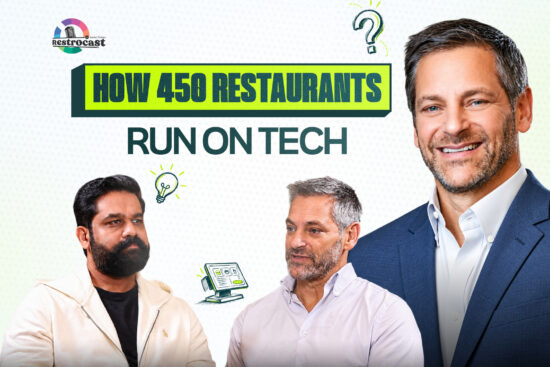
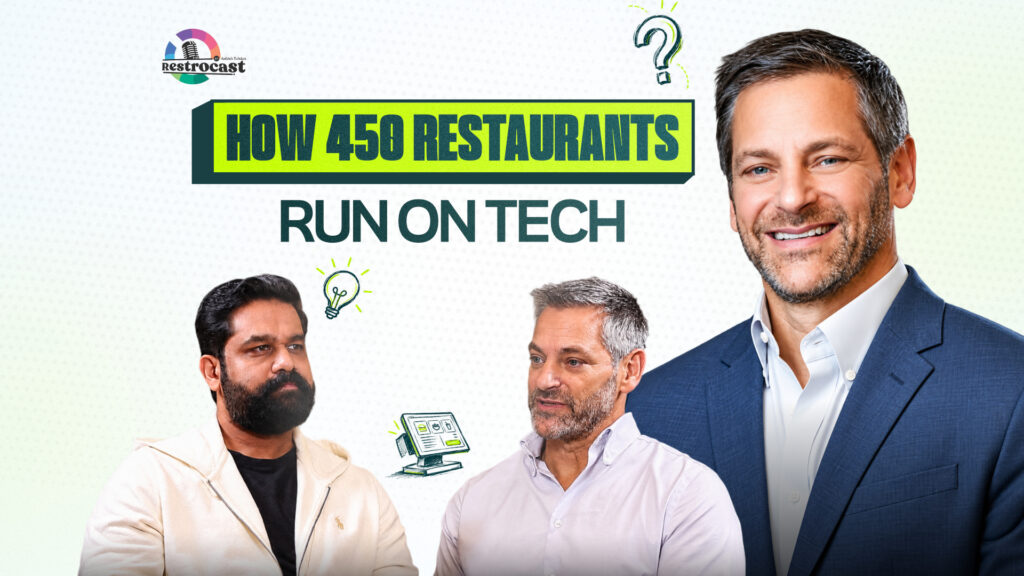

Some of the most influential leaders in restaurant technology never set out to work in it, and Todd Kaufman, Chief Information Officer at SSP America, is one of them. A political science graduate who once worked at Capitol Hill, Todd found his way into the industry from behind a bar, as the only person in the restaurant who could figure out how to program the cash register. More than 25 years later, he leads technology for more than 450 restaurants across 60 airports in the US and Canada, spanning over 200 brands.
Todd joined Ashish Tulsian, Co-Founder and CEO of Restroworks, on Restrocast to talk about the journey that took him from installing POS systems at Micros to technology roles at IHOP and, for the last 18 years, SSP America. There, he has grown the IT team from three people to more than 40 and turned IT from a function that simply kept the lights on into a strategic partner the business relies on. Here are the highlights of their conversation, from bridging the gap between technology and operations to the realities of AI and the leadership lessons Todd has picked up along the way.
How did restaurant technology happen to you?
Completely by accident. I studied political science in college and worked at Capitol Hill for a year before deciding it wasn’t the job for me. I started working as a waiter and bartender, became a restaurant manager, and around 1997 helped a friend open a restaurant as a GM. I was the only one who figured out how to program the cash register, mostly because I was probably the only one who read the instructions. In 1998, Micros was hiring like crazy because it was Y2K compliant, and I needed health insurance. I joined as an installer, spent a few years doing that, realized I enjoyed the madness, and have been in restaurant technology ever since.
You don’t come from a technical background. How do you approach the role of a CIO?
I can’t code, and I’m not a techie in that sense. My strength has always been understanding technology well enough to talk to the people building it, and then explaining it in plain terms to the business, especially to operations. It works the other way too. Operators will never tell you they need a particular technology. They tell you their actual problem: managers are spending too much time in the back office, or it takes too long to get the data they need. My job is to take that back to our architects and vendors and find where our tech stack can solve it. When I talk to my counterparts, most successful CIOs at restaurant companies came up through operations in some way, and I think that is the biggest key to success.
What kept you in restaurant technology during your early years at Micros?
Part of it was pure luck. On my first day, we had a big orientation, and the person running it simply divided the room in half: this half learns hotels, this half learns restaurants. I happened to be sitting on the restaurant side. I joke that if I had picked a different seat, who knows where I’d be. Those were the growth days of Micros, and they moved fast. We used to joke about installing software from CDs that didn’t even have labels because they had just come out of development. I was young, I enjoyed the travel and the adventure, and by my second or third year I could see this becoming a real lifelong career.
How did your career lead you to SSP America?
After Micros, I joined a large IHOP franchisee in Texas, which grew to about 40 units while I was there. It was fun to start from zero and build a tech stack, and it took me beyond the POS, into inventory, labor management, and security. From there, I moved to IHOP corporate in California for about three years, and then joined SSP America in Northern Virginia in 2008. At the time, SSP America was relatively small, at around $175 million in revenue, and the IT team was two people plus me. Eighteen years later, we’re at about $1.2 billion in sales with a team of around 40.
After COVID, restaurants faced staff shortages and changing guest expectations. How did SSP America approach that challenge with technology?
We were facing problems that didn’t have ready-made solutions, especially around labor shortages and retention, and there was a push for more self-ordering. One option was putting tablets on tables, but in an airport setting it didn’t feel very hospitable. Our surveys showed guests weren’t crazy about them, and there were real costs involved. Pure pay-as-you-go QR codes didn’t fit either, because we still want that interaction with a server. So we worked with our vendors and our team on a QR solution that works together with your server. You can order a round with your server, the next round through the QR code, dessert from your server again, and pay however you like. Because the check stays open in the POS, we can even send a text after 20 or 30 minutes asking if you’d like another drink. I got heavily involved in selling it, not just to directors of operations but to individual servers and bartenders, explaining why it enhances their job rather than threatens it. That’s when I really moved from providing tech solutions to figuring out strategic ones.
How has IT’s role evolved at SSP America, and how did operations come to see it as a strategic partner?
I feel like I’ve worked for three different companies while I’ve been at SSP. From 2008 to 2014, IT was purely a support role: keep the lights on, keep the POS running, and get some inventory and labor numbers. In 2014, under a new CEO, we entered our first real phase of growth, opening a lot of airports and units, and IT’s job was to put the right tech stack in place to support that. Then COVID hit airports harder than almost anywhere, and our IT team was cut back to just two people. As travel came roaring back, we rebuilt the team, largely by bringing back the same people. About 18 months ago, I reorganized the department again to put people in the roles that suit them best and to review our technology against what the business needs today.
The way operations see us has changed just as much. A district manager who has been with SSP even longer than I have told me that in the early years, when I came up to speak at our annual conference, people would say, “It’s just Todd,” and go back to their emails. A couple of years ago, his entire table stopped and said, “Hold on, I need to hear what Todd’s saying.” That came from showing business value. Operators want to be operators. Give them a solution that helps them, and they will embrace it with everything they have. Give them extra work, and they will fight you every step of the way.
Where does AI really stand for you today, and how are you thinking about its cost?
I compare AI to the web in 1998. We’re already seeing benefits, but we don’t know what will last, only that it’s going to change everything. Right now, we use it most for internal productivity. Most restaurant companies already have all the data they need; they just can’t act on it quickly. So we’re experimenting with AI that flags issues and sends them to the right person with recommended actions, because if there’s no action to take, it’s just a report. Cost is still an open question. I don’t think the AI companies themselves know yet whether to charge flat fees, tokens, or licenses, and every new capability comes with another license, so we’re careful about who needs what. When other departments ask how they can use AI, my answer is that I don’t know their job as well as they do, so I need them to explore and propose the use cases. Fifteen or 20 years ago, every IT leader was scared of shadow IT. Today, I actually encourage it, within guardrails that we are all still figuring out. The use cases range from dynamic pricing and automated scheduling to simply turning a phone photo into a professional image for our kiosks.
There’s a lot of talk that SaaS is dead and that companies will build their own software with AI. Where do you stand?
I don’t see companies replacing their vendors by building everything themselves. For 20 years, I’ve been build vs. buy. Nobody chooses one of our restaurants because we have the best tech, and partners bring what they’ve learned across the industry, often solving problems before we even know we have them. AI can make building cheaper in the short term, but it doesn’t solve long-term support, enhancements, or only knowing what you know. Where AI really changes things is in how we use what vendors already have. Our kiosk vendor’s dashboard can tell me when a printer is out of paper, which is great, but I don’t want my team logging into yet another dashboard. I want vendors to open up their data and build MCP connectors so that information flows directly into our own alert and service desk systems. With AI, my small team can now build those integrations ourselves, which is like having a whole new development team. So it’s less about building our own software and more about getting direct, actionable insight from the tools we already use.
How has your leadership changed over the years, and what would your team say about it?
Enormously. Like many technologists on the operations side, I used to start with why something wouldn’t work. I got defensive and took things personally. Over time, I learned to look for the real problem behind a request, which often started three departments earlier, in a process or governance gap that no technology will fix. I also learned to let go of fixing everything myself and choose the battles that matter most. And I believe failure is an option. It’s never the goal, but you need to know how you’ll measure success and be willing to say, “This isn’t working,” and stop digging. Four of my six direct reportees have been with me for over a decade, and I think they’d say I’ve become far more direct. I stopped avoiding tough conversations years ago. I also warn people that my questions often sound like statements: when I say, “This is what we need to do,” I usually mean, “Push back on this.” We debate a lot, but at the end of the day it’s not a democracy, and I think they appreciate that it’s a discussion, not orders from an ivory tower.
What keeps you grounded, and how do you keep learning?
Years ago, I was panicking about a risk, and our general counsel reminded me that we’re selling beers and burgers to travelers. I take my work seriously, but it’s my job, not my life. I’m an avid sports fan, and the only time I’m truly unavailable is during Washington Commanders games. I try to stay healthy and still get involved in local politics. As for learning, the biggest lesson I carry from politics is to understand the other side. However something is being done, someone wants it that way and someone benefits from it. That’s not a reason never to change it, but you need to understand why before you do. I see this with vendor replacements all the time. You list ten gaps in your current system, the new vendor promises to fix them, and after implementation you discover ten other things your old system quietly solved that you never thought to ask about. So whether it’s work or life, I try to understand what something is really solving, and for whom, before deciding to change it. I look at all sides, make sure I fully understand what’s happening, and accept that I’ll still miss things. The goal is simply to miss a little less each time.
Conclusion
Todd Kaufman’s journey is a testament to the idea that great technology leadership is defined not by an academic degree, but by the value one brings to the business. From programming a cash register by reading the instructions to steering technology across more than 450 airport restaurants, his story shows how IT can move from invisible to indispensable when it is built around the people it serves. Whether you are excited or worried about AI, or aspiring to step into a leadership role, Todd’s candid insights offer a practical roadmap for navigating the ever-evolving landscape of restaurant technology.