
A cloud kitchen, also known as a ghost kitchen or dark kitchen, is a delivery-only food establishment. Cloud kitchens operate exclusively through online food delivery platforms and do not have a dine-in area. Ghost kitchens often host multiple brands in one location, each renting space to fulfill online orders.
A virtual kitchen operates out of an existing restaurant but focuses on one or more delivery-only brands. Cloud kitchens can significantly reduce overhead expenses compared to traditional restaurants. Cloud kitchens represent a significant evolution in culinary services, focusing on preparing meals for takeaway or delivery purposes.
The cloud kitchen model allows entrepreneurs to capitalize on the growing trend of food delivery without the overhead costs associated with running a full-service restaurant. Launching a cloud kitchen requires a well-structured business plan that outlines startup costs, kitchen setup, staffing needs, and marketing strategies.
Many first-time cloud kitchen entrepreneurs think licensing is less complicated compared to opening a conventional restaurant. “We’re not serving food in a dining room. We’re not serving liquor. We’re not employing front-of-the-house staff. So we will need fewer licenses.”
Not true. One of the costliest mistakes you can make before serving your first dish is this assumption.
The worldwide cloud kitchen business was estimated at USD 85.5 billion in 2025 and might be projected to grow to USD 185.7 billion by 2034. With such large numbers, the authorities treat cloud kitchens like conventional food companies. They’re not “lite” versions of conventional restaurants.
What You Will Learn
- About legally opening your cloud kitchen in the United States.
- What are the essential licensing requirements
- About important licenses and their cost.
Cloud Kitchen Licensing Requirements: How They Differ from Traditional Restaurants

Cloud kitchens operate differently from traditional dining rooms in that there are no dine-ins, but they are by no means exempt from regulation. Rather, in many cases, they can be even more complicated than traditional eating establishments. In order for cloud kitchens to succeed, they need to rely mainly on their online presence and delivery system to draw in customers.
EXPERT INSIGHT
This makes a big difference. You’re in a different regulatory environment, but it’s not a lighter one.
Essential Federal and State Licenses
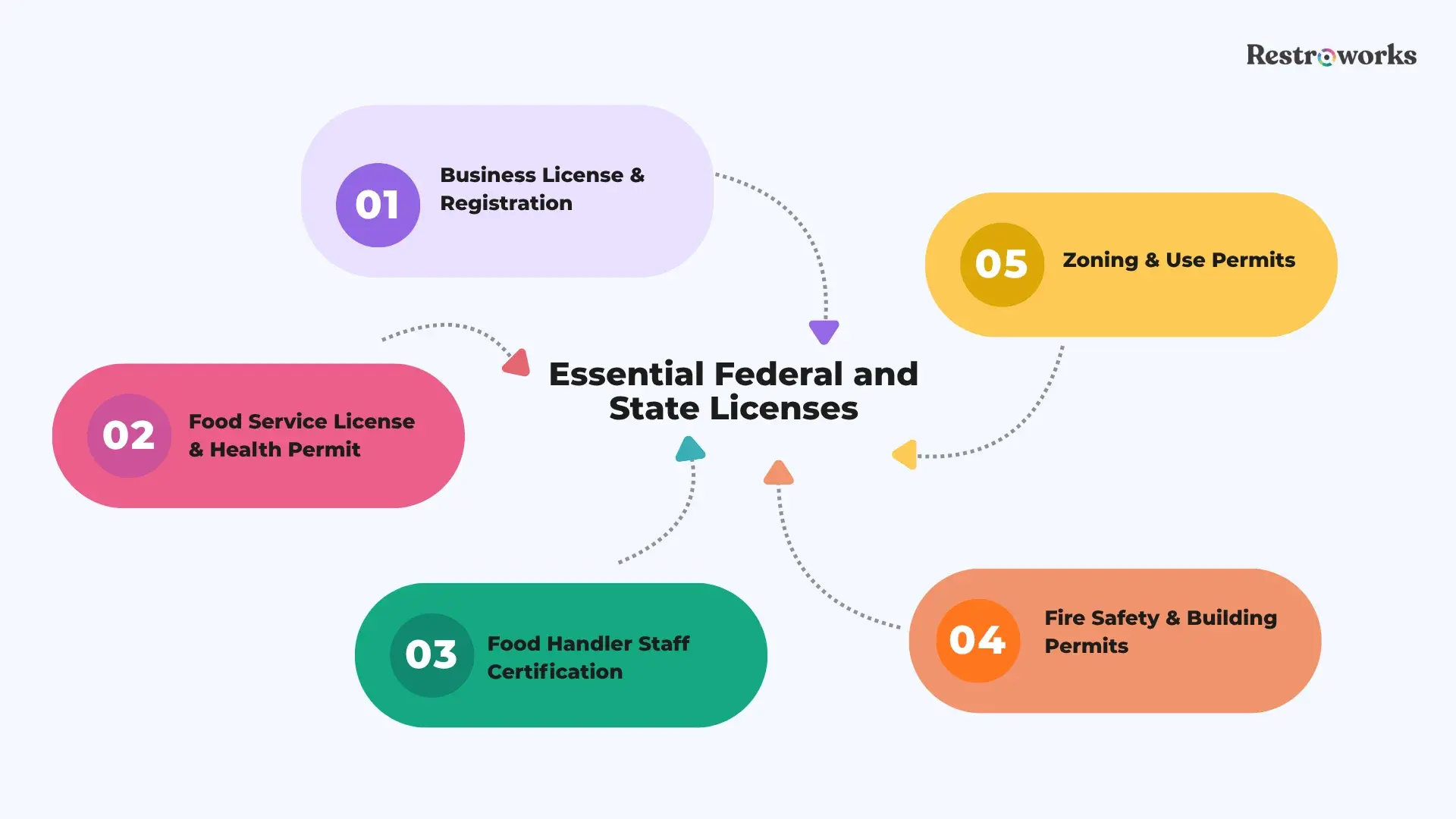
Cloud kitchens are required to have a business license to operate and sell food to consumers. Essential Federal and State licenses are:
Business License and Registration
But before we get into anything else, your business must have a legal personality.
Most business owners opt for an LLC, but sole proprietorship and partnership are also acceptable.
You will need:
- Employer Identification Number (EIN) from the IRS (for free)
- This is necessary for hiring, business bank account, and tax purposes
- Without this, you cannot operate as an employer
You will need to register your food business name at the local level. If you operate under a different name, you will need to file for a DBA.
Food Service License and Building Health Permits
This is your most critical requirement. A health department permit is essential for cloud kitchens to ensure compliance with hygiene norms set by local health authorities.
- A Health Department Food Establishment Permit will be issued after your ghost kitchen has been inspected to ensure it meets the food safety standards for a safe and clean kitchen.
- Cost: $100-$1,000
- Mandatory before cloud kitchen operations begin
- You will also need to ensure your staff has the necessary food safety management plan, training, and certification:
- A food handler’s permit will cost your employees $100-$500 each.
- The permit will be valid for 3-5 years.
Local Municipality Requirements
The cloud kitchens should adhere to processes that will stop the accumulation of dirt in the kitchen utensils and other equipment. Cleaning and maintaining hygiene in the kitchen area is very important for cloud kitchens so that there is no contamination of food products. It is very necessary to clean the kitchen premises regularly so that there are no microorganisms in the kitchen. The efficient arrangement of the kitchen in the cloud kitchen can be achieved by fulfilling municipal requirements.
Local municipal corporation requirements include:
Fire Safety and Building Permits
Your kitchen has to be inspected by the fire department. This involves:
- Fire suppression systems
- Ventilation compliance
- Emergency exits
Cost: $50-$300
Zoning and Use Permits
Cloud kitchens must comply with local zoning laws, which may require a zoning permit for commercial use. Commercial food production involves the following zoning approval:
Key points:
- Most residential cloud kitchen setups are restricted
- Cottage food laws apply, but restrict earnings and products
- Not suitable for delivery-first businesses.
NOTE: Obtaining the necessary licenses for a cloud kitchen can take time and may involve various application fees. Failure to comply with licensing requirements can lead to penalties, fines, or even closure of the cloud kitchen.
Shared Facility & Commissary Kitchen Licensing
Working from a shared cloud or ghost kitchen does not lessen your licensing requirements; in fact, it increases them by one layer.
- You must comply with:
- The master permit for the facility
- Your individual food licenses
The hidden danger is:
If another tenant in the facility does not pass inspection, you could have your food business shut down temporarily.
Before you sign:
- Check the inspection record for the facility
- Check the insurance requirements
- Check if you have liability insurance
What are Third-Party Platform Requirements
Partnering with a third-party food delivery service can help connect your cloud kitchen to a larger customer base. Delivery services such as DoorDash, Uber Eats, and Grubhub require more than just a basic license.
What are the requirements?
- Business license
- Health permit
- Food safety certifications
- Insurance
The permit takes 2 to 4 weeks to approve, but here’s the catch:
Applying before all permits are complete will freeze your applications, and you will have to begin again.
Step-by-Step Cloud Kitchen License Application Process
Obtaining the necessary licenses and permits is crucial for operating a cloud kitchen legally.
To avoid delays, the following steps should be taken in this order:
- Form your business entity and get your EIN
- Find your commercial kitchen space (make sure the zoning is correct first)
- Submit your health permit application
- Schedule your fire safety inspection (at the same time as the above step)
- Get your staff food handler certificates
- Get your sales tax permit (it’s usually free)
- Get your Certificate of Occupancy (if required)
- Onboard with the online food delivery platforms
Application Timelines & How to Speed Them Up
The licensing process will take 2-4 weeks.
A benchmark figure: Cloud kitchen operators in Chicago have achieved an average online order value of $32 and a weekly delivery figure of 11,700. However, the timelines will reduce only if the licensing process is streamlined.
Cloud Kitchen License Cost Breakdown
Cloud kitchens are projected to be a profitable and scalable business model due to the rise of online food delivery. The initial setup costs for a cloud kitchen can range from $10,000 to $50,000. Recurring monthly costs for a cloud kitchen can range from $5,000 to $20,000. Let’s break it down further to understand better:
License / Permit | Typical US Cost |
Business license/registration | $50–$500 |
Employee Identification Number (EIN) | Free |
Health department permit | $100–$1,000 |
Health inspection fee | $50–$500 |
Fire safety permit | $50–$300 |
Building health permit (if renovating) | $100–$1,000 |
Food handler’s permit (per person) | $100–$500 |
Sales tax permit | Free (most states) |
Sign permit (if applicable) | $20–$200 |
Business insurance (annual) | $1,000–$5,000 |
Hidden Costs Most Operators Miss
Common hidden costs:
- Resubmissions due to incomplete applications
- Temporary kitchen rental: $2,000 to $5,000 per month
- Cross-state certification issues
- Platform rejection blocks revenue for 30 to 90 days
Licensing can cost as much as $3,000 to $8,000 per month in pre-revenue burn.
Common License Rejections and How to Avoid Them
Common cloud kitchen license rejection issues and how to avoid them:
Incomplete documentation: kitchen layout plans, equipment lists, pest control contracts, etc. It is important to have a complete set of documentation before proceeding.
Zoning issues: applying for a food safety license in a location that does not have commercial zoning for food business preparation. It is crucial to understand local zoning laws in your area before signing a lease.
Poor kitchen layout plans: the layout will be examined for the separation of food storage, cross-contamination workflows, and the placement of hand-washing stations. It is recommended that you have these professionally done.
Poor hygiene setup: if you have not included hand-washing stations in your virtual kitchen, you will fail inspection, which will set you back in terms of launch time.
Sequential application instead of parallel application: It is recommended that you apply for your platform at the same time as you apply for local permits and fire safety.
Residence vs. business address: It is crucial to note that if you have a residential address and you are planning to operate from a commercial kitchen space, you will have zoning issues, which will cost you money.
Multi-Location Licensing Strategy
Scaling across cities creates complexity:
- Licenses are non-transferable
- Each state requires separate applications
- Some states do not honor out-of-state certifications
The independent cloud kitchen market size is expected to reach 56% market share in 2026. This creates complexity for multi-location operations.
Anton Soulier, CEO of Taster, stated: “We doubled the size of the food service business in six months” by partnering with existing restaurants instead of building our own.
This eliminates license complexity by utilizing existing compliant facilities.
David Bloom stated on Restrocast: “There’s the brand, the franchisee, the kitchen operator… each potentially requiring compliance.”
How to Ensure Compliance in Ongoing Operations & License Renewals
Licensing is usually renewed annually.
- Failure to meet deadlines can lead to:
- Fines
- Suspension of cloud kitchen operations
- Removal of your listing
Recommended:
- Create a renewal calendar
- Schedule reminders 60 days prior to renewals
- Designate ownership of each license
Ensure your virtual kitchen is ready at all times.
Real-World Case Study: Cloud Kitchen Licensing in Action
The Healthy Bowl Kitchen case is directly instructive. Three entrepreneurs wanting to launch a healthy meal delivery service were able to efficiently go through their country’s food licensing portal (India’s FSSAI registration and FSSAI license scheme under the Food Safety and Standards Authority). This resulted in a timely launch and instant approval from food aggregators.
The US equivalent is exactly the same. There is a need for a valid local health department permit and food service business license before approving any restaurant listing on these food platforms. Without these cloud kitchen licenses, you cannot operate legally or take online orders.
Cloud Kitchen Licensing Challenges Nobody Talks About
The challenges in cloud kitchens are:
Shared kitchen liability exposure: In cloud kitchens, you are directly significantly impacted if there is a violation in your kitchen by someone else. This is not a hypothetical situation.
Platform vs. regulatory conflicts: In a cloud kitchen, platform documentation requirements and local food safety regulations sometimes conflict with each other. This is a major issue for cloud kitchen operators.
Omar Shihab, founder of BOCA Dubai, said in Restrocast-

It is not recommended to consider it a secondary operation in the overall hospitality business.
Documentation duplication: In cloud kitchens, you have to maintain different documentation requirements for different locations. This is a major issue for cloud kitchen operators.
Why Getting Licensing Right Matters in the Food Delivery Industry
It is not only about avoiding non-compliance from a restaurant’s perspective but also ensuring that they do not lose out on revenues.
In case your food business fails to meet the quality standards of licensing paperwork required by these platforms, you will lose access to these revenue channels for up to 30 to 90 days. It means that you incur losses worth $3,000-$8,000 per week due to lost revenues during licensing.
INDUSTRY INSIGHT