
The most profitable cloud kitchen menus are built around 15-25 items, with 6-10 heroes that share core ingredients, travel well in sealed containers, and can be assembled quickly. A focused menu built this way can help keep food costs at an ideal 28-32% while generating several menu combinations from a few base components.
That matters because, according to Precedence Research, 2025, the global cloud kitchen market reached USD 81.94 billion in 2025. In fact, cloud kitchens in the U.S. are expected to consistently grow from $29.4 million in 2025 to $89.4 million by 2035, at a CAGR of 11.8%.
If you are opening a cloud kitchen in the U.S., the opportunity is real, but only if your menu is built for how delivery actually works. This is why you have to approach menu planning smartly. Instead of simply listing popular dishes, focus on items that align with delivery demand and operational efficiency.
Here are the specific cloud kitchen menu ideas that perform well for delivery, followed by the operational framework for choosing, testing, and pricing them.
What you will learn
- Factors to think about when planning your cloud kitchen menu
- Building a flexible and scalable menu
- Popular cloud kitchen menu ideas that you can sell in your virtual restaurant
Cloud Kitchen Menu Ideas That Work for Delivery
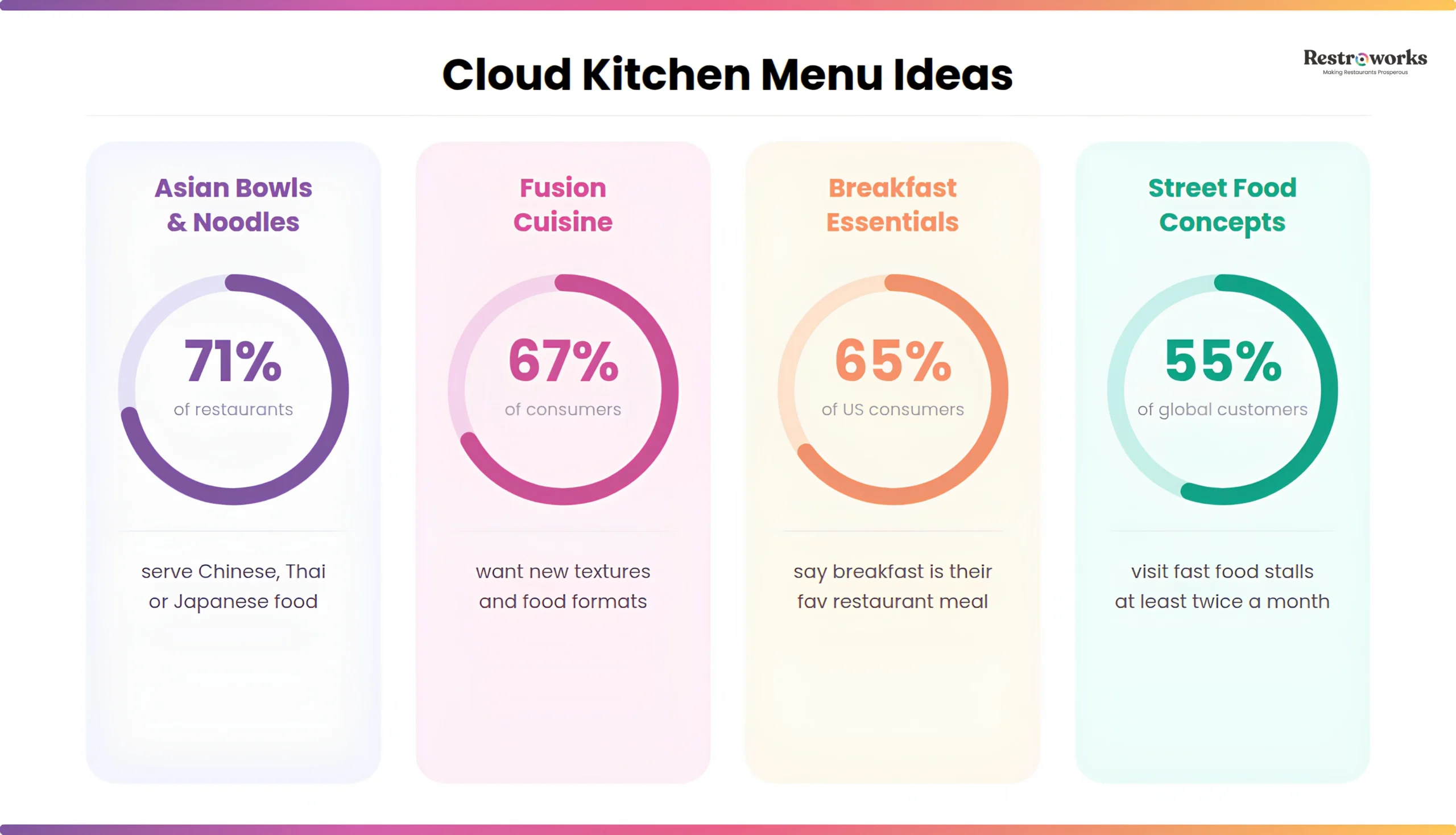
Each category below includes specific dishes, typical food cost ranges, and a brand example showing how operators apply the concept.
Not every category has a well-documented brand case, so where data is limited, the focus stays on the dishes and margins. These ranges vary by city, supplier costs, and cuisine complexity, so treat them as starting benchmarks to validate against your own numbers.
A. Rice Bowls, Asian Noodles, and Dim Sum
Fried rice bowls, ramen, teriyaki chicken bowls, and dim sum sides. Typical food cost: 28-35%. They’re filling, flavorful, and easy to assemble quickly.
A good example is Wow Bao, a U.S. virtual restaurant brand that partners with kitchens nationwide to sell steamed bao, dumplings, rice bowls, and noodles through delivery platforms, achieving high order volume with a streamlined prep system.
B. Healthy Bowls and Salads
Protein or keto bowls, fresh salads with hearty toppings, plant-based meals, low-carb wraps, and gluten-free options with premium ingredients.
For instance, Sweetgreen shifted its delivery menu toward heartier kale and warm grain bases over mixed greens, and adopted sealed multi-compartment containers to keep dressings and toppings separate during transit, a packaging approach that operators report helps improve delivery repeat order rates.
C. Street Food and Wraps
Tacos, burritos, wraps with varied sauces, and loaded fries or nachos. Taco Bell has tested ghost kitchen formats with simplified street food menus using shared proteins and toppings, an approach designed to handle high daily order volumes from a single prep line.
D. Fusion Dishes
If you want to add a new twist to your menu to stand out, fusion cuisine is a good option. For adventurous eaters, it combines elements from different culinary traditions, such as butter chicken tacos, sushi burritos, kimchi fried rice, and tandoori chicken pasta.
E. Comfort Foods
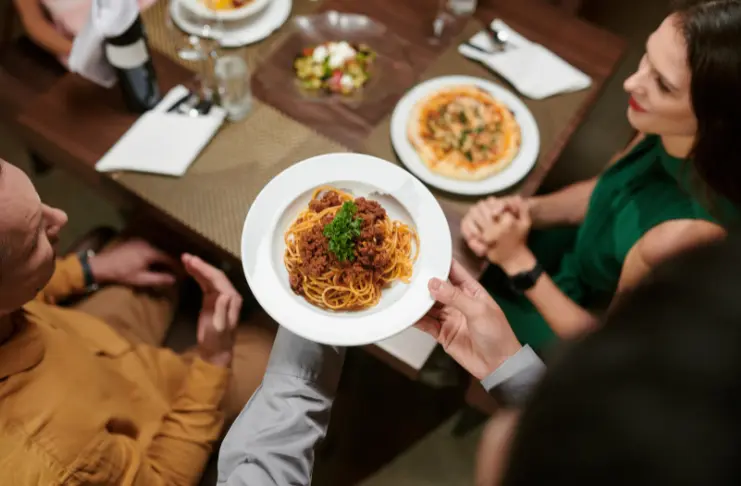
For 81% of Americans, food is a source of comfort. Foods like Pasta, biryani, curries, mac and cheese bowls, and loaded fries can be a great addition to your ghost kitchen menu.
They can also be made at a lower food cost because high-carbohydrate, low-protein ingredients cost less per serving. These dishes also hold temperature well in standard delivery containers.
F. Gourmet Burgers and Sandwiches
Classic beef or chicken burgers, smash burgers, grilled chicken sandwiches, and sub-style sandwiches are popularly loved, easy to assemble and perfect for combo meals.
An excellent example of a burger-focused virtual brand done right is MrBeast Burger, a delivery-only burger brand launched by YouTuber Jimmy Donaldson in 2020.
It launched as a virtual brand through about 300 existing restaurant kitchens at once, with partner operators preparing a simple menu of burgers and fries under the brand name. Within four months, the brand sold over one million burgers.
G. Breakfast Items
Breakfast is one category that is easy to overlook. Breakfast burritos, egg sandwiches, pancakes, smoothies, and acai bowls.
It has been one of the fastest-growing dayparts, with Circana’s Eating Patterns in America report showing significantly higher traffic in Q1 2025, based on $1.7 trillion in spending across more than 618 billion consumer interactions.
If your competition focuses only on lunch and dinner, a breakfast menu fills an underserved window with items that are fast to prepare and inexpensive to source.
H. Wings
Bone-in wings, boneless bites, and tenders with a rotation of sauces (buffalo, garlic parmesan, honey BBQ, lemon pepper). It’s Just Wings, a delivery-only brand created by Brinker International out of existing Chili’s kitchens, scaled to over 1,000 virtual locations by using equipment and staff already in place, demonstrating how a focused wing menu can layer incremental revenue onto an existing kitchen operation.
I. Pizza and Flatbreads
Classic and specialty pizzas, flatbreads with premium toppings, and calzones. These items work well for delivery because they can be prepared using shared dough, sauces, cheeses, and toppings, helping kitchens control inventory while offering variety.
800 Degrees Pizza’s partnership with REEF Technology illustrates how pizza brands can expand their delivery footprint. In 2021, the companies announced plans to open 500 locations over five years, leveraging REEF’s existing network of delivery-focused kitchens.
For pizza concepts, this model offers a way to reach new delivery markets without building a traditional dine-in restaurant at every location.
J. Desserts and Beverages
Cookies, brownies, mochi, churros, bubble tea, lemonade, and specialty shakes. These work best as add-ons to an existing concept rather than standalone brands, because average order values for dessert-only orders tend to be low.
Bundling a cookie or drink into a combo meal can lift order value while keeping incremental prep time under two minutes.
How to Evaluate Any Cloud Kitchen Menu Idea
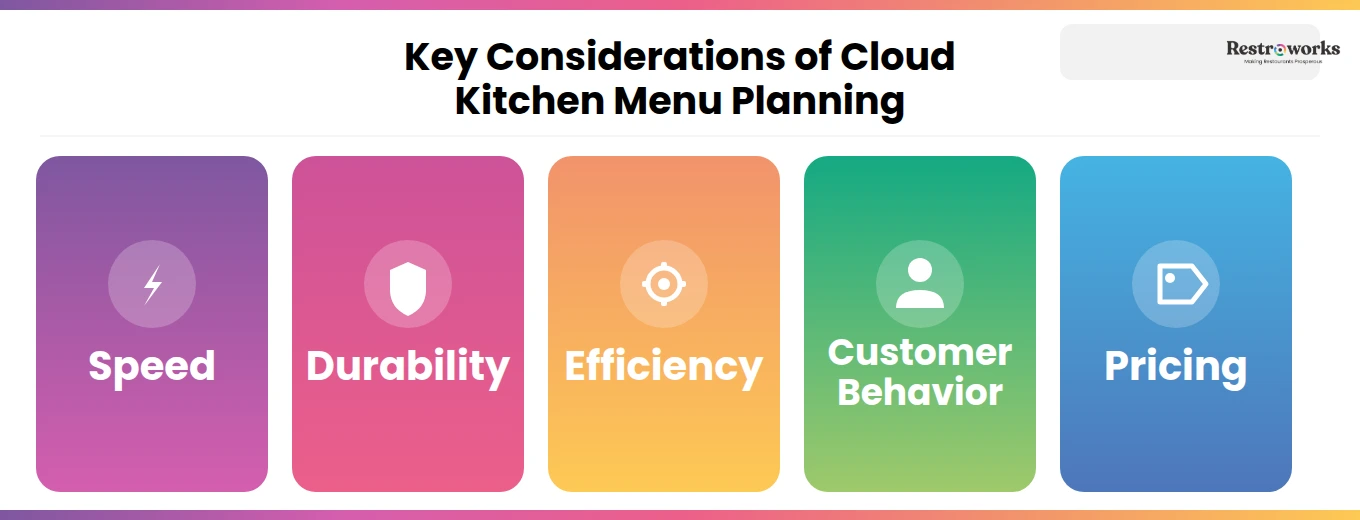
The menu ideas above are starting points. Before any item earns a permanent slot, run it through these five filters:
How to Build and Test Your Cloud Kitchen Menu
1. Start With a Focused Menu
As Jasper Reid, Founder and CEO of International Market Management Ltd, who operates multi-brand cloud kitchens across Southeast Asia, says, “I think the wrong thing to do is have long menus.”
A good way is to fill 60-70% of your menu with popular dishes and 30-40% with new offerings. To determine which items belong in the core, sort your delivery platform dashboard by units sold per week. Items consistently above 10 orders per week can earn a permanent spot.
2. Prep Components in Advance
Design menu items around components prepared earlier in the day:
- Sauces and flavor bases (chili oil, curry pastes, teriyaki): 2-3 week refrigerator shelf life
- Garlic butter and garlic-in-oil preparations: Follow your local health code and HACCP plan, as these carry botulism risk and USDA guidance limits homemade garlic-in-oil to a few days refrigerated
- Grains (rice, noodles, quinoa, pasta): Cook in 25-lb batches, holds 2 days refrigerated
- Marinated proteins: Prep overnight to reduce service cook time
- Toppings (chopped vegetables, pickled onions, roasted nuts): Prep daily for freshness
3. Validate Before Full Launch

Run a limited-time pilot on one or two delivery platforms for 7 days. Track orders per day, repeat order rate, prep time, and customer ratings. A concept that cannot reach 15 orders per week in a test market is unlikely to sustain a full launch.
Understand what people are ordering online and align menu items with popular search categories, such as healthy meals, vegan and plant-based items, or global cuisines to improve visibility and orders.
Virtual-brand operators often test concepts before committing to a broader rollout, with successful concepts expanding while weaker ones are cut or reworked.
4. Create Combos and Rotate Seasonally
Restaurants with well-planned combos increase average order value by 20-35% on delivery platforms like DoorDash. Price bundles at 10-15% below the sum of individual items.
For seasonal rotation, swap 2-3 items every 8-10 weeks while keeping your base-ingredient list unchanged. Remove any item that drops below 5 orders per week for 30 consecutive days.
5. Track Performance and Iterate
According to Scoop Market, 2025, over 30% of cloud kitchens now use AI-driven tools to track customer preferences, sales trends, and bestselling menu items. You can do the same with your cloud kitchen software or delivery platform dashboards.
Look at changing customer preferences, sales trends, and bestselling menu items using your cloud kitchen software to refresh the menu and retire poor performers every few months.
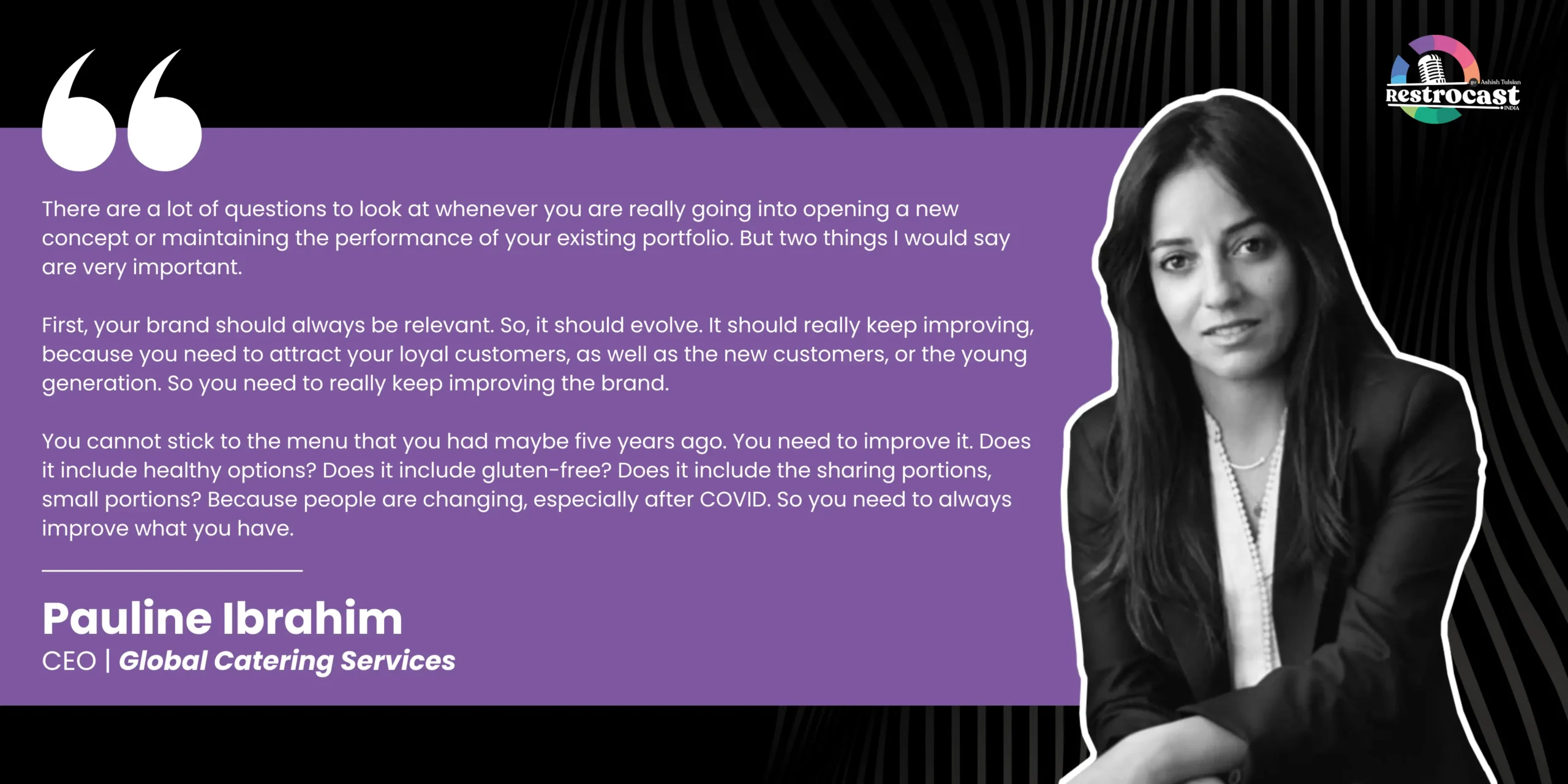
This is something Pauline Ibrahim, CEO of Global Catering Services, agrees with. When asked what advice she would give to F&B players looking to enter the UAE’s restaurant industry, she mentions-
6. Analyze Competitors in Your Delivery Zone
Set your delivery address to your kitchen location on DoorDash or Uber Eats. Search the top 3 cuisine keywords relevant to your concept.
Screenshot the first 20 results and map them on a grid with price on one axis and concept specificity on the other. The empty quadrants are your positioning opportunities.
What to Avoid: Items That Kill Cloud Kitchen Margins
Crispy fried items that lose texture during a 30-minute delivery ride, dishes requiring more than two unique ingredients not used elsewhere on the menu, and any item taking too long to prepare should be tested carefully before committing to a permanent menu.
For fried items specifically, vented packaging or separating crispy components from sauces can preserve texture during delivery. Loaded fries, tenders, and fried rice work when packaging is designed for them.
Items like tempura or crispy spring rolls, where the coating absorbs moisture on contact with steam, are harder to solve without component separation
Cloud Kitchen Success Stories
Pardon My Cheesesteak, created by the hosts of the Pardon My Take podcast in partnership with Virtual Dining Concepts, launched as a delivery-only brand operated out of existing restaurant kitchens.
What makes it unique is a small menu that focuses on one single item: delicious cheesesteaks created for easy prep and delivery performance. The brand did three simple things to get where they are today-
- A highly focused menu: Created a compact menu inspired by sports fandom and game-day appetites, featuring a variety of cheesesteaks, tenders, and fries.
- Delivery-ready foods: The entire menu is designed to travel well and stay satisfying after delivery.
- Playing on existing demand: Pardon My Take podcast, with its 1 billion+ downloads, already brought massive engagement and reach. Now, a food brand by the beloved hosts? It was bound to receive a huge fanbase.
By leveraging the podcast’s large audience for brand awareness and the Virtual Dining Concepts licensing model for kitchen access, the brand scaled to over 1,200 locations within its first two years.
A successful cloud kitchen menu is all about understanding your target audience, focusing on appealing cuisines, and continuously monitoring and adapting your offerings. Plus, partnering with reliable third-party apps helps expand your reach and ensure that the meal arrives fresh and well-presented to your customer base.
Re͏member,͏ ͏the key to succ͏ess ͏in the͏ cl͏oud kitchen͏ bus͏iness ͏is͏ to͏ st͏a͏y flexi͏ble, inn͏o͏vate cons͏tantly͏, an͏d keep th͏e customer at the͏ cent͏e͏r of your ͏decisions.
KEY TAKEAWAYS