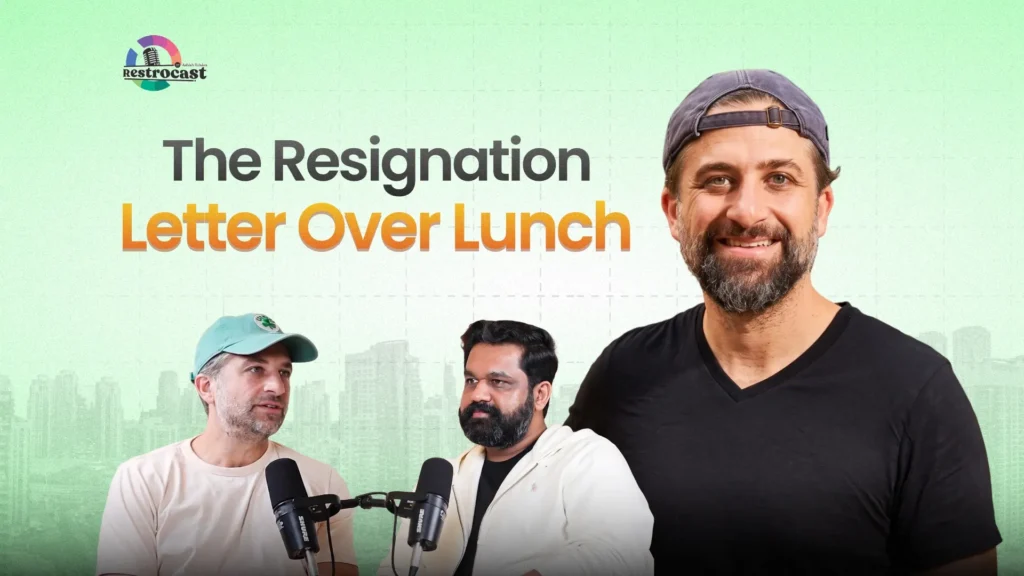

The restaurant industry’s best origin stories tend to share one quality: nobody planned them. Sultan Chatila, a chemical engineer turned Fortune 500 executive who spent decades at General Electric, Booz Allen Hamilton, and Honeywell, did not plan to be a restaurateur. His wife posted a story on his Instagram while he was asleep. That post became a supper club. The supper club became a burger competition. The competition became a trip to Dallas. Dallas became a resignation letter. And the resignation letter became Eleven Green Burgers, now with four locations across Dubai and Sharjah, and international expansion on the horizon. In this Restocast, Ashish Tulsian sits down with Sultan to talk about accidental beginnings, the discipline behind freshness, what happens when a trusted employee steals your concept, and why the fire inside a calm person burns hottest.
You grew up cooking, but ended up in chemical engineering. How did that happen?
Sultan Chatila: Both my parents loved to cook and were great at it, which is rare. Usually,y it’s one or the other. Growing up in Saudi Arabia, food was always the subject. As a toddler, I played with pots and pans instead of cars. I wanted to go to culinary school in Rhode Island, but my parents said no, if you want to cook, stay home, we’ll teach you. If you’re going to the US, you become a doctor, a lawyer, or an engineer. The doctor was ten years old. Law school was nearly impossible for my nationality. I thought: chemical engineering is the closest thing to cooking. You’re putting things together and creating something of value. So that was my compromise.
I went to Tufts, graduated, worked for Fortune 500 companies, and kept cooking the entire time, for classmates in the dorm, for girlfriends, for friends. I missed home. I started with Syrian Lebanese food, and it evolved into Spanish and Mediterranean cuisine because my family had a deep connection to Spain. I never stopped. I just found joy there that I didn’t find anywhere else.
How did the supper club start?
Sultan Chatila: One night, my wife looked at me and said, why can’t we do what we love? I told her I had a career, responsibilities, and I couldn’t just walk away. I suggested she start baking on her own. She wasn’t convinced. We went to sleep. What I didn’t know was that she took my phone and posted on my Instagram: Hi everyone, my husband and I are starting a supper club. He cooks salty things, I cook sweet things. First table this Friday, table for six, message us if you’re interested. I woke up to 30 or 40 messages from people I hadn’t spoken to in years. We had to decide: do we do this or not? That was April 2019.
It was called Tano’s at 8. Just my wife and me, no staff, table for six, twice a week. Five-course Mediterranean meal, Spanish, Italian, French influences, and my wife’s desserts. The table grew to eight, then ten, then twelve. We were doing it three to four times a week while I was still Chief Commercial Officer at a Fortune 500 company. Sometimes my own direct reports were sitting at that table. The next morning, they’d be reporting to me. It ran for four and a half years. Dates for the whole month would book out in twenty minutes.
What made you finally leave your corporate career?
Sultan Chatila: In April 2022, during Ramadan, a food incubator in Dubai announced a burger competition. My wife said: You’re not a burger guy, these people eat burgers for breakfast. I said I just want to have fun and learn something. To enter, you submitted a photo of a burger you’d made. I went through my gallery and found one I’d cooked at home on the Weber for the kids. It didn’t look like much. I sent it anyway.
Once I was in, I went all in, researching cuts of meat, how to grind them myself, and making my own buns. My burgers kept improving through each round, and I found myself in the final against two people who had been doing burgers for years, judged by some of the UAE’s best chefs. I won. And the winner got a golden ticket to the World Food Championship in Dallas in November.
I went with just my wife. We found beef by visiting ranches. I brought my buns from Dubai in my carry-on and talked my way past the immigration officer. I went in expecting to make the top ten for fun. I finished third. Coming home after that, I knew. I wrote the resignation letter in January 2023 at lunch with my cousin at Orfali Brothers. Read it with him, clicked send, and by February, I was out. We opened Eleven Green on May 1st.
Freshly ground beef daily, no freezer on premises. What was the cost of that commitment in the beginning?
Sultan Chatila: For the first three or four months, we kept running out. I refused to grind extra beef to cover the next day; if it wasn’t same-day, it wasn’t going out. We’d sell out at 5 or 6 PM on a night we were supposed to be open until 1 AM. People would be standing in the queue, and we’d have to tell them halfway through the line: no more burgers, but you’re welcome to lemonade and fries. One-star reviews, people were furious. It was painful.
But it also created something we didn’t engineer. People kept coming back because they couldn’t get in. The scarcity was real, not manufactured, and word spread because of it. Today, across all three branches, I’m in a daily group forecasting beef demand to keep that freshness intact. It’s still the strategy. We’re just getting better at it.
You spent six months in the kitchen before stepping out. What did stepping out cost you?
Sultan Chatila: It came with a hard lesson. I had someone I’d trained through the competitions and the early days of Eleven Green. I trusted him, put him in charge of the kitchen in Jumeirah so I could step back. What I didn’t see was the culture he was creating: ego, negative energy, tension with the team. I didn’t know how to handle it because I depended on him. Then he told me he was leaving for a cafe opportunity. What he actually did was open a burger joint that included dishes from my supper club, my burger recipes, and my wife’s desserts. All of it.
I thought about going after it legally. I decided not to. The dishes aren’t the business. The brand, the energy, the people around it, that’s what makes it work. Anyone can copy a recipe. Not everyone can build what surrounds it.
What surprised me was what happened the moment he left. The kitchen became lighter. People stepped up. The negative cloud just lifted, and everything ran better than before. That taught me more about culture than anything else in this journey. No,w when I hire, I don’t look at qualifications. I’ve trained stewards who couldn’t chop an onion into CDPs and sous chefs. Attitude is the only thing you can’t teach.
What has entrepreneurship done to you personally?
Sultan Chatila: It amplified things I didn’t know were there. On the positive side, I make a lot of decisions on gut instinct, locations, people, partnerships, and I’ve become far more connected to that. It’s served me well. On the other side, I overthink, and I carry more than people see. I’m told I seem calm. Laid back. That everything looks fine. But there’s a fire inside that nobody sees. Entrepreneurship showed me that about myself. The stress is real, it just doesn’t come out the way people expect.
What I didn’t anticipate was that I left a corporate structure, and I’m slowly building one again inside my own company. The discipline, the systems, the SOPs, you end up recreating what you escaped, except this time it’s yours. And that changes everything.
One burger brand anywhere in the world that you respect most.
Sultan Chatila: I love Au Cheval in Chicago and New York, their concept, their burger, the whole feel of the place. But from a business standpoint, Five Guys. They kept their ethos while scaling globally, and I have enormous respect for that. What people don’t realize is that for the first fourteen years, they had six branches, all in Virginia. Six. The family ran them, understood them fully, and built the foundation. That’s why 1,200 locations later, everyone in the world knows the name. Patience is the most underrated part of the story.
What do you tell someone thinking about opening their first restaurant?
Sultan Chatila: If it’s purely a business calculation, reconsider. The ones that last are built on something authentic, real passion, real energy, a genuine desire for people to have a good experience. That’s what carries you through the parts that are terrible, and there are many. People keep telling me to add things to the menu, to expand the concept, to put dishes on there that will sell. I won’t. Everything at Eleven Green is true to who I am. The moment you start serving things because they sell rather than because they’re yours, you lose the thing that made people come in the first place.
Talk to people who’ve done it. Get help with the landscape: licensing, regulations, operations. You cannot navigate it alone, especially in Dubai. And understand that the overnight success you see from the outside is almost always four or five years of compounding that nobody photographed.
Conclusion
Sultan Chatila’s story resists easy summary because it is, at its core, a story about a person finding himself, through a pot and pan childhood in Saudi Arabia, through dorm kitchens in Boston, through supper clubs that ran four nights a week while he ran corporate meetings the next morning, through a burger competition he entered just for fun, and through a resignation letter sent over lunch that changed everything. Eleven Green is not just a burger chain. It is the physical form of a life that kept pointing in one direction until the person finally followed it. Four locations, a fifth internationally on the horizon, a menu built on fresh-ground beef and zero freezers, and a founder who is, by his own admission, completely calm on the outside and completely on fire within.