

Inevitably, every growing chain of restaurants reaches a critical moment when the decision about loyalty cannot be delayed any longer, but not whether to go for it –this choice has been made already– but how to develop the structure of the loyalty program which will operate effectively in various restaurants with various teams working in them, dealing with different customers in particular situations.
The importance cannot be underestimated. In Rich Hope’s words, the Chief Marketing Officer at Jersey Mike’s Subs, their loyalty program covers 45-47 percent of weekly income, well surpassing the minimum 20 percent required to declare the program successful. Chipotle claims that its loyal customers account for 30 percent of total revenue. At Starbucks, Rewards account for 60 percent of sales in the USA. This contribution is important indeed, but is it really enough to sustain the work of the best-performing restaurant chain in America?
Let’s find out how customer loyalty programs for multi-unit restaurants work.
What You Will Learn:
- What is restaurant loyalty
- How to choose the right structure of a loyalty program for your restaurant
- How to use software to design and implement the best restaurant loyalty programs
Restaurant Loyalty: Why Multi-Unit Is a Different Problem
The first thing to understand about customer loyalty programs for multi-unit restaurants is that they are not the same as single-location loyalty programs. The technology might look identical. The customer-facing experience might feel similar. But the operational and financial mechanics are fundamentally different.
Wade Allen, EVP of Strategic Growth at Costa Vida, built on that point with a direct challenge to how most operators think about loyalty: “The fundamental head fake that marketers fall for is the program of loyalty. They fall in love with points, merchandise, earn-and-burn, or redemption. Anybody who understands the value of loyalty understands it’s the data. It’s knowing how often you’ve come, when you’ve come, how profitable you are for us, what your history of eating is like.”
This is the lens through which every decision in this guide should be read. A restaurant loyalty program is a data-collection infrastructure that also drives repeat visits. Operators who build it the other way around, starting with the rewards mechanic and hoping the data follows, tend to end up with programs that cost money without generating proportional insight.
Despite that complexity, the market data makes clear why restaurant loyalty is worth the investment. Loyalty members now represent 39% of total restaurant visits, with loyalty traffic increasing by 5% in the last year alone, according to PMQ Magazine research. Restaurant traffic from loyalty programs doubled over the past five years. And 85% of QSR loyalty members say their loyalty program influences their purchasing decisions. The opportunity is real, provided the program is built correctly.
Rewards Program: Key Features & Choosing the Right Structure
Before any technology decision, multi-unit operators need to settle on a rewards program architecture. Not all loyalty programs are created equal, and the structure you choose determines everything downstream, from cost modeling to staff training to customer engagement.
The most common loyalty program structures in multi-unit restaurants are:
Points-based systems: customers earn points for every dollar spent, which can be redeemed for discounts, free food rewards, or free drink offers. This is the most familiar format and the easiest to explain to customers. Jersey Mike’s runs a points-based program where customers earn points only on sub purchases, and it accounts for nearly half of their weekly sales. Simplicity matters, and customers understand exactly how they earn rewards and can track their progress in the mobile app.
Tiered loyalty programs: customers unlock better benefits as they spend more, creating a sense of achievement and encouraging higher spending to reach the next level. This structure works well for restaurant concepts with higher average check sizes, where customers can meaningfully differentiate their behavior to move between tiers. Tiered systems encourage customers to earn rewards at a pace that creates emotional investment in the brand.
Subscription loyalty: customers pay a monthly or annual fee for recurring benefits, creating predictable revenue and guaranteed visit frequency.
The data is worth sitting with here. Guests with rewards orders are likely to opt for premium items, resulting in checks that are 67% higher than those of first-time guests. Loyalty members make 22% more visits per year than non-members. These numbers reflect what happens when the rewards program is well-designed, not what loyalty generates by default.
Customer Loyalty Program Architecture: Centralized vs. Decentralized
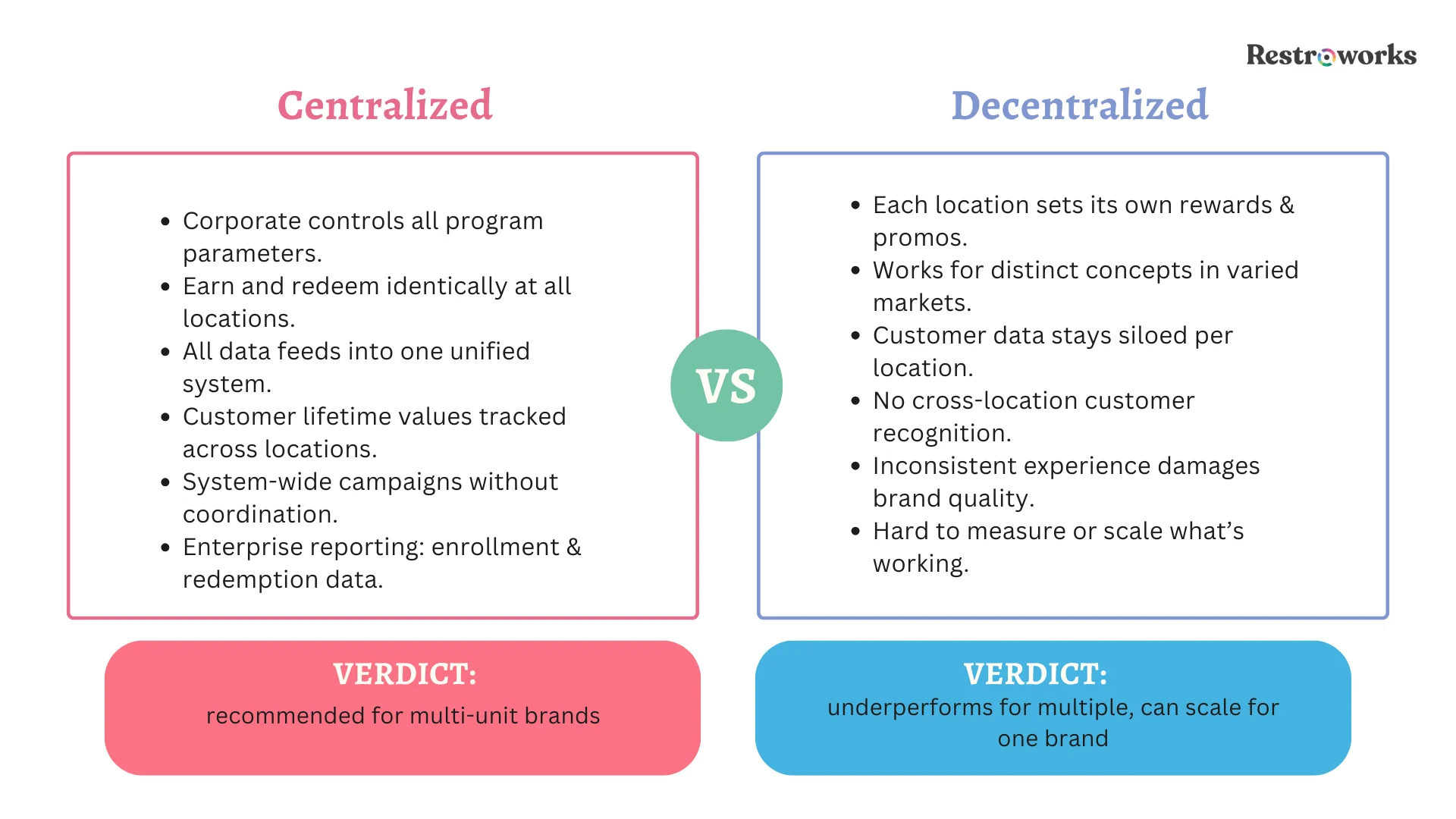
The most consequential decision in building customer loyalty programs for multi-unit restaurants is whether to manage the program centrally or allow individual locations flexibility. This is the decision most operators rush past, and it is the one that most often causes programs to underperform at scale.
Centralized loyalty programs ensure that the corporate or franchisor controls all program parameters, including earnings rates, rewards catalog, promotional activities, and communication cycle. Customers can earn and claim their loyalty points at any location using the same process. All the data is fed into a single system, enabling the identification of customers across locations, the measurement of lifetime value, and portfolio-level analysis.
There are many benefits to this approach. Firstly, it ensures brand loyalty since the loyalty program is delivered consistently in all locations. Secondly, the data asset grows more rapidly when all transactions are linked with the same customer profile information. Thirdly, marketing campaigns can be conducted system-wide without coordinating multiple variations across different locations. Lastly, reporting at the enterprise level will provide insights into which locations are driving enrollment and redemption.
Decentralized approaches give each location or regional operator discretion over local promotions, reward systems, and customer communications. This strategy can be appropriate when the restaurant group manages unique concepts across varied market areas, with distinct customers and pricing structures. However, when restaurant operators manage multiple locations under a single brand name, a decentralized approach often leads to inconsistencies that erode customer loyalty.
The assumption that must be dispelled here is that unified loyalty programs must have identical menu prices among their various locations. It does not necessarily have to be so. Multi-location restaurants are known to provide consistent point-earning structures while permitting regional pricing options for their customers. Sweetgreen is a successful example of the approach, providing customers with points on purchases at 200+ locations and offering regional menu prices rather than national pricing.
Loyalty Members: What They’re Worth and Why You’re Probably Undercounting Them
Multi-unit operators consistently undercount the value of their loyalty members because they look at per-visit metrics rather than lifetime value. A customer who visits one location twice a month appears to be a member with moderate loyalty. A customer who visits three different locations in your portfolio once a month each is actually one of your most valuable customers, but without cross-location data, they appear identical to a single-visit guest.
This is the financial case for centralized loyalty infrastructure. Multi-unit operators without unified programs lose a meaningful share of potential repeat customers who visit multiple locations but cannot consistently earn and redeem. The cross-location customers, typically only 12% of the base, often spend significantly more annually than single-location visitors and represent a disproportionate share of revenue.
More than half of executives across industries say that while customer loyalty is vital, their loyalty systems are not delivering the outcomes they need, according to PwC’s 2025 Customer Experience Survey. For restaurant operators, that gap typically exists because programs are measuring the wrong things: redemption rates rather than customer lifetime value, enrollment numbers rather than engagement depth.
Brand Loyalty: Building It Across Locations
The reason brand loyalty is harder to build in multi-unit environments than in single-location restaurants is consistency. A customer who has a great experience at one location of your chain and a mediocre experience at another leaves with a diluted impression of the brand, not a negative impression of one manager or one shift.
This is why successful restaurant loyalty programs treat every customer touchpoint as a brand interaction, not just a transaction. The loyalty program is the connective tissue between locations. When customers earn bonus points on their birthday at one location and try to use those points at another, the redemption experience either reinforces or undermines brand loyalty in a way that is directly measurable in subsequent visit behavior.
INDUSTRY INSIGHT
Karl Goodhew, CTO at BurgerFi, developed the chain’s loyalty program, mobile app, and delivery platform as integrated components of a single digital relationship, in which loyalty connects to mobile ordering, which feeds customer profiles that enable personalized engagement at scale.
69% of consumers report that exclusive features are the most important aspect of restaurant loyalty programs, according to Klaviyo’s Restaurant Consumer Trends Report. That preference for exclusivity over generic discounts signals that customer engagement deepens when the program offers something that feels personal and differentiated—early access to new menu items, birthday rewards, experiential rewards for high-tier members—rather than a straightforward free-food rewards mechanic that any competitor could replicate.
Restaurant Loyalty Software: The Honest Cost Picture
This is where most multi-unit operators get caught off guard, and it is worth being direct: the price you see advertised for restaurant loyalty software is almost never the price you will actually pay.
Single-location rates of $79 to $159 per month are real for one-location operators. For multi-unit deployment, enterprise-level loyalty platforms typically cost $500 to $2,000 per location per month. But software is only 30 to 40% of the total program spend. The reward funding, the actual cost of the free items, discounts, and bonuses you are giving customers, represents 60 to 70% of total program economics.
At ten locations with moderate volume, a well-run loyalty program costs $5,000 to $20,000 per month all-in, accounting for software, reward redemptions, and the staff time required to train teams and manage the program consistently. That number is almost never quoted in vendor conversations, and operators who budget based on software costs alone consistently underinvest in the program infrastructure and overspend on redemptions they did not model.
The earnings rate mathematics matter enormously here. If rewards are too generous, margins collapse. A model that gives 1 point per dollar spent, with 100 points redeeming for a $5 reward, creates a 5% discount floor on every transaction for active loyalty members. At a 30% food cost, that is a meaningful margin impact, particularly for high-redemption customers. Paytronix data suggests that loyalty transactions already cost operators approximately 9% more than standard transactions when reward liability is fully accounted for. That cost is not a reason to avoid loyalty programs; the incremental visit frequency and spend more than offsets it at scale, but it needs to be modeled before launch, not discovered after.
There is a critical warning here for operators considering platform switches: loyalty data inside POS-native systems like Toast Loyalty or Square Loyalty is not portable. Switching POS platforms means losing the entire loyalty member database, a migration cost of $10,000 to $50,000 or more that is almost never disclosed upfront.
How Loyalty Programs for Restaurants Work: Making Them Perform Across Locations
Knowing that loyalty programs drive revenue is not the same as knowing how to make them work across multiple locations. The mechanics that generate results at one location require deliberate systems to replicate at ten or fifty.
The consistent factors in successful customer loyalty programs for multi-unit restaurants are:
Mobile app integration. Modern loyalty apps unify marketing, data, and guest engagement, where customers can track reward points, place online orders, receive bonus point notifications, and redeem rewards in a single interface. Heather Perry, CEO of Klatch Coffee, solved a friction problem that affects many multi-location programs by switching to mobile phone numbers as the primary loyalty account identifier instead of passwords: “Guests told us they had trouble remembering passwords, and ‘I can’t access my account’ is a common customer service inquiry.” The fix reduced enrollment friction and immediately improved repeat-visit rates.
Frictionless enrollment. Programs that require lengthy sign-up processes see lower enrollment rates than those with automatic sign-up at POS or quick QR code scans. The faster a customer becomes a loyalty member, the sooner their data starts enriching the customer profile. Wushiland achieved 98,000 members by making enrollment a natural part of the transaction rather than a separate action.
Personalized offers, not broadcast discounts. Data-driven personalization uses unified customer profiles to send targeted offers based on order history and customer preferences. AI analyzes individual purchase history to send tailored promotions that increase conversion rates 5 to 8 times compared to generic discount campaigns. The difference between a birthday reward sent to a customer who always orders the same item paired with a relevant upsell offer versus a generic 10% off coupon is measurable in redemption rates and average check size.
Staff training that sticks. Staff turnover in multi-unit restaurant environments averages 89% annually, so loyalty program training must be built into core onboarding systems rather than delivered as one-time optional training. If team members at the register do not actively promote the right loyalty program, enrollment rates at that location will underperform the rest of the portfolio, regardless of how well the technology functions.
One multi-unit chain that transformed its CRM and loyalty infrastructure, alongside its customer journey design, achieved 30% growth in loyalty membership and a 7% increase in sales from loyalty members over two years.
QSR Loyalty Programs: Benchmarks That Matter
The scale of QSR loyalty programs sets a useful reference point. Chipotle Rewards crossed 30 million members and generated approximately 30% of total sales. Subway’s MVP Rewards has over 30 million users with a tiered membership system. Starbucks Rewards, with over 34 million members, drives roughly 60% of US revenue through a mobile app that handles loyalty, ordering, and payments in one interface.
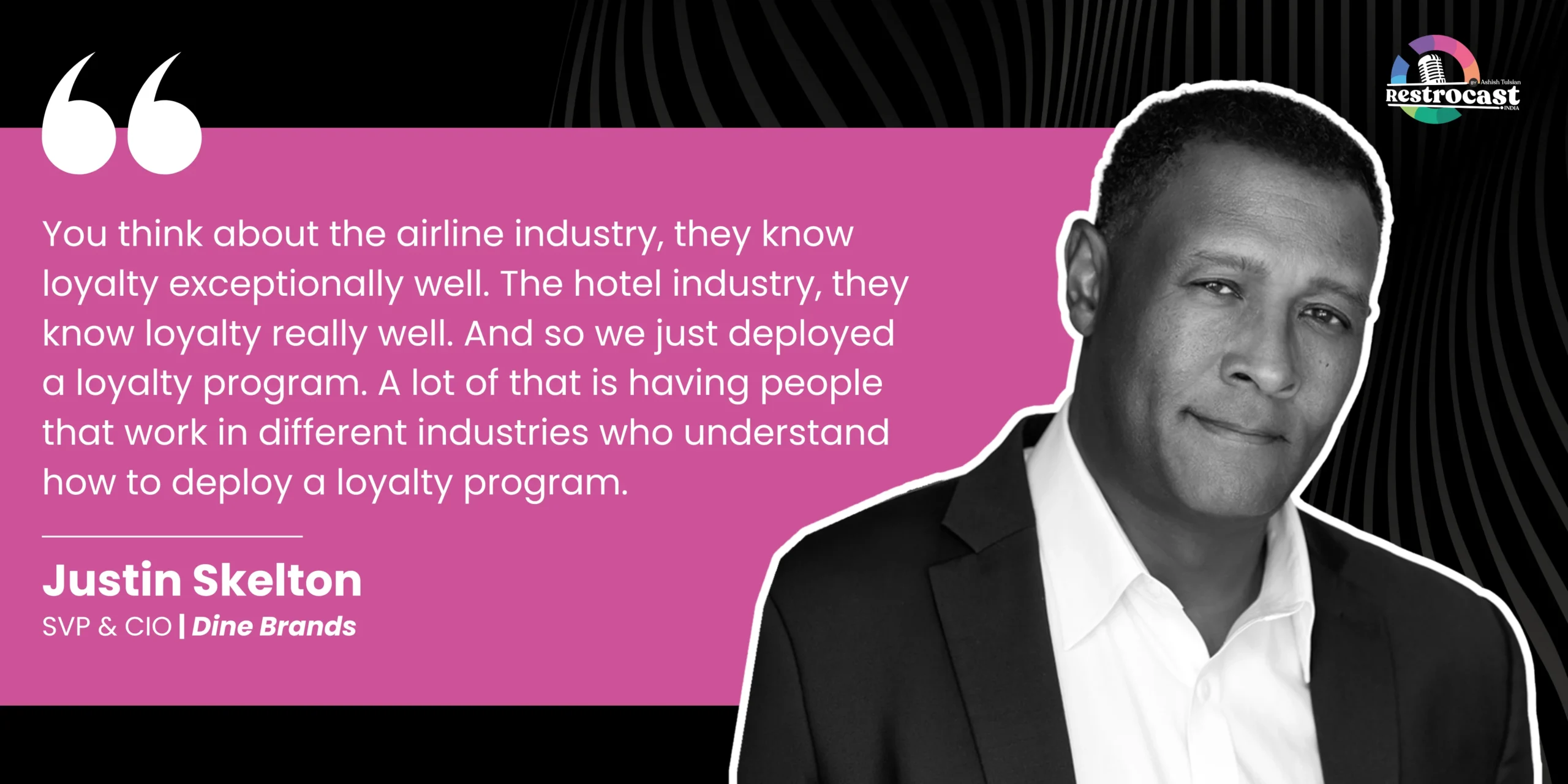
Justin Skelton, a tech leader in the restaurant industry featured on Restrocast, observed that restaurants are still learning from industries that have been building loyalty programs for decades:
Loyalty Software: What to Look For and What to Avoid
The loyalty software market ranges from POS-bundled basic programs to enterprise platforms built specifically for multi-unit operations. The right choice depends on the number of locations, POS compatibility, and the sophistication of your data and personalization needs.
- POS-native loyalty (Toast Loyalty, Square Loyalty): Lowest cost, fastest setup, works well for one to three locations. The major limitation is that the data is trapped inside the POS ecosystem. These programs work for operators who are not yet considering cross-location analytics, but they create a POS lock-in problem that becomes increasingly expensive to resolve as the operation scales.
- Mid-market platforms ($500-$2,000/month for 5-20 locations): Solutions like SpotOn, TouchBistro Loyalty, and similar platforms offer more feature depth than POS-native options, better segmentation tools, automated marketing tools, and reporting that goes beyond basic transaction summaries.
- Enterprise platforms ($2,000-$10,000+/month for 20-plus locations): Paytronix, Punchh, and Como are built specifically for multi-unit and franchise restaurant operations. They handle cross-location redemption, consolidated reporting, franchisee-level analytics, and CRM integration in ways that mid-market platforms cannot match. The cost is significantly higher, but operators at 20-plus locations typically find that the visibility and automation capabilities justify the investment.
The delivery channel gap every vendor avoids mentioning: DoorDash, Uber Eats, and Grubhub orders do not feed into most loyalty platforms. For operators doing 30 to 40% of revenue through third-party delivery, this means a substantial share of customer transactions are invisible to the loyalty system. Those customers are not being enrolled, are not earning points, and are not receiving personalized offers. This is not a solved problem, but operators should model the revenue impact of that gap before committing to a platform that cannot address it.
Best Loyalty Program Design: The Structural Principles
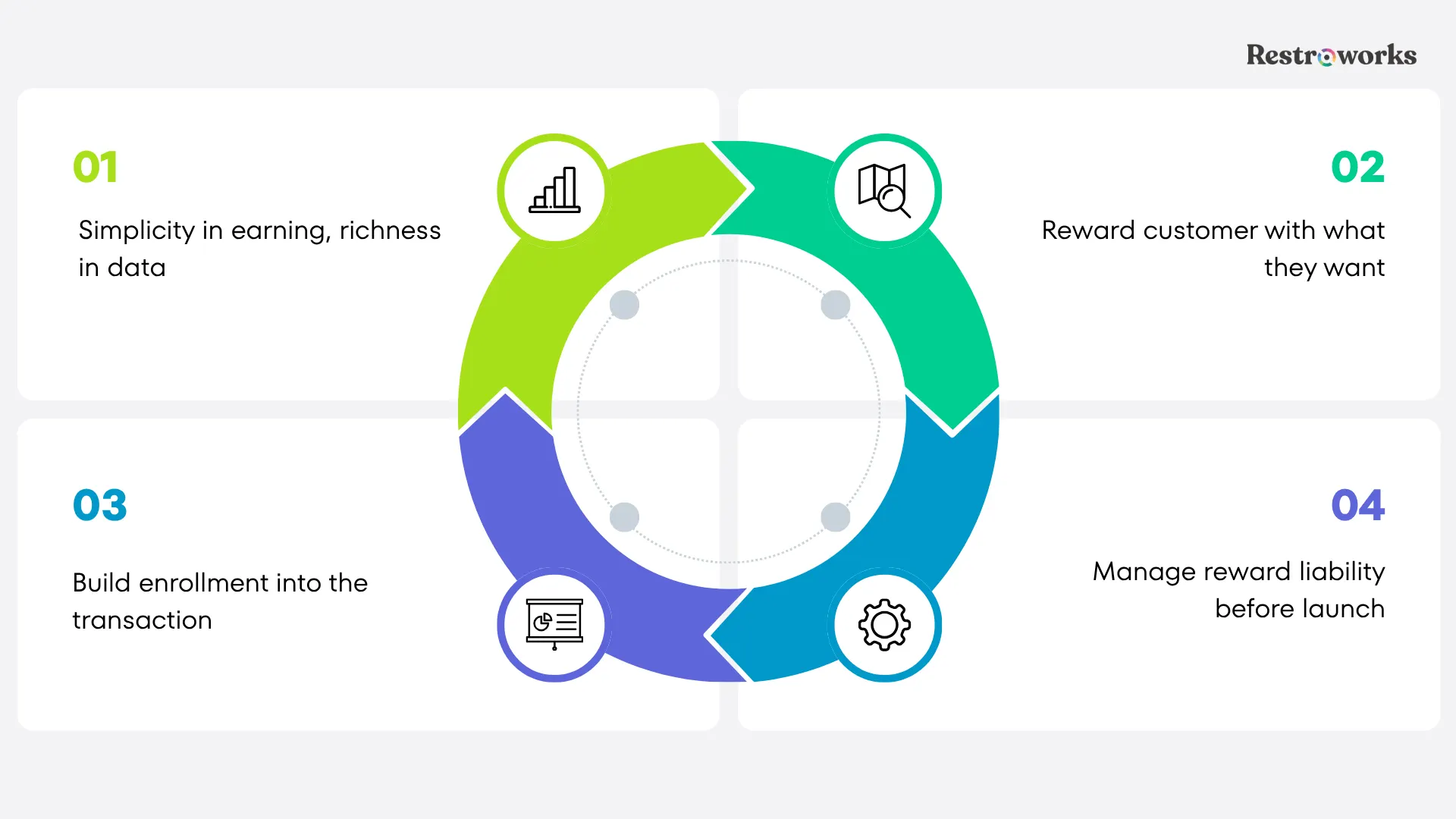
The best loyalty program for a multi-unit restaurant is not the one with the most features. It is the one your customers use consistently, your staff promotes naturally, and your finance team can model accurately.
A few principles that consistently separate programs that perform from those that underperform:
Simplicity in earning, richness in data collection. Customers should be able to explain how they earn rewards in one sentence. Every transaction should capture order history, visit time, location, channel, and payment method. The visible simplicity drives enrollment; the data richness drives personalization and retention.
Reward customers with what they actually want. Rich Hope at Jersey Mike’s surveyed customers and got an unambiguous answer: “We want free subs.” Free food rewards beat experiential rewards and merchandise for most QSR and fast-casual customers. Build around what your customers actually value.
Manage reward liability before launch. Every unredeemed loyalty point is a deferred revenue liability under ASC 606. Address this with your accountant before scaling, and understand that state escheatment laws on unredeemed points vary by jurisdiction.
Build enrollment into the transaction. Programs requiring a separate app download or account creation before the first transaction see dramatically lower enrollment rates. Make becoming a loyalty member the path of least resistance.
Right Loyalty System: Implementation Sequencing
Implementing the right loyalty program that works across various locations is not just about choosing the correct platform but also about timing it correctly. Below is a 90-day framework based on what multi-site companies have used when launching their loyalty programs.
- Days 1 to 30: Architecture and foundation: Decide on your platform and ensure POS compatibility before anything else. Audit each site for potential customer data overlap and identify how many customers visit multiple sites. This will give you an idea whether centralized tracking would yield useful results in your case. Determine your earn rate, redemption mechanism, and build the business model, including costs and funding of the rewards at your expected enrollment and redemption rates.
- Days 31 to 60: Pilot and training: Pilot the program in two to four sites. The chosen pilot sites should have motivated managers who can provide candid feedback on how the process is working. Teach employees how to market enrollments as part of the regular transaction process. Monitor the enrollments, early redemptions, and employee compliance individually. Determine where the glitches lie before a full-scale launch.
- Days 61 to 90: Assessment and expansion: Evaluate pilot results. Look at the enrollment rate as a percent of total transactions, redemption rate, average time to initial redemption, and return visit rate in the 30 days after enrollment. Does the actual information support what you predicted in your model? If so, it is time to start expanding to more stores using the revised training and enrollment scripts.
There have been many brands that implemented the right loyalty program for their brand and found success. Some examples are Pizza Hut, Subway, and Chick-fil-A.
Pizza Hut’s Hut Rewards program allows customers to earn unlimited points and receive a free pizza with just one order, making it one of the most straightforward loyalty programs in the industry. Subway’s MVP Rewards program, launched in 2023, features a tiered membership system that rewards customers based on their annual spending, with automatic enrollment for previous loyalty members. Chick-fil-A’s Chick-fil-A One loyalty program, introduced in 2016, is a tiered membership program in which customers earn points on purchases, with higher tiers offering more points per dollar spent.
Take inspiration from these brands and make something that fits your brand and your customers.
Loyalty Features: What Actually Moves the Needle
After analyzing data from loyalty programs at all levels, it is clear that the loyalty attributes that produce tangible effects are narrower than most loyalty platforms’ features imply.
Automatic birthday gifts: Birthday gifts have high redemption rates and create an emotional bond with the brand. This should be part of every loyalty program, regardless of its complexity.
Bonus-point events: Limited-time double-point promotions encourage behavioral changes, with loyal customers visiting twice per week instead of once when double points are offered.
Marketing tools activated based on behavior: The most efficient way to engage customers is through interactions that are activated based on behavior – a customer who has not been seen in 45 days gets an “we miss you” deal, while a customer who recently upgraded gets recognized and gets early access to a new product release. Such automated processes do not require continuous intervention from the marketing team and yield higher levels of customer engagement than broadcast emails.
Receipt integration into the digital platform: Each time a purchase is made, the transaction should update the loyalty system and send an electronic receipt showing the customer’s point balance and their current status toward the next reward.
Loyalty programs do not have to include all the features listed in a software vendor’s checklist. What is important is that they have the key components well implemented across all locations, with employees knowing how to sign up customers and systems that capture the necessary data effectively.
Best Loyalty Considerations: Franchise-Specific Challenges
For franchise networks, the loyalty program introduces governance elements that a straight corporate business model does not need to consider. When the franchisee is not aligned, he will sabotage the loyalty program without even trying by understaffing the training process, not promoting enrollment through point-of-sale promotions, and not allowing redemption processes that lower his store sales.
The franchise agreement needs to provide for loyalty fees and cost allocation in advance of the program implementation. The Wingstop strategy of splitting the loyalty program costs 60 percent to the corporation and 40 percent to each franchise owner, based on where points are generated and redeemed, solves the issue of cross-subsidization, which has led to the demise of many franchise loyalty programs.
Focus Brands CFO Mike Dixon described their multi-concept loyalty infrastructure: “It is easy for brands to operate in a silo. But at Focus Brands, we have built a robust platform structure that allows our brands to benefit from the scale and size of the company.” That cross-brand data integration is what prevents the fragmentation that undermines loyalty programs at scale.
In conclusion, what makes a truly successful loyalty program in the realm of multi-unit restaurant businesses is not simply its size in terms of number of loyalty members or number of rewards distributed, but rather the ability to connect the dots between all aspects of data, operational practices, and customer experience at each location. Those who have been most successful in the field are those who view their loyalty programs as an infrastructure project, not just a marketing ploy, and establish the systems that gather valuable data, organize franchise owners and employees around execution, and thoroughly analyze the financial ramifications prior to implementation.