Franchise restaurants differ mainly in startup cost, earning potential, and the skills and involvement they demand, so the right choice depends on how much capital you have, what you’re good at, and what return you need.
The sector is also growing. In 2026, the expected number of franchises in the U.S. will be 845,340, and franchise production will be $921.4 billion. One of the most appealing and highly competitive franchise types is the food franchise, which gives the entrepreneur brand, system, and customer recognition that an independent restaurant lacks.
However, not all franchise restaurants are the same, and choosing the right one depends on the entrepreneur’s capital, abilities, and investment needs.
This manual compares different franchise restaurants based on parameters such as start-up cost, earning capacity, and other factors.
What You Will Learn
- How major fast food franchise brands compare on cost, revenue, and franchisee support
- The financial and operational factors that distinguish high-performing food franchises
- Which franchise opportunities are best suited to different investor profiles
- How to research and assess a franchise before committing capital
How to Compare Franchise Restaurants
Before starting your comparison among various brands, decide what kind of criteria you are going to apply to evaluate any franchise opportunity.
Key criteria include-
- Cost and ongoing fees
- Average unit volume (the annual income a typical unit brings)
- Franchisee satisfaction and support
- Territory availability in your market
- Time requirements and staffing challenges
In the US, most of the information you need is in each brand’s Franchise Disclosure Document (FDD):
| Criterion | What it tells you | Where to find it in the FDD |
|---|---|---|
| Cost and ongoing fees | Upfront investment, franchise fee, royalties, and marketing fees | Items 5, 6, and 7 |
| Average unit volume (AUV) | The annual revenue a typical unit brings in | Item 19, if the franchisor provides it |
| Franchise satisfaction and support | Training, ongoing help, and how happy current owners are | Item 11, plus conversations with franchisees |
| Territory availability | Whether your market is open and how protected it is | Item 12 |
| Time requirements and staffing | How involved you must be and how hard the unit is to staff | Item 15, plus conversations with franchisees |
The range of options is wide. According to the US Census Bureau’s Economic Census, there are over 300 different types of franchise businesses in America, and franchised restaurants make up approximately 54% of all fast-food restaurants and about 73% of fast-food restaurant employment.
In this respect, it can help to engage a franchise consultant, someone with experience working with various brands, who can provide an unbiased evaluation of what each franchise really offers compared to what the marketing materials claim.
EXPERT OPINION
“Franchising restaurant concepts allows for fast growth. If you expand your brand through franchising, the investment in new outlets comes from franchisees. Critically, franchising gives you an opportunity to grow in multiple markets simultaneously.”
— Michael Einbinder, Founding Partner, Einbinder & Dunn
Fast Food Franchise Giants: McDonald’s, Subway, and Domino’s
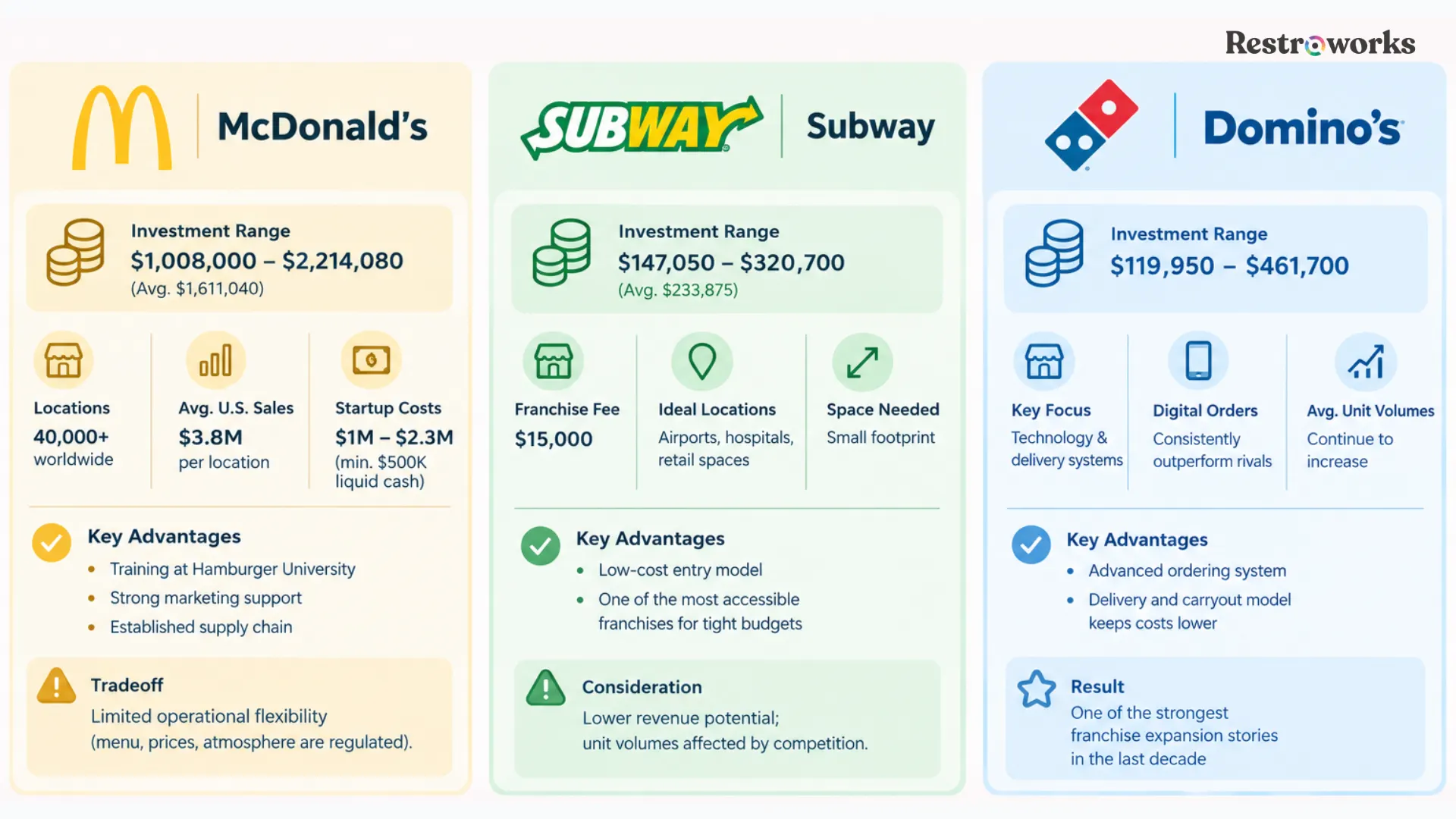
McDonald’s, Subway, and Domino’s represent three very different franchise investments. McDonald’s offers the highest sales but costs well over $1 million to open; Subway is one of the cheapest major brands to enter but generates lower revenue; and Domino’s sits in between with a lower-cost, delivery-focused model.
All three are quick-service restaurants (QSRs), which prioritize speed, high volume, and low prices, relying on standardized recipes and operating systems for consistency.
Here’s how they compare with other major fast-food franchises, based on 2026 FDD figures:
| Brand | Franchise fee | Initial investment | Royalty + Ad fund |
|---|---|---|---|
| McDonald’s | $45,000 | $1.47 million – $2.81 million | 4–5% + 4% |
| Subway | $15,000 | $239,000 – $537,000 | 8% + 4.5% |
| Domino’s | $10,000 | $120,000 – $462,000 | 5.5% + ad fund (varies) |
| Papa John’s | $25,000 | $281,485 – $890,267 | 5% + 6% |
| Dunkin’ | $40,000-$90,000 | $532,000 – $1.8 million | 5.9% + 5% |
| KFC | $45,000 | $1.21 million – $4.16 million | 4–5.25% + 5.8% |
Let’s explore such big brands in detail.
McDonald’s
A McDonald’s franchise costs about $1.47 million to $2.81 million to open and requires $750,000 in non-borrowed funds, but it offers some of the highest sales in fast food.
As the largest fast food franchise company by revenue, McDonald’s has 44,000 establishments worldwide. The brand averages about $3.8 million in annual sales per location in the U.S. market, one of the highest average unit volumes in the fast food sector.
McDonald’s offers franchisees comprehensive training at Hamburger University, strong marketing support through national ad campaigns, and a well-established supply chain.
The tradeoff is limited operational flexibility, as the menu, prices, and the restaurant’s overall atmosphere are tightly regulated. Thus, McDonald’s franchise opportunity is one of the most financially stable options if an investor is ready to risk capital and leverage the brand’s recognition.
Subway
Subway has become the world’s largest fast food chain by number of locations through its low-cost entry model. It features an initial investment of about $239,000 to $537,000 and a $15,000 franchise fee, though its unit revenue is lower than burger and chicken chains.
While revenue potential is lower than that of burger and chicken chains, Subway’s unit volumes have been affected by stiff competition in the fast-food industry. Despite that, Subway remains one of the most accessible fast-food franchises for those on slightly tighter budgets.
Domino’s
Domino’s offers a lower-cost entry, at about $120,000 to $462,000, into a delivery- and carryout-focused model backed by strong ordering technology, with an average unit volume of about $1.3 million.
Domino’s has achieved one of the best franchise expansion stories in the food industry over the last decade through investment in technology and delivery systems.
Why it appeals to investors:
- A digital ordering system that has consistently outperformed rivals in capturing sales through digital orders
- An emphasis on delivery and carryout, which keeps costs lower than full-service restaurants
Chick-fil-A: The Unusual Franchise Business Model
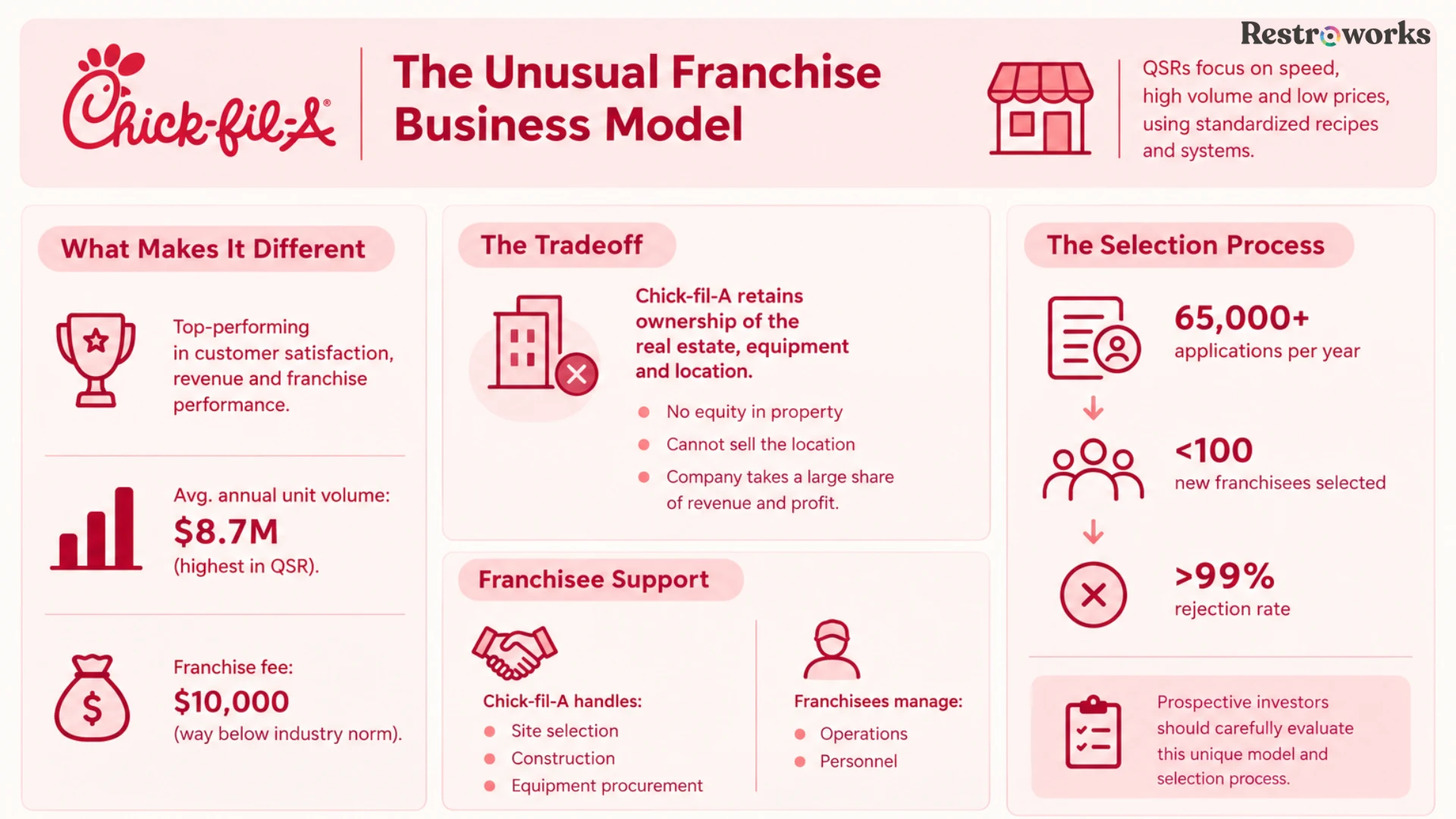
Quick Service Restaurants (QSR) prioritize speed, high volume, and low prices, relying on standardized recipes and operating systems for consistency.
Chick-fil-A and What Makes It Different
Chick-fil-A has the highest sales in the segment, with average annual sales for freestanding restaurants of $9.16 million in 2025, per the 2026 FDD.
What makes Chick-fil-A different is that operators run the restaurant without owning it, in exchange for access to the highest-grossing fast-food restaurants per location in the US.
It uses an unusual operator model: you pay just a $10,000 fee, but the company owns the restaurant, takes 15% of sales plus roughly half of pretax profit, and selects well under 1% of applicants.
However, franchisees receive strong support from headquarters: Chick-fil-A handles site selection, construction, and equipment procurement, while franchisees focus on operations and personnel management in the restaurants.
Getting selected is the hardest part of the whole deal. Chick-fil-A doesn’t publish official figures, but estimates suggest 60,000 to 100,000 people express interest each year, with only around 100 to 150 new operators selected. Prospective investors need to evaluate this format carefully, since both the business model and the selection process are unique in the fast-food category.
Burger and Chicken Restaurant Franchise: Burger King, Wingstop, and Others
Burger and chicken franchises range from about $300,000 to more than $10 million to open. Burger brands like Burger King typically require large freestanding builds, while chicken concepts like Wingstop offer smaller formats with lower entry costs and strong sales.
Burger franchises are one of the largest segments in fast-food franchise investment, and chicken concepts are among the fastest-growing. Here’s how the major options compare:
| Brand | Category | Franchise fee | Initial investment | Royalty + Ad fund |
|---|---|---|---|---|
| Wingstop | Chicken wings | $25,000 | $298,000 – $1.0 million | 6% + 5% |
| Popeyes | Chicken | $50,000 | $505,000 – $3.9 million | 5% + 5% |
| Zaxby’s | Chicken | $35,000 | $1.46 million – $3.81 million | 6% + 4% |
| Burger King | Burger | $50,000 | $2.06 million – $4.73 million | 4.5% + 4.5% |
| Culver’s | Burger | $65,000 | $3.4 million – $10.3 million | 4% + 2.5% |
Food Franchises Beyond Fast Food: Dairy Queen, Auntie Anne’s, and Krispy Kreme
In 2026, the most profitable restaurant franchises focus on smart profit margins, data-based insights, and scalable profitability, rather than just revenue generation.
Dairy Queen
Dairy Queen has more than 4,000 outlets in America, including Grill & Chill restaurants and smaller-scale DQ Treat-only concepts.
Starting costs for a full Grill & Chill concept range from $1.1 million to $1.8 million. Being both a dessert shop and a food franchise helps Dairy Queen attract clients all day, every day.
Auntie Anne’s
Auntie Anne’s is one of the most recognized food franchises in the United States that doesn’t sell burgers or chicken, thanks to its fresh-baked pretzels in malls, airports, and entertainment venues. The start-up cost ranges from $199,475 to $385,100.
The small shop and narrow menu make the business easier than other restaurant franchises. For an entrepreneur seeking a unique fast-food franchise that requires less capital to start, Auntie Anne’s is a strong option.
Krispy Kreme
Krispy Kreme has further enhanced its franchise business not only through standalone stores but also through shop-in-shop locations inside existing stores, providing an affordable opportunity for franchisees who cannot afford the cost of opening a standalone store.
The brand’s iconic presence in the donut category, along with its expansion into hot coffee, provides more variety to Krispy Kreme’s menu.
INDUSTRY INSIGHT
In 2026, a healthy EBITDA margin for restaurant franchises generally ranges between 12% and 20%, with top-performing QSR and fast casual brands exceeding 18%.
The numbers confirm the structural advantage of running a business under a well-known brand name with strong marketing efforts, reliable logistics, and loyal customers; however, at the same time, they only serve as average numbers that conceal the difference in performance between the best-performing units and the worst-performing ones within any particular franchise network.
How to Choose the Right Franchise Opportunities For Your Brand?
Selecting among competing franchise restaurant businesses demands both self-assessment and financial planning. It is imperative that you choose the accurate representation of your brand model for your franchisees (or potential franchisees).
Franchise models provide a proven business framework, making them more resilient during economic uncertainty compared to independent restaurants.
Nonetheless, here are a few considerations before selecting a concept:
- Capital: Capital requirements for franchise restaurants range from less than $200,000 to more than $4 million, depending on the business type. Search only for those restaurants that match your liquid capital position.
- Hours needed to run the restaurant: Some fast-food franchise restaurants require the franchise owners to be present during the early operating period for 50 to 60 hours a week. Other concepts offer semi-absentee operation with a capable general manager and a strong team.
- Market availability: Not all franchise restaurants offer an open market in your area of interest. Learn which concepts have open markets in your area before applying to an oversaturated concept.
- Exit strategy: Each franchised restaurant’s resale value differs. You should analyze the resale value and process before getting into a franchise contract.
Successful franchise operators in 2026 are increasingly relying on digital visibility and AI-driven insights to enhance operational efficiency and profitability. Franchises that effectively centralize data across locations and automate operational actions can significantly improve their efficiency and profitability. Casual Dining focuses on providing an extensive menu and full table service in a relaxed atmosphere, serving as social gathering venues.
Fast Casual restaurants offer higher food quality and a modern ambiance compared to QSR, often emphasizing fresh ingredients and customizable meals. Fine Dining aims to offer a premium experience with a strong emphasis on service, restaurant experience, and high-end menu offerings, requiring a larger initial investment.
Franchise restaurants can be classified into various segments such as Quick Service Restaurants (QSR), Fast Casual, Casual Dining, and Fine Dining, each with distinct operational focuses.
KEY TAKEAWAYS
- There is huge variation in initial costs, average unit volumes, franchisee support services, and operations among the different franchise restaurants; comparison of these franchises must focus on something other than mere recognition of the name
- While Chick-fil-A has the highest average unit volumes in fast food restaurants, they retain control over all the assets involved and rejects more than 99% of its applicants, quite different from the traditional restaurant franchise system
- Fast food franchises like Subway, Auntie Anne’s, and Domino’s are available for entrepreneurs who don’t have much money to invest, while the high-end burger or chicken restaurants need at least a million dollars investment
- The franchise disclosure document, more importantly Items 7, 19, and 20, and phone interviews with current franchisees are two non-negotiable steps that must be taken before investing in a franchise business
Frequently Asked Questions
1. What are the top 5 most popular franchises?
McDonald’s, KFC, Subway, Burger King, and 7-Eleven are among the world’s most widely recognized franchise brands.
2. What are the 10 most profitable franchises?
Profitability varies by location and operator, but established brands such as McDonald’s, Chick-fil-A, Taco Bell, 7-Eleven, UPS Store, and Dunkin’ are often considered attractive opportunities; actual profits depend on costs and revenue.
3. Does it cost $10,000 to own a Chick-fil-A franchise?
The initial franchise fee in the US is $10,000, but operators must meet additional financial and operational requirements, and the company retains ownership of the restaurant.
4. What are the 4 types of franchise?
The four common types are product distribution, business format, manufacturing, and investment franchises, classified by how the franchising relationship operates.