
Let me shoot you with some unpredictability: you just (right at the very moment) found out that there will be a music festival a block away from your restaurant this coming weekend (in the next 3-4 days, to be precise). What’ll you do?
Did you just say “I’m not sure”? That’s exactly what restaurant forecasting is for – to make you go from “I’m not sure” to “yeah! This is my moment to shine,” especially when it comes to forecasting special events in restaurants, because, whether you knew it or not, according to a five-year longitudinal study on restaurant performance, special event promotions have measurable impacts on full-service restaurant customers.
Not only that, but a “well-optimized” sales forecasting strategy helps restaurant owners predict future sales, prepare for customer demand, improve inventory management, and protect profit margins during local events.
Intrigued? Hence, this guide. It will walk you through why, when, and how restaurant forecasting for special events makes sense, and ways you can actually nail it.
What You’ll Learn
- What’s so different about event-based forecasting?
- How to classify events and use the right demand multipliers?
- How can you rework your inventory, staffing, and menu right before the event?
- How to track the overall performance at last? (And make sure the same mistake doesn’t happen next time, if any!)
Why and (How Exactly) Special Events Don’t Sync With Your Normal Forecasting Patterns?
See, it’s very simple – Your usual restaurant forecasting process runs on relatively clean historical data and predictable customer behavior. But local events introduce external factors that are basically off-script most of the time and disrupt normal sales-forecasting patterns.
For example, a college graduation weekend is nothing like a local farmers’ market, and so customer behavior, customer traffic, and average spend per guest are bound to differ at both. Similarly, if there’s a corporate conference, people will come in for lunch and leave by 5 PM at the latest.
If there’s a sporting event, more people will order drinks than a full-on dinner.
What I mean is that each event has its own fingerprint, and if you’re applying the same forecasting methods/logic to all of them, you’re merely guessing rather than truly building an accurate forecast.
And sorry to break it to you, but restaurant operators that fail to account for local events often struggle with inaccurate restaurant forecasting, rising labor costs, food waste, and inventory management issues.
“The biggest challenge is always the unknown, especially when it comes to labor and economic policies that directly affect the work we do every day as an industry. To manage through this, restaurants should hone in on where they can drive efficiencies across their operations to set themselves up for success in the face of uncertainty. – Bo Davis, CEO and co-founder, MarginEdge |
Now, while I mentioned how big an impact events have on restaurants, this can sometimes be in a negative way as well.
Imagine a parade, for example. Roads are blocked, and so is half of your regular lunch crowd.
Plus, if a new restaurant is opening nearby offering the same (or better) cuisine and service as you, it will most likely pull customers who’d normally choose you.
And this is why forecasting special events requires its own framework.
The bigger question – How can you build this framework, and ensure its “accurate” for you? Here are the steps:
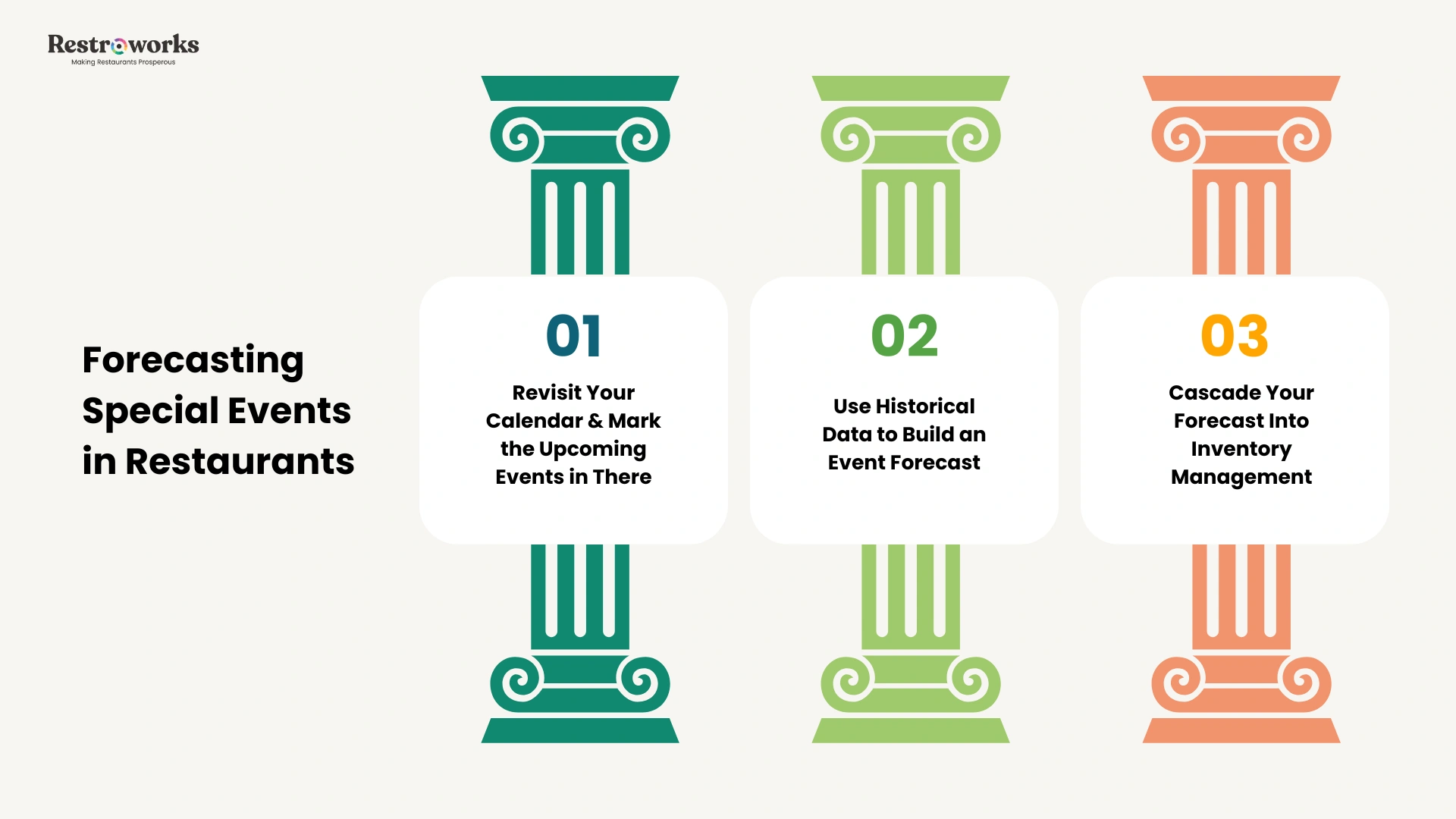
Step 1: Revisit Your Calendar & Mark the Upcoming Events in There
Right, restaurant forecasting indeed starts with pulling in historical sales data, but here you first need to figure out what’s actually happening (or will soon happen) in your area.
Strong restaurant sales forecasting depends on identifying local events early because they directly influence future sales, customer demand, sales volume, and projected sales.
Upcoming events can also affect customer expectations, marketing campaigns, menu planning, labor costs, and inventory needs.
Here’s where you should look:
- Your city or municipality’s events page
- Local convention center booking calendars
- Sports team schedules (pro and college)
- School and university academic calendars for graduation, spring break, and orientation dates
- Community Facebook groups/Instagram/TikTok
- Your chamber of commerce
Once you have your calendar, group events into three categories:
Number 1 – Boost events (the ones that probably bring in more customers than usual)
Number 2 – Suppress events (days you might get fewer customers due to blocked access, traffic, or competition)
Number 3 – Shift events (same volume but different timing or ordering patterns).
Since not every event with high attendance means higher restaurant sales, failing to segregate them and plan accordingly is you (purposefully if you still don’t do this after reading this article) leaving money on the table.
Step 2: Use Historical Data to Build an Event Forecast
Let’s have your past sales data earn its keep. How? Go through the calendar you just prepared and see if you’ve, in the past 2-3 years, operated through any of the “similar” events before.
This historical data analysis helps restaurant owners identify patterns, predict sales more accurately, and improve forecasting accuracy over time.
Now, pull your sales data from those events.
- How much did you make?
- How many covers did you serve?
- What was the average spend per customer?
- What were the actual sales compared to projected sales?
- When were the peak hours and dip hours?
- Which menu items were mostly preferred (those ordered and reordered) by customers?
Compare your findings against a regular week, and the resulting ratio is roughly your event multiplier.
Mind that doing such an in-depth analysis during the forecasting process allows restaurant operators to forecast future sales more confidently while accounting for seasonal fluctuations, market trends, and customer behavior.
The thumb rule, however, for this is –
For any small local event, your event multiplier will be around 1.2-1.3 times your baseline. For a medium event, it will be between 1.5 and 2. And for events like regional conferences and local FIFAs, it will be two to three times the baseline.
Whatever ratio you got, apply it to your expected baselines covers for the period, and there you’ve your starting forecast.
This will help you make informed decisions around staffing, inventory management, food costs, labor costs, and future revenue planning.
The next step (I’m basically merging it here) is analyzing the forecast for some basics, like –
- Will the event be within walking distance?
- Is there parking nearby?
- Does your restaurant naturally attract the crowd that will come in due to that particular event? Like people may come from different towns altogether just to attend the event, and in a way, will find you, so basically, they are not your regulars, and will likely not be in the future, too, unless they attend that event every year.
There might be a case you’ve just opened a few months back and don’t have enough past sales data, that’s absolutely alright. Industry benchmarks exist for a reason. All you have to do is either do a quick online search or talk to other local operators, or we recommend doing both because leveraging historical data and industry benchmarks together often produces a far more accurate forecast than relying on assumptions.
Step 3: Cascade Your Forecast Into Inventory Management
For those who don’t know, the dictionary says cascading is “a process whereby something, typically information or knowledge, is successively passed on.” Passed on to what? Let’s say here it’s to rebuild your inventory management strategy and inventory needs. Like you didn’t do all the analysis in Step 1 and Step 2 to “not put it in use,” right?
Effective restaurant forecasting should directly influence purchasing decisions, menu planning, and labor forecasting.
So, first things first, look into your average spend and menu mix from comparable past events. If your sales data, for example, shows that a sports event in X month made people order your special burger 40 times more, you know what ingredients you should buy, how much, and what you should prepare for.
This is how forecasting sales helps restaurants reduce food waste, control food costs, and protect profit margins.
For perishable items, make sure your timing is right as well. You may order some ingredients (like your staples) four weeks prior, and perishables much closer to the event date to reduce variable costs and avoid supply chain disruptions.
INDUSTRY INSIGHT
How to Forecast Labor Needs for Events?
It’s common sense that if you don’t plan for any event in advance, you’ll either have to work overtime last-minute or bring in more people to handle the day. Like you must have seen someone in your family working late at night when any of us “plan” to throw in a surprise party. That’s home, still manageable. We are talking about a restaurant here.
That’s where labor forecasting comes in handy.
Once you know roughly how many guests you’re expecting, you can work backward from there to analyze how many servers or tenders you’ll need using your covers-per-server ratio.
Accurate restaurant forecasting helps restaurant owners optimize food and labor costs while improving customer satisfaction. Without proper restaurant sales forecasting, labor costs can quickly spiral during high-volume events.
Again, it won’t be this easy in practice because customer behavior changes. At a particular event, table turns might be faster or slower, bar volume might unexpectedly spike, and kitchen throughput could hit a wall.
These external factors can significantly impact sales volume, customer traffic, and forecasting accuracy.
A few “tried and tested” methods that work in such cases are:
- Cross-train staff so you always have flexible coverage.
- Build a ‘call list’ of part-time staff who can fill in for the role immediately as you call.
- Stagger start times so your labor curve matches your expected demand curve.
- Schedule a dedicated coordinator for events.
A recent industry study found that most restaurants are not properly staffed for 38% of shifts in a given week. During events, that percentage gets even worse because the variability is higher.
How Do You Adjust Your Menu Per the Event Demand?
If you, by chance, thought that event-driven demand only changes how many people will show up at your restaurant, you couldn’t be more wrong. Think about it, you’ll be expecting a whole new crowd on D-Day, and a new crowd means you have no idea what they might order.
What we have seen so far is that for sports events, people tend to incline more towards shareable items, quick-turnaround food, and alcohol.
Business conferences, on the other hand, see longer lunch stays, higher check averages, and lighter dinner crowds. Holiday events like Valentine’s Day and Mother’s Day favor prix fixe menus, which actually simplify kitchen operations and make forecasting easier because the menu mix becomes predictable.
If your past sales records show that on particular nights, burgers move three times the usual, but pasta does it only half as much, you can prep accordingly and reduce the risk of a kitchen slowdown (or worse, a shutdown) mid-service.
A streamlined event menu also reduces ticket times, which directly supports customer satisfaction and restaurant operations.
One thing worth noting here is: don’t try to run your full menu at full capacity for a 2x-volume event. Simplify it. Create event-specific bundles, and try to make it easier for the kitchen to produce consistently under pressure.
What Should You Do After the Event?
Did you just breathe out, “Finally, the event is over”? Hold on, you might need to sit once within 48 hours and log what actually happened.
This post-event variance log of yours should capture:
- Forecasted covers vs. actual covers
- Forecasted revenue vs. actual revenue
- Projected sales vs. actual sales
- Which menu items sold out the most and which the least?
- Staffing levels vs. actual need
- Any operational issues that affected the service
These historical data become increasingly valuable with every cycle because they help restaurant operators identify trends, improve forecasting methods, and build more accurate forecasts in the future.
How exactly do they help you? When the same event rolls around next year, or when a similar event comes to your area, you’ll now have data to look at. With each cycle of forecast → execute → review, you’ll build institutional memory.
Over time, leveraging historical data this way improves financial management, strengthens cash flow planning, and supports long-term business growth.
“By using pre-pandemic budgets as a metric, we mitigated our losses enterprise-wide by 78% from 2020 to 2023, significantly improving cash flow management and even positioning us to acquire five management contracts during the height of the pandemic. |
How Can Technology Help in Forecasting Special Events in Restaurants?
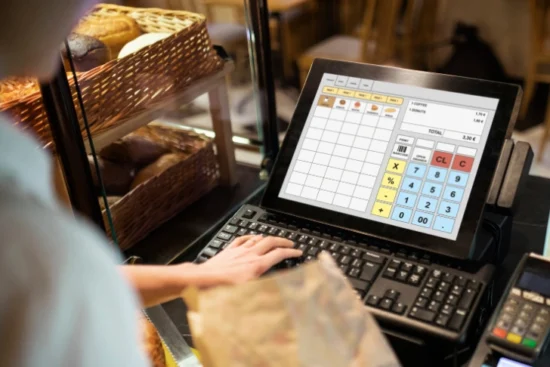
Yes, you don’t need an enterprise software suite to forecast special events. But you do need your POS system to be working for you at every level.
Modern POS systems can analyze historical sales data, identify patterns, track seasonal fluctuations, and generate sales projections for staffing and inventory management.
Many forecasting tools now also use machine learning to improve forecasting accuracy by analyzing customer behavior, customer preferences, market trends, weather conditions, and local events in real time.
Restaurant operators using integrated POS systems and forecasting tools are often better positioned to forecast future sales, manage cash flow, and maintain profitability. If your current system isn’t already doing this, you’d better reevaluate your choice.