
This trend is not sustainable unless restaurants can cut their expenses through digital transformation, which allows them to optimize operations and staffing planning, increase labor efficiency, and deploy financial reporting and cost management.
Restaurant Technology Key Trends: Why Restaurant Industry Operators Are Leveraging Technology
Data from surveys conducted by KPMG indicate that 74 percent of operators perceive restaurant technology as complementary to, rather than competitive with, the workforce; 80 percent are implementing enhanced digital ordering capabilities, while 67 percent intend to optimize loyalty programs and improve CRM features. These numbers are not mere pipe dreams either. Operators know that using old-school technologies to manage cost pressures will make no sense.
What sets this period apart from previous periods is that integration plays a huge role. Multi-unit operators would normally be running six or more distinct back-office technologies that cannot talk to each other. This is why integrating all of those functions—from inventory management to labor scheduling to sales forecasting and customer data—is currently the greatest change happening in the restaurant industry, and managers have to adjust operations accordingly.
Inventory Management and Food Costs within the Restaurant Industry: How to Gain Competitive Advantage with AI
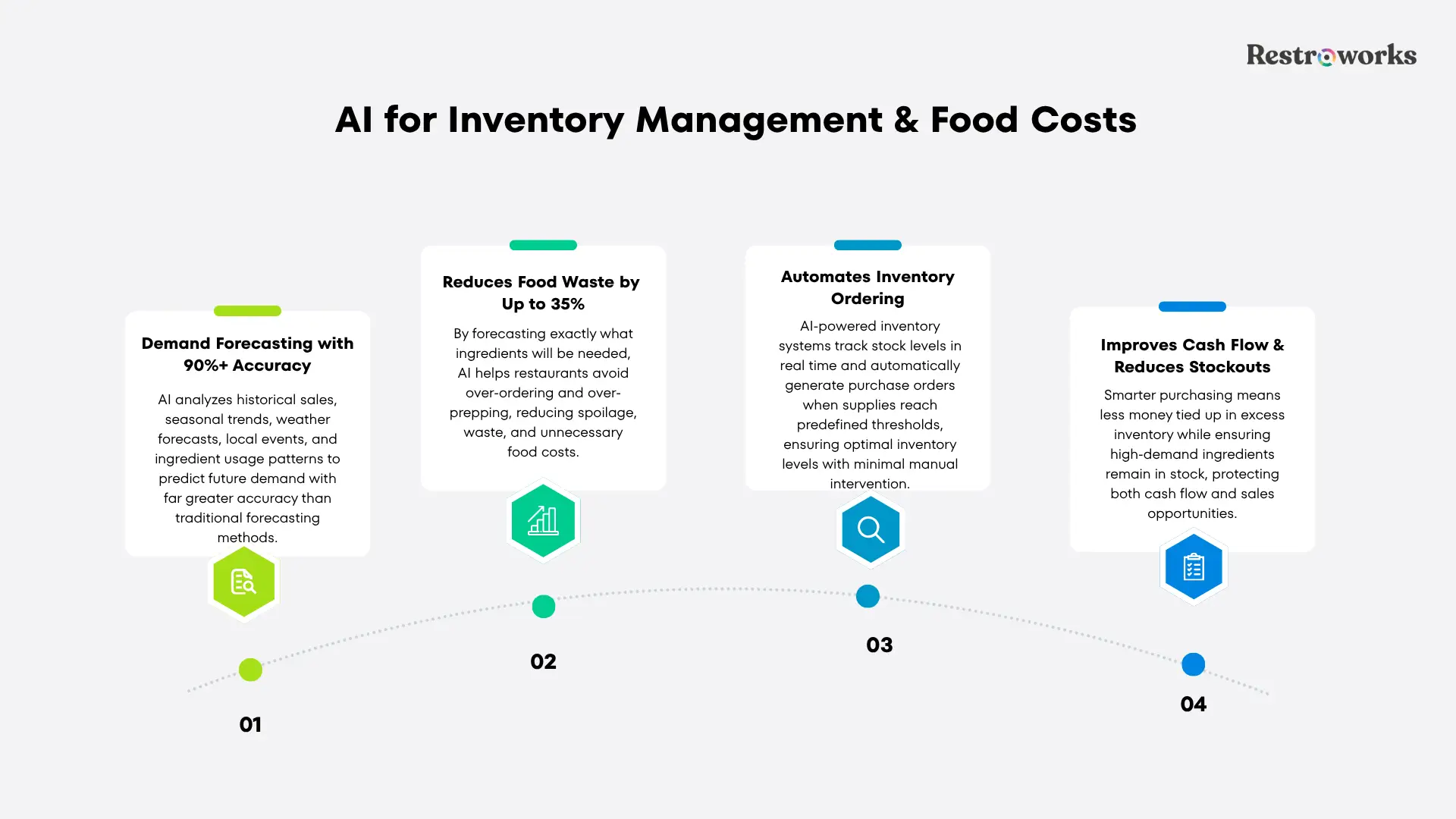
Artificial Intelligence is being used for automated scheduling, dynamically adjusting staff shifts based on real-time traffic predictions. AI and automation are increasingly used in restaurants to streamline operations, with predictive analytics helping to forecast demand and manage inventory, reducing food waste by up to 35%. AI-powered inventory management systems are transforming supply chain operations by automatically generating orders using predictive algorithms, thereby improving cash flow and reducing stockouts. AI tools predict demand by analyzing past consumption, local events, and weather to automate ordering and minimize waste.
Operators within the restaurant industry report that their sales forecasts are only 60% accurate on average, despite 72% using some form of tech-based forecasting tools. That accuracy gap is where food costs bleed out. When a restaurant over-orders based on an optimistic forecast, the excess becomes waste. When it under-orders, it loses sales and disappoints guests. Both outcomes hurt.
AI-powered inventory management addresses this by simultaneously analyzing historical trends, weather patterns, local events, and ingredient usage to generate accurate item-level forecasts. AI systems now forecast demand with over 90% accuracy by analyzing historical sales, seasonal trends, and local weather. The results at the restaurant level are concrete. Jimmy John’s franchise operator 83 Subs cut bread waste by 53% across 17 locations. Red White and Que BBQ saves over three racks of ribs daily, translating to $107 in daily cost savings, by using AI to forecast demand for items that require 12-plus hours of preparation. Groucho’s Deli extended ingredient-level AI forecasting across 31 franchise locations and achieved consistent prep planning that protects margins across the entire portfolio.
The principle behind all of these results is the same: accurate forecasting turns food costs from a reactive expense into a controllable variable.
Back of House and Kitchen Robotics: Solving the Labor Equation in the Restaurant Industry
Labor is where the math gets most difficult for multi-unit operators. 59% of operators say staffing challenges directly impact their ability to expand. Only 31% are confident their current scheduling systems can balance staff efficiency within budget. In the current restaurant industry landscape, labor costs continue to rise faster than menu price increases can offset.
The answer is not replacing people with machines across the board. It is automating the parts of kitchen operations that are most vulnerable to inconsistency and waste, as well as repetitive tasks like fry station management, portion control, and makeline production. Kitchens are adopting targeted automation for repetitive tasks to address persistent labor shortages. Kitchen robotics handles these functions to consistent standards across all locations and shifts, regardless of staffing levels. For multi-unit brands where consistency is brand equity, that reliability has real financial value.
Customer Relationship Management: Enhance Customer Experience and Give Loyalty Programs
The front-of-house restaurant technology conversation for multi-unit operators comes down to one core tension: third-party delivery platforms provide reach but extract 15 to 30% commission per order and deliver zero customer data back to the restaurant. Direct online ordering and mobile apps reverse both of those dynamics. Restaurants within the restaurant industry that are implementing kiosk and mobile ordering systems are reporting sales gains of 12 to 22%, and the valuable data captured through direct channels is what powers effective loyalty programs at scale.
Wingstop is building toward exactly that capability. By unifying its data architecture across all locations, it achieved a single customer view that powers AI-driven personalization across the entire operation: “We’re able to move faster, make smarter decisions and deliver more personalized digital experiences at scale.”
Real-time data visibility is what connects all of this. 84% of restaurant operators say real-time visibility into inventory is important. Without it, operators are making decisions about staffing, ordering, and marketing on information that is days old, while competitors act on what is happening right now.
Multi-Unit: Your 18-Month Implementation Roadmap
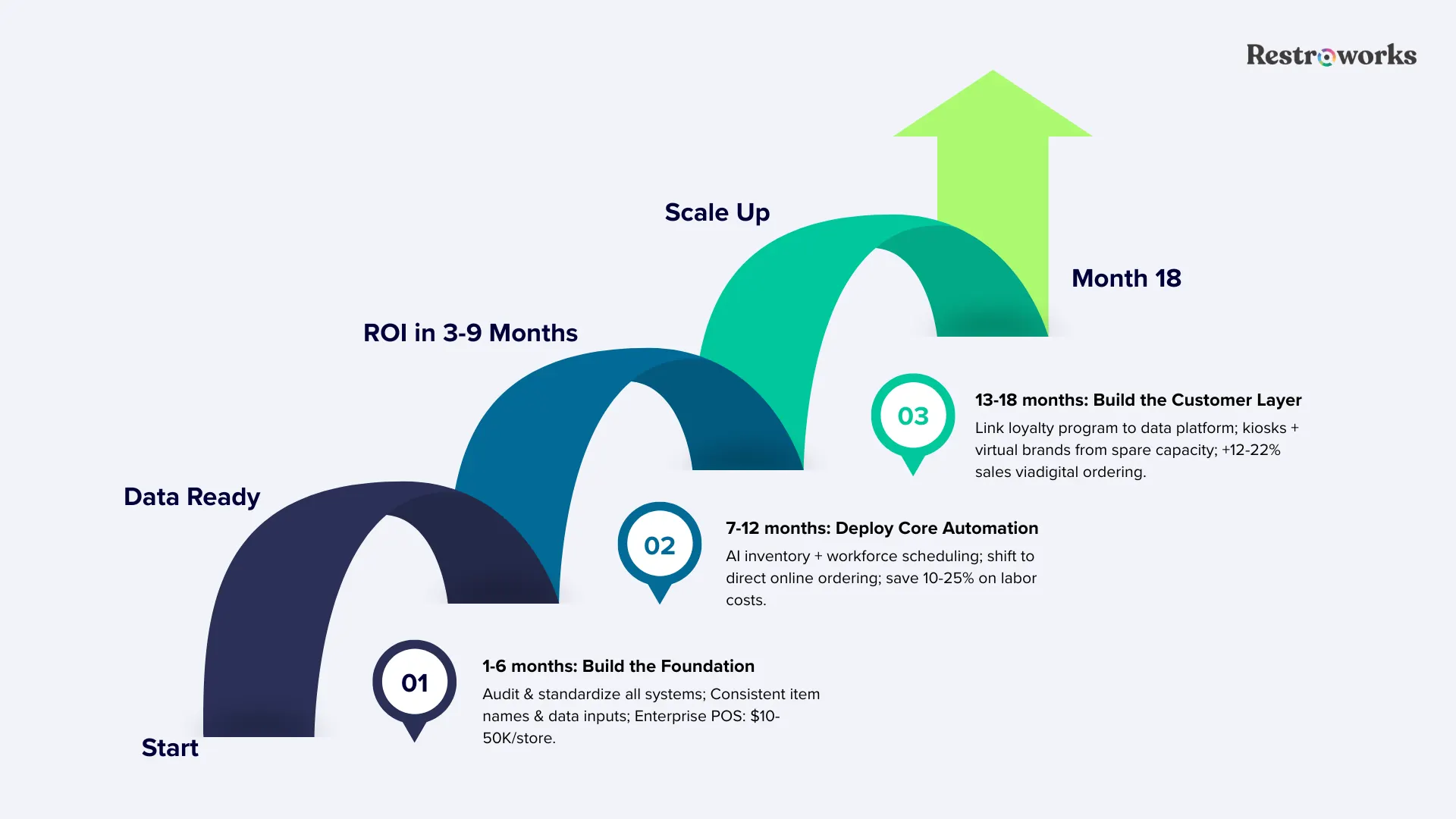
The mistake most companies make in their restaurant technology roadmap is trying to deploy both AI and automation without first building a strong data foundation. Within the initial experimental phase, this is what you should try:
Months 1 to 6: Build the data management foundation.
Do an audit of your current system. Ensure standardization of item names, data entry, and reports across all stores so that each piece of software uses consistent, accurate data. AI-generated forecasts will be inaccurate if the data used is inconsistent. This process will cost $10,000 to $50,000 per store for Enterprise POS deployment.
Months 7 to 12: Deploy core automation.
Armed with your cleaned data, automate your inventory using AI and schedule your workforce. This process should coincide with the diversion of your delivery revenue to direct online ordering channels. Scheduling AI is expected to generate ROI within 3 to 6 months. Inventory AI ROI will be seen within 6 to 9 months. It’s possible to save 10-25% on labor during this period.
Months 13 to 18: Build the customer layer & enhance guest experience
Link your loyalty program to your data platform. Assess kiosk and voice ordering for those higher volume units. Based on your demand data analysis, create virtual brands out of spare kitchen capacity. At this point, restaurant operators tend to see a 12-22% increase in sales from additional digital ordering capabilities.
In 2026, 60% of restaurant operators reported improved operational efficiency and 52% better customer retention due to the adoption of digital innovations, highlighting the importance of technology in enhancing guest experiences by always meeting guest expectations and consumer preferences. 73% of restaurant operators increased their technology investments in 2024, focusing on enhancing the customer experience and operational efficiency through tools such as kiosks and online/mobile ordering platforms. It’s the restaurant industry operators who have executed these three steps in order, data solution, automation, customer technologies, that produce the success stories we mention all across this guide. And it’s the restaurant operators who skip straight to the exciting part, without having put their data in order and implemented automation, who end up abandoning costly implementations just a few months down the line.