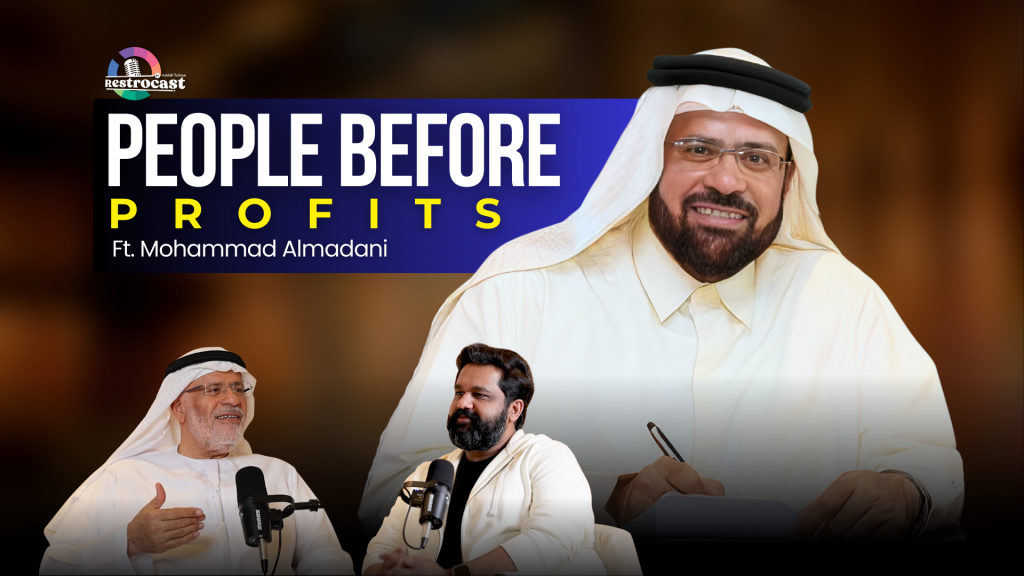

Some business journeys start with timing. Others start with opportunity. But Mohammad Al Madani’s journey begins with heritage, a small tailoring shop in the 1940s that quietly shaped how generations of Dubai’s leaders dressed, appeared, and carried themselves.
Growing up in that shop, surrounded by craftsmanship and community, Al Madani learned lessons that would later guide him through fashion retail, franchising, and eventually the creation of a multi-country F&B footprint with brands like Charley’s.
In this conversation, he reflects on how a childhood spent measuring kanduras and greeting customers became the foundation of a career defined by integrity, innovation, and people-first leadership.
You come from a family whose history is deeply intertwined with Dubai’s. Can you take us back to the early years? How did your journey begin?
Al Madani: It all began with my father. Our tailoring business goes back to the mid-1940s, long before Dubai Municipality or trade licenses existed. My father opened a shop in the old Atras area and became known for something very simple: treating customers with warmth and respect. He was the first young tailor among older craftsmen, and people loved how he greeted them, stood up for them, served them tea, and solved their problems.
I practically grew up in that shop, doing homework in one corner, watching him measure kanduras, and learning how to serve customers. Even today, that store still stands, and we’ve been in operation for over 75 years. We stitched kanduras for Sheikh Rashid, and for Sheikh Mohammad, Sheikh Maktoum, and Sheikh Hamdan when they were children. Three generations of the most prominent families in the UAE still come to us.
Tailoring to fashion retail is a natural evolution, but restaurants are a different universe. How did that transition happen?
Al Madani: From tailoring, I expanded into retail fashion in 1996; Levi’s, Dockers, Hang Ten. We opened 40 fashion stores across major malls in the UAE.
The restaurant journey began almost by accident. When signing leases for our retail stores at the Mall of the Emirates, the leasing team asked if I had an F&B brand for their food court. I remembered Charley’s Grilled Subs from my sourcing trips to the US. I called the founder in Columbus, Ohio, and that’s how Charley’s entered the UAE.
Our first Charley’s opened in September 2005 at the Mall of the Emirates, opposite Ski Dubai. From there, every major mall started approaching us.
The jump into F&B must have been challenging. What were your early learnings?
Al Madani: My franchisor questioned my lack of F&B experience. My background was in petroleum engineering, not tailoring or restaurants! But growing up in business teaches you resilience. I learned everything from scratch: reading, training, and attending IFA conventions in Las Vegas.
We made mistakes too. Our first standalone store on Al Diyafa failed because:
- Food courts need traffic, the high street wasn’t right
- We underestimated power requirements
- We didn’t realize how much kilowatt is needed to run a restaurant
We also learned the supply chain the hard way, finding the right protein suppliers, bakeries, vegetables, etc. Franchising helped because the US team had approved vendors.
Many franchisees lose money. Where do people go wrong?
Al Madani: Three major reasons:
- Cutting corners: Reducing portion sizes, compromising quality, thinking it will save money. It always backfires.
- Not following the manuals: Franchising only works if you strictly follow the systems. Deviations cause failure.
- Choosing the wrong location: Location is everything. Many franchisees fall in love with cheap rent, not the footfall. We regularly reject locations that don’t have the required transaction volume.
As a master franchisee, how do you manage relationships with franchisees?
Al Madani: Transparency and partnership. We don’t treat franchisees as distant operators. We have:
- Regular meetings
- Dinners, gatherings
- Direct communication, not only through brand managers
- Open channels when the US franchisor visits
We negotiate rents for them, support them during relocations, defend them with malls, and help with renovation negotiations. Many of our franchisees have renewed their agreements for a second 10-year term because they know we stand with them.
My philosophy:
“Your success is our success. Your failure is our failure.”
The new generation (Gen Z) is changing global food culture. How do you stay updated and relevant?
Al Madani: We invest heavily in:
- A robust loyalty app
- Social media
- Collaborations with influencers Gen Z follows
- Limited time offers & seasonal innovation
- Health-friendly options (brown bread, vegetarian items)
- Customization for local tastes (rice bowls, fish sandwiches)
You also recently brought new Vietnamese and health-focused brands to the GCC. Tell us about that.
Al Madani: At the Franchise India Expo in Delhi, I signed master franchise rights for three Vietnamese concepts: coffee, tea, and a unique health/nutrition brand focused on pregnancy and early childhood wellness. These concepts are innovative, community-driven, and perfectly suited for today’s younger audience.
What has changed most in you as a leader over the years?
Al Madani: Understanding that people are your biggest asset. I maintain one-to-one relationships with my teams. Many employees have worked with us for over 10–20 years. I learned from my father to treat staff with dignity, never to raise my voice, always to share tea, and always to listen. Even today, former retail employees wave when I walk by their stores.
If a young restaurateur comes to you wanting to invest millions into a restaurant, what advice would you give?
Al Madani: If you lack experience, start with franchising; it’s the easiest way to avoid big mistakes. But I’m equally proud of local homegrown brands like Saddle, Salt, and Home Bakery. They started from homes, parks, and food trucks and are now global. If a young person has a strong idea and passion, they can succeed just like them.
Conclusion
Mohammad Al Madani’s journey shows that lasting success in the restaurant business isn’t about chasing trends, but building on strong fundamentals. From a small tailoring shop to a multi-country F&B portfolio, he’s led with the same principles: serve people with dignity, keep learning, choose integrity over shortcuts, and treat partners like your own business. Across tailoring, retail, and restaurants, one belief anchors everything he does: people, not systems, are the real engine of growth.