How Much Does a Food Truck Cost to Operate?

Affordable Food Truck Cost: Your Guide to Starting a Food Business

Home / Blog /  

Affordable Food Truck Cost: Your Guide to Starting a Food Business

Read summarized version with

Traditionally, food and restaurant businesses require extensive capital investment, which might not be a luxury everyone can afford. So, is there an alternative way to start building your own food business? On the one hand, street food is a rewarding and popular option; on the other hand, it is criticized for poor hygiene standards.

Here comes a prospect gaining traction among young entrepreneurs who want to start a restaurant with limited resources. What better way to begin than setting up a Food truck?

But before you jump right in, it is important to know the cost of a food truck. In this blog, we cover the breakdown of all food truck costs, including set-up, operations, repairs, etc. This guide will provide all the information you need to create a full-proof food truck business plan.

How to Start a Food Truck Business?

The global food trucks market size was valued at USD 2.71 billion in 2025 and is projected to grow from USD 2.88 billion in 2026 to USD 4.17 billion by 2033.

Similarly, the U.S. food truck services market size was valued at USD 1.16 billion in 2021 and is expected to expand at a compound annual growth rate (CAGR) of 6.4% through 2030. Plus, the food truck business count is growing at a 23.8% compound annual growth rate from 2020 to 2025.

What’s more, street vendor industry revenue is expected to expand at a CAGR of 4.6% to reach USD 4.1 billion over the five years to 2026, making it an excellent market for your food business.

Plus, a food truck can be launched with lower investment and overheads, while offering greater flexibility in where you can operate from and how you experiment with the menu. This also makes it a significantly profitable business

To start a food truck business, you need to plan carefully. Leaving any loose cog in the wheel might cause your investment to evaporate. Here are the steps you should follow to ensure that you do not miss anything important:

  • Research: Conducting proper research on the following points can help you get a headstart:
    • Study your market well.
    • What are customers looking for, and at what price?
    • Understand the SWOT of your competitors.
    • Know about the costs involved, both capital and operating.
    • What licenses and permits are required?
  • Plan: Once you have conducted your research, it is time to create an action plan to help you establish your food truck business.
  • Buy/Rent a Truck: One key component of food truck costs is the rent or cost of the truck. Understand which is best for your requirements and buy or rent the food truck accordingly.
  • Get the permits: Select the location of your food truck and get all the necessary licenses and permits.
  • Set up your truck: Once the legal aspects are taken care of,
    • You can set up your food truck
    • Buy and install all the equipment
    • Customize the menus
    • Buy the raw material
  • Launch your business: Launch your business with big offers or a small community event. You can promote your food truck business by marketing on social media. Taking online orders using platforms like third-party delivery apps, WhatsApp, or Instagram can also attract digital-age customers.
  • Start serving: You can start serving your delicious food to the customers and hook them as permanent visitors by offering the best quality and taste at reasonable price.

Cost of Renting Vs. Buying a Food Truck

Before starting your food truck business, one of the most significant decisions is whether you should buy a truck or rent it. While both have pros and cons, you should choose the one that suits your requirements. Let’s compare how both these food truck costs affect you:

Cost Comparison Renting a Food Truck Buying a Food Truck
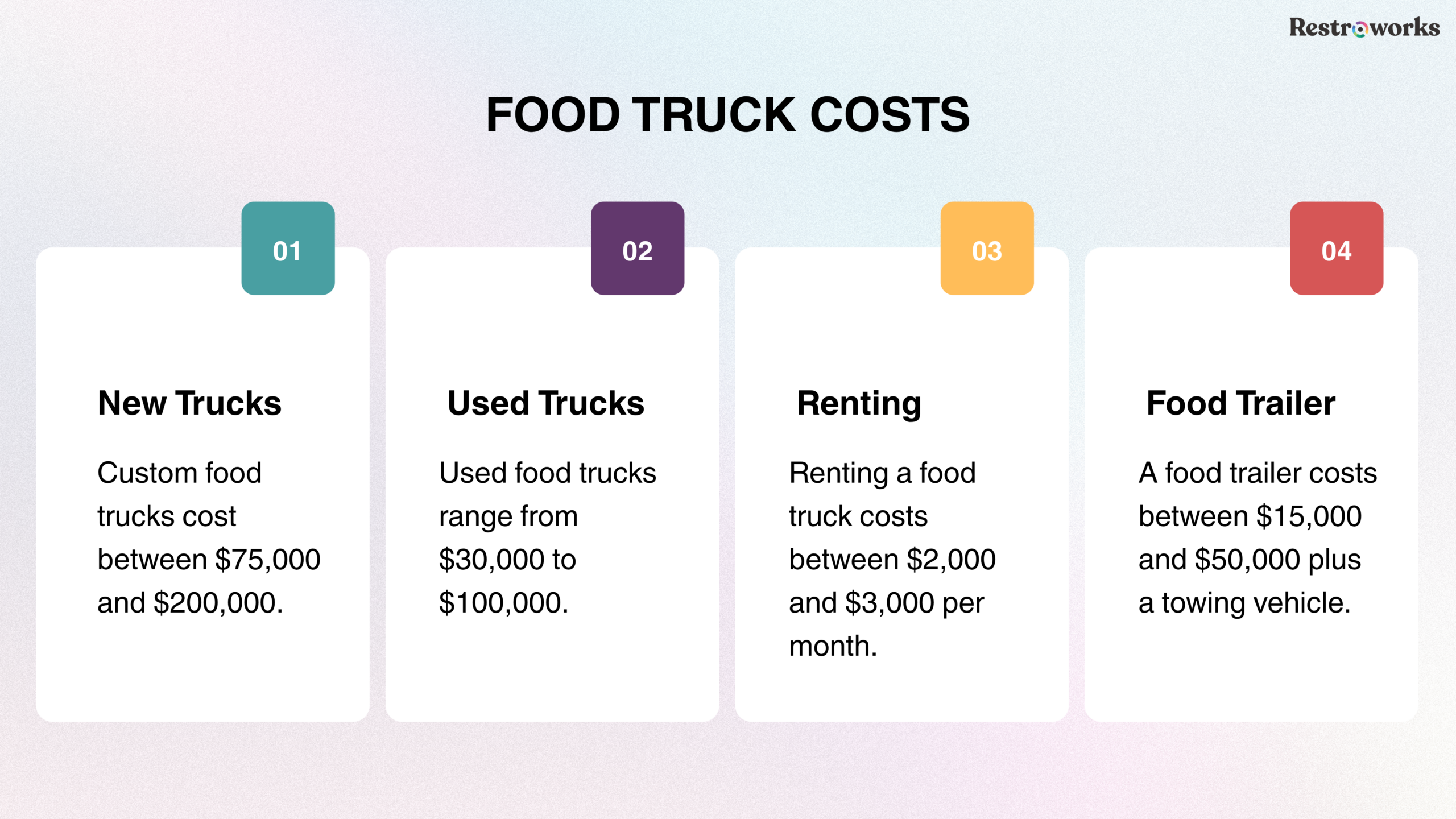
Initial Outlay The initial investment in a rented truck is low, with the average cost around $46,800. You might have to make a one-time deposit of a few months’ rent. You must buy the truck by paying all the money upfront. You can either pay for it, take a bank loan or purchase it. The average cost of purchasing a food truck in 2026 is around $109,500.
Ownership A rental truck belongs to its owner, and you cannot claim ownership. You have to vacate if the owner forces you to. When you buy a food truck, you are the food truck owner. You can make any decision to modify the truck independently.
Flexibility Rental trucks give you a lot of flexibility. You can shift your operations quickly because you don’t have much investment in it. If you want a better food truck or to open a restaurant, you can simply walk away from the rental agreement. You are bound to manage and maintain the truck with an owned food truck business. If you want to upgrade, you must stop your operations entirely and finish the repair. You cannot just walk away from your truck.
Repairs and Maintenance costs You need not worry about the food truck’s repair costs. The owner can have the truck repaired while you temporarily shift your operations. You are solely responsible for the repair work and maintenance expenditure. You have to close your operations or pay additional rent to shift your operations when the maintenance work is ongoing. It is not only cost-intensive but also requires your time and effort.
Recurring Expenses Rent is a significant recurring expense along with raw material costs. It does eat up into your profits. There are no significant food truck costs other than raw materials for an owned truck.  However, if your loan or hire-purchase, you need to pay the EMI regularly which can burden your profits.

Food Truck Startup Costs Breakdown

Let’s look at a summary of approximate estimated costs for two scenarios. This will help you decide whether to open a food truck in India or the US.

Save up to 20% on food costs with smart inventory and cost tracking—every dollar counts!

Cost Components of Food Truck Business India (in INR) US (in USD)
Rental Owned Rental Owned
Cost of the Truck 30 K – 50 K 8 L – 20 L 2 K – 5 K 30 K – 100 K
Equipment 2 L – 5 L 2 L – 5 L 10 K – 50 K 10 K – 50 K
Permits 50 K – 1 L 50 K – 1 L 500 – 5 K 500 – 5 K
Branding 50 K 50 K 1 K – 10 K 1 K – 10 K
Inventory 1 L – 1.5 L 1 L – 1.5 L 2 K – 5 K 2 K – 5 K

Food Truck Startup Costs Breakdown

Here is the estimated cost for total food truck costs, both initial and recurring.

Food Truck Costs Rental Truck Cost in India (in INR) Owned Truck Cost in India (in INR) Rental Truck Cost in the US (in USD) Owned Truck Cost in the US (in USD)
Total Initial Cost 3 L – 6.5 L 11 L – 26.5 L 11.5 K – 65 K 41.5 K – 165 K
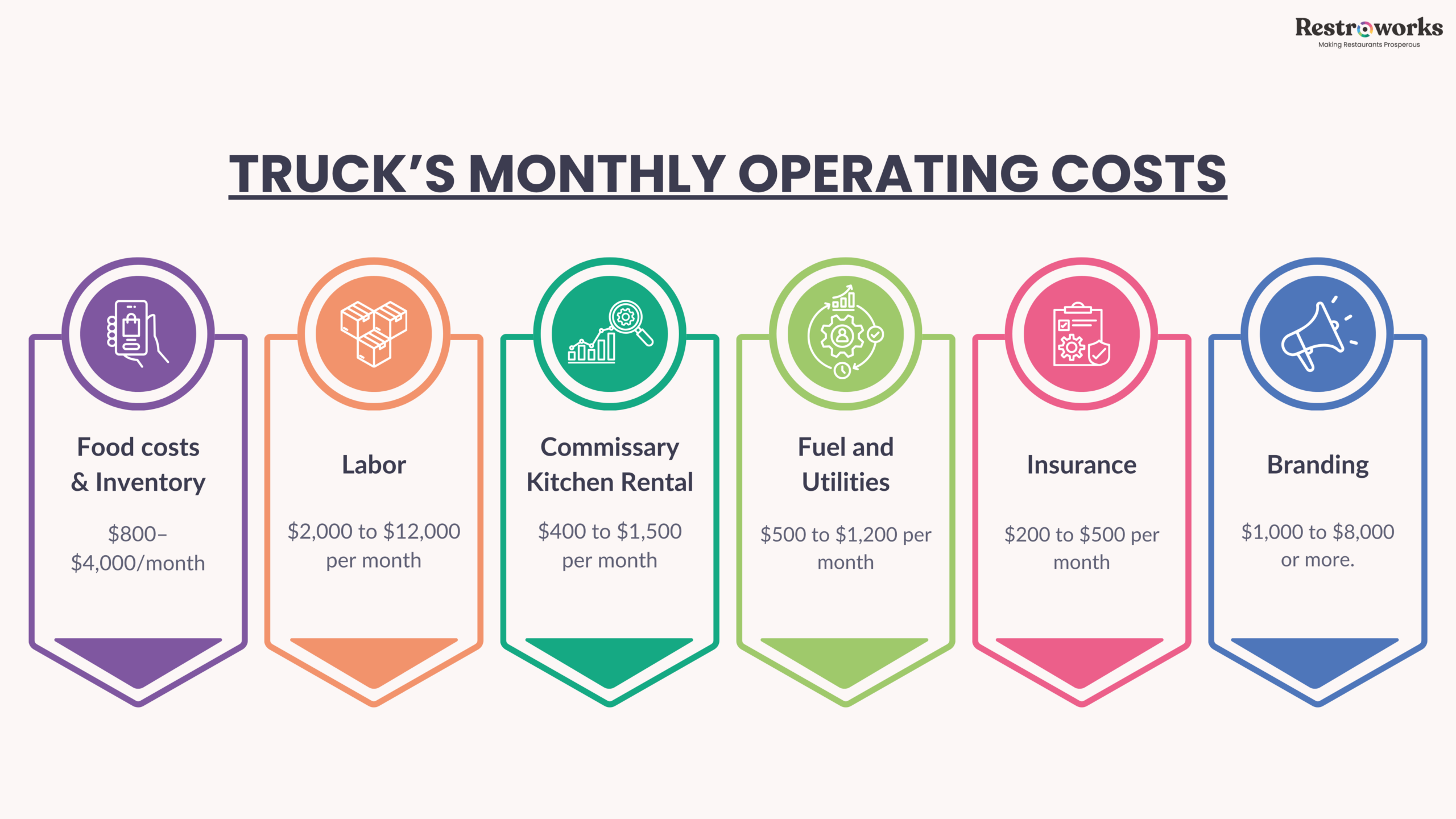
Total Recurring Cost 1.8 L – 2.3 L 1 L – 1.5 L 2.2 K – 10 K 2 K – 5 K

Components of Startup Costs for Food Trucks

Now that you understand how to analyze the food truck costs, let’s examine each component in turn.

Location

Choosing a suitable location for your food truck business is extremely important. Many variables for your business are affected by the location you choose:

    • High-traffic locations or dedicated food centers can ensure more footfall.

    • The rent cost for a prime location can be high.

    • There can be separate charges for special permits and parking fees in prime locations.

    • You might also want to set up your truck at carnivals, festivals, or fairs. This might cost extra money.

Food Truck Purchase and Renovation

The food truck itself is the most crucial expenditure that can make or break your food truck business. Whether you choose to buy or rent the car should depend on the cost-benefit analysis and the availability of resources.

    • Whatever you choose must be economically viable.

    • You can also buy a used food truck, which might need new equipment.

    • The truck should meet all the health and safety standards.

    • It should be compatible with your operational needs.

Equipment Costs

Purchasing food truck equipment is another significant cost. The kitchen equipment should fulfil all your requirements for preparing food. You can also decide to buy used equipment at a lower cost. However, it should be in good condition. Having the following equipment is essential for your food truck:

    • Cooking appliances

    • Refrigerators

    • Freezers

    • Storage compartments

    • Fire extinguishers

    • First aid kits

    • Utensils and crockery

Labor Costs

According to Bureau of Labor Statistics data analysis, food trucks drive fast employment growth in mobile food services.

While a food truck doesn’t require much staff, it is essential to hire at least a chef and an assistant to ensure that the operations run smoothly. Even if you take the chef role, you need at least 1 – 2 helpers.

Inventory

The target cost structure for food trucks includes food costs at 25-30% and labor costs at 20-30% of revenue. Depending on your menu, you need a range of ingredients, which accounts for a big part of the food truck’s cost. 

    • Some perishable ingredients need to be used and replaced quickly. 

    • You can stock other ingredients with a higher shelf life and replace them periodically. 

    • If you serve food in disposables, you should also maintain the inventory for it.

Marketing and Branding

Believe it or not, investing in marketing has become an inevitable cost. To run a successful food truck business, you should use the tools at your disposal and get traction:

    • You can design an attractive and eye-catching logo.

    • Allow multi-platform access to your services, including social media orders, third-party delivery apps, etc.

    • Brand your food truck.

Food Truck Licenses and Permits

To keep your business from legal troubles, you should spend a part of the food truck cost on obtaining the necessary food truck permit & licenses. It also helps customers to feel safer about coming to your truck. Although the cost depends on many factors like location, size of your truck, type of food you serve, etc., you should obtain the following:

    • Health licenses

    • Vehicle registration

    • Safety certifications

POS Software

POS (Point of Sale) software has become indispensable for managing restaurant operations. Investing in POS can help you streamline your sales and payment, even for a food truck business. You can also manage your inventory using POS systems and get detailed reports for making decisions. 

Utilities

One of the recurring expenses is the utilities you use to operate the food truck business for food preparation. They include:

    • Cost of Gas

    • Water connection

    • Electricity

However, you can use alternative energy sources, like solar panels on the top of the truck, to fund your electricity needs. This can help you reduce recurring expenses.

Insurance

Food trucks often face hazardous situations like fire. Buying insurance will protect you against the losses. You should purchase cover for:

    • Your business equipment and inventory.

    • The truck.

    • Employees and customers.

Miscellaneous Expenses

You should keep a separate budget for miscellaneous expenses. These are food truck costs that you can count as ancillary. These can include:

    • Uniform cost

    • Cleaning supplies

    • Menu board

    • Packaging

How to Choose the Best Location for Your Food Truck?

You should check the following points to choose the best location for your food truck business:

How to Choose the Best Location for Your Food Truck?

  • Choose the areas having high traffic and customer footfall like:
    • Markets

    • Food Parks

    • Office parks

    • Festivals

    • Carnivals

    • Book Fairs

    • Tourist Hotspots

    • Other prime locations
  • Choose a place that has reasonable rent and utilities costs.
  • The location should comply with the laws and regulations.
  • There should not be conflict between food vendors.

How to do Food Truck Marketing?

With technological advancements, it has become easy to market your ventures. Here are the tools you can use to promote your food truck business:

    • Establish a strong online presence.

    • Post shorts and videos about your food truck on Instagram, YouTube, etc.

    • Share the menu, location, offers, etc., regularly.

    • Update your followers about any changes.

    • Offer attractive discounts and loyalty programs.

    • Partner with local brands and influencers to add value.

    • Participate in competitions, food festivals, carnivals, etc.

    • Give back to society and promote your business.

Take a page from Kogi BBQ or Seoul Taco’s marketing playbook. Both these food truck brands started small, offering Korean-Mexican cuisine. Their marketing strategy included active use of social media for new product and location announcements. 

This led to a $2 million revenue for Kogi BBQ in the first year, while Seoul Taco’s opened its first physical space within a year and expanded to five restaurants and multiple food trucks eventually.

In the end…

There are both fixed and variable food truck costs. Various types of expenses are required to set up your food truck business. Right from the decision to rent or buy a food truck to raw materials and other operating costs, all should form a part of your planning. As they say, well begun is half done. You should carefully plan and budget the expenses for your food truck business before starting your venture.

Frequently Asked Question

The cost of starting a food truck business depends on many factors, including:

  • Location
  • Purchase or rental truck
  • Equipment cost
  • Operating costs
  • Licenses and permits

It is not all. Many other expenses contribute to this, so it is not possible to pinpoint the exact amount.

While it depends on your resources, plans, and priorities, renting a food truck is better for the short term. However, if you are looking long-term, you should prefer buying a truck.

Recurring expenses for a food truck business can include:

  • Staff salaries
  • Inventory
  • Utility costs
  • Insurance
  • Marketing

You can use social media for marketing your food truck business at nominal costs. Here are the strategies you can use:

  • Leverage social media platforms by regularly posting about your food truck.
  • Collaborate with influencers and local brands.
  • Create loyalty programs.
  • Offer attractive discounts.

Yes. You have to incur food truck costs to get some permits:

  • Vehicle Registration
  • Health Permit
  • Parking Permit
  • Business License

These requirements and costs can vary depending on the location of your truck.

Newsletter subscription banner

Talk to a restaurant expert today and learn how Restroworks can help your business.

Request Demo >

Share

Discover More Insights to Power Your Journey

How Luma Makhlouf Built a Multi-Brand F&B Business on Reputation Alone

The restaurant industry has a way of humbling people who come in from the outside. Luma Makhlouf, a Palestinian-American, finance-trained,…

Forecasting Special Events in Restaurants: Strategies to Predict Demand

Let me shoot you with some unpredictability: you just (right at the very moment) found out that there will be…

Forecasting for Quick-Service Restaurants: Improve Demand & Sales Planning

The US quick-service restaurant industry is huge and highly competitive. Since restaurant owners operate under slim margins, there is very…

AI-Powered Forecasting in Restaurants: Smarter Demand Predictions

Just enter any restaurant during the weekday lunch hour, and you will find some empty seats. When you come back…

Impact of Weather on Restaurant Forecasts: How Weather Affects Demand

You forecast your restaurant demand because it's meant to reduce uncertainty. You look at past data, identify patterns, and plan…

Key Metrics for Forecasting Restaurant Demand: Essential KPIs Explained

Running a restaurant means you have a lot of important information at your disposal—sales reports, covers, table turns, online orders,…

Join. Learn. Grow.

Sign up to receive the latest hospitality insights and stories straight to your inbox

Streamline your operations with Restroworks