Influencer marketing for franchise restaurants helps chains build local awareness and attract customers through trusted voices in each market, while maintaining a consistent brand identity across locations.
For franchised restaurant chains, it sits at the crossroads of brand consistency and localization, which can be hard to reconcile at times but, when done right, can create some of the most successful customer acquisition and brand recognition campaigns that restaurant franchisors can implement.
Traditional advertising informs the target customers about your product. Influencer marketing introduces it in a familiar, trustworthy, and authentic way. Influencer marketing can yield an average return of $6.50 for every $1 spent, making it a cost-effective strategy for franchises looking to drive sales and brand recognition.
Social media influencers can boost franchise restaurant brand awareness and engagement by leveraging trusted local voices to create authentic, relatable content. According to Fortune Business Insights, the global influencer marketing industry was valued at $23.59 billion in 2025 and is projected to reach $89.90 billion by 2034, at a CAGR of 15.90%, and restaurant brands are among its most active niches.
For restaurant franchisors, influencer marketing offers an opportunity to engage local audiences at each franchise location while maintaining brand consistency.
What You Will Learn
- Influencer marketing techniques for franchise restaurants, both nationally and locally
- The selection process of appropriate influencers for your business and market
- Strategies for working with influencers through campaigns and building up relationships for better performance
- The metrics that should be used to measure the effectiveness of your campaign
Why Influencer Marketing Works for Franchise Restaurants?
Influencer marketing works for franchise restaurants because it combines visual content, audience trust, and social proof to influence decisions, something traditional marketing methods can’t offer.
Unlike traditional advertising, which communicates a brand’s message directly, influencer content lets potential customers see menu items, explore the dining experience, and hear recommendations from creators they already follow.
Restaurant influencer marketing lets restaurant franchises reach new customers, drive traffic, and build interest in promotions. Franchises can market nationally and locally, tailoring the same campaign to different locations.
Here are some of the key benefits for restaurant franchises:
- Build local brand awareness: Reach potential customers through creators who already have an audience in the outlet’s trading area.
- Showcase the dining experience: Use food reviews, user-generated content, short videos, and behind-the-scenes content to bring menu items and restaurant experiences to life.
- Promote offers and launches: Give local audiences a reason to try a new menu item, visit a recently opened location, or redeem a limited-time offer.
- Maintain brand consistency: Provide creators with approved messaging, visual guidelines, and campaign objectives while allowing them to adapt the content to their local audience.
Micro-influencers, who are creators with 1,000 to 100,000 followers, can be more effective for localized campaigns than macro- or mega-influencers. Nano-influencers, with smaller followings, can also be valuable when their audience is concentrated in the communities surrounding a franchise location.
The right creator tier depends on whether the goal is broad awareness or local engagement. Restaurant industry benchmarks can help inform the decision, although engagement rates vary by platform and are not a guarantee of restaurant visits or sales.
In the U.S., micro-influencers on Instagram recorded a median engagement rate of 0.79%, compared with 0.56% for macro-influencers, according to Click Analytic’s 2026 creator market study.
For franchise brands, combining local creator posts with clear campaign guidelines makes it easier to connect with individual communities without losing the consistency customers expect across locations.
Watch: Restaurant marketing trends in 2026
How to Increase Franchise Opportunities with Brand Awareness Campaigns?
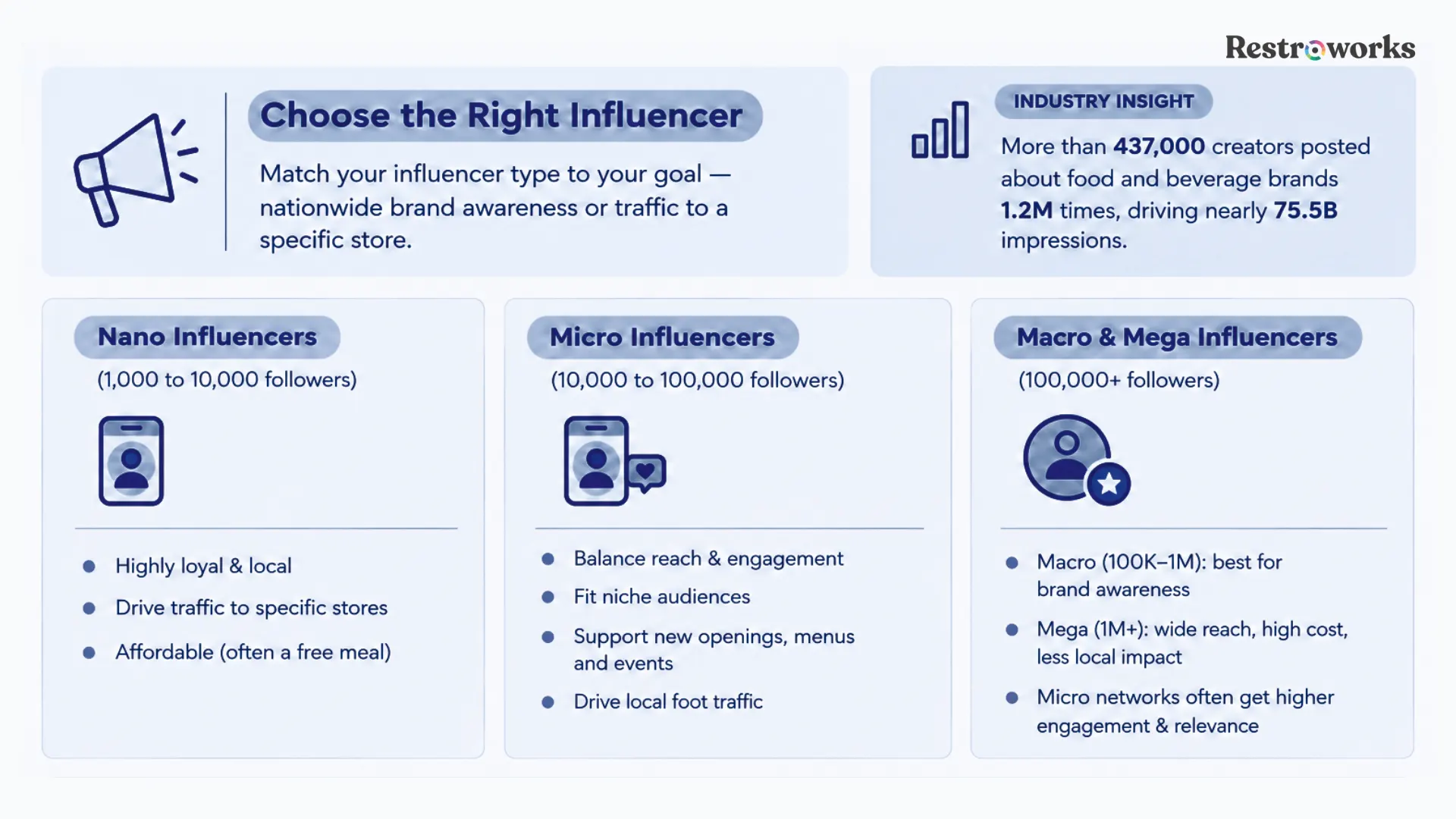
Choosing the right influencer category for your franchise’s marketing goals is the foundation of successful influencer marketing campaigns, and it depends on whether you are planning a nationwide brand awareness campaign or trying to drive traffic to a specific franchise store.
Partnering with local nano-influencers (1k–10k followers) and micro-influencers (10k–100k followers) can drive traffic to specific franchise locations.
| Influencer tier | Typical follower range | Potential campaign for franchises |
|---|---|---|
| Nano | 1,000-10,000 | Promote an outlet to a neighborhood or niche audience |
| Micro | 10,000-100,000 | Increase brand awareness and showcase menu items |
| Macro | 100,000- 1 million | Support regional campaigns or multiple-location launches |
| Mega | Over 1 Million | Generate broad awareness for national campaigns |
Nano Influencers (1,000 to 10,000 followers)
Nano influencers have very few followers, but they are incredibly loyal and localized. In franchise influencer marketing that activates individual locations, nano influencers in the immediate trade area help engage the local community. They’re affordable to collaborate with and can be paid with a free meal in exchange for an honest post.
Micro Influencers (10,000 to 100,000 followers)
Micro-influencers, with 10,000 to 100,000 followers, are often the most commonly used type of influencer because they balance reach and real engagement, specializing in specific niches that align well with brands.
Micro influencers are a strong fit for a franchise influencer marketing strategy because of their reach and audience engagement. They can support activations such as new location openings, seasonal menu launches, and event promotions. Their recommendations appear more authentic and are better at driving local foot traffic to specific franchise locations compared to celebrities
Food and beverage content is especially active on social platforms. Sprout Social’s 2024 Influencer Marketing Benchmarks Report recorded more than 11.5 million influencer posts in the food and drink category in 2023, with an average engagement rate of 1.19% across the category.
Macro and Mega Influencers
Macro-influencers (100,000–1 million followers) are best suited for brand awareness campaigns, such as launching a new franchise concept or running a nationwide promotion. Mega influencers (over 1 million followers) offer nationwide exposure at a high cost and limited local relevance for marketing a franchise restaurant.
In most franchise restaurant marketing strategies, spending the same amount on a micro-influencer network yields higher engagement and relevance with local audiences than hiring macro or mega influencers.
Brands often use a mix of influencer types, including mega-influencers (over 100,000 followers), macro-influencers (10,000-100,000 followers), micro-influencers (1,000-10,000 followers), and nano-influencers (fewer than 1,000 followers), to balance reach and authenticity.
INDUSTRY INSIGHT
More than 437,000 creators posted about food and beverage brands more than 1.2 million times, driving nearly 75.5 billion impressions.
Influencer Campaigns: What Is Your Influencers’ Work and How to Identify the Right Influencers for Your Franchise
Your influencers’ work is to create authentic, local content that turns their followers into diners at a specific franchise location.
This has a direct effect on footfall. A 2025 survey by MGH found that 58% of users have visited a restaurant after seeing it on TikTok, up from 38% in 2022, and 56% traveled farther than usual to visit a restaurant they saw.
That’s why finding the right influencers depends on factors beyond follower count, including audience fit, high-quality content production, and genuine affiliation with the dining and food category.
Influencers appropriate for your franchise restaurant marketing campaign have a number of traits in common:
- Their audience matches your potential customers based on demographic factors and location, as well as interests
- They have a track record of being genuinely interested in food, dining, or lifestyle content
- Their engagement rates are based on genuine relationships and interaction with followers, not the purchase of fake followers
- Their content style matches your brand guidelines.
When running social media influencer campaigns for your franchise restaurants, use multiple local influencers, one or two per franchise restaurant, instead of a single influencer for all markets.
Otherwise, you won’t achieve local relevance, and multiple nano/micro influencers in each location will drive more locally relevant traffic than a centralized campaign with national influencers.
The numbers support this approach. Smaller creators cost far less per post and get much higher engagement:
| Influencer tier | Median engagement rate | Median cost per sponsored post | Median reach per post |
|---|---|---|---|
| Nano | 6.7% | $480 | 1,840 |
| Micro | 3.9% | $1,840 | 21,400 |
| Macro | 1.4% | $24,700 | 274,000 |
| Mega | 0.9% | $87,400 | 1,420,000 |
The same study found that micro influencers deliver the lowest cost per acquisition of any tier, because their conversion rate is higher than nano influencers’. That makes a network of micro and nano creators, one or two per location, the most efficient setup for most franchises.
Influencer Partnerships: Structuring Collaborations for Brand Consistency and Creative Freedom
Structure franchise-influencer partnerships by fixing a short list of brand non-negotiables and giving influencers full creative control over everything else. This keeps every location on-brand while letting the content read like a genuine recommendation rather than an ad.
To make franchise and influencer partnerships successful, it is necessary to find the balance between two opposite aspects: the need for clear rules regarding brands that would ensure brand consistency within the franchise chain and the need for enough creative freedom to create organic content and generate buzz that will be well-received by the audience of the influencer.
Influencer content that looks like an advertisement is much less effective than content that comes from a recommendation. When developing an influencer brief, clearly define which brand elements must be included, but leave all creative aspects to the influencer.
In a survey, 43% of consumers respond more favorably to influencer marketing than traditional advertising in the restaurant sector.
In your influencer brief, your expectations should consist of the following:
- The purpose of the campaign,
- The franchise store or product in question,
- Mandatory messaging,
- Brand guidelines that must be followed,
- Proper disclosure requirements (the influencers must clearly disclose as per the FTC guidelines),
- Delivery deadline,
- Usage rights, and
- Measures of a successful campaign.
Creating a collaboration brief that outlines clear expectations, deliverables, and campaign goals is essential for successful influencer partnerships. Building brand ambassadors by collaborating with the same influencers over several months makes endorsements feel more genuine.
Influencer Marketing Campaigns: Campaign Structures That Generate Results
Franchise influencer marketing campaigns work best when built around a specific objective with clear success metrics, rather than launched as general brand-awareness activities with no defined outcome.
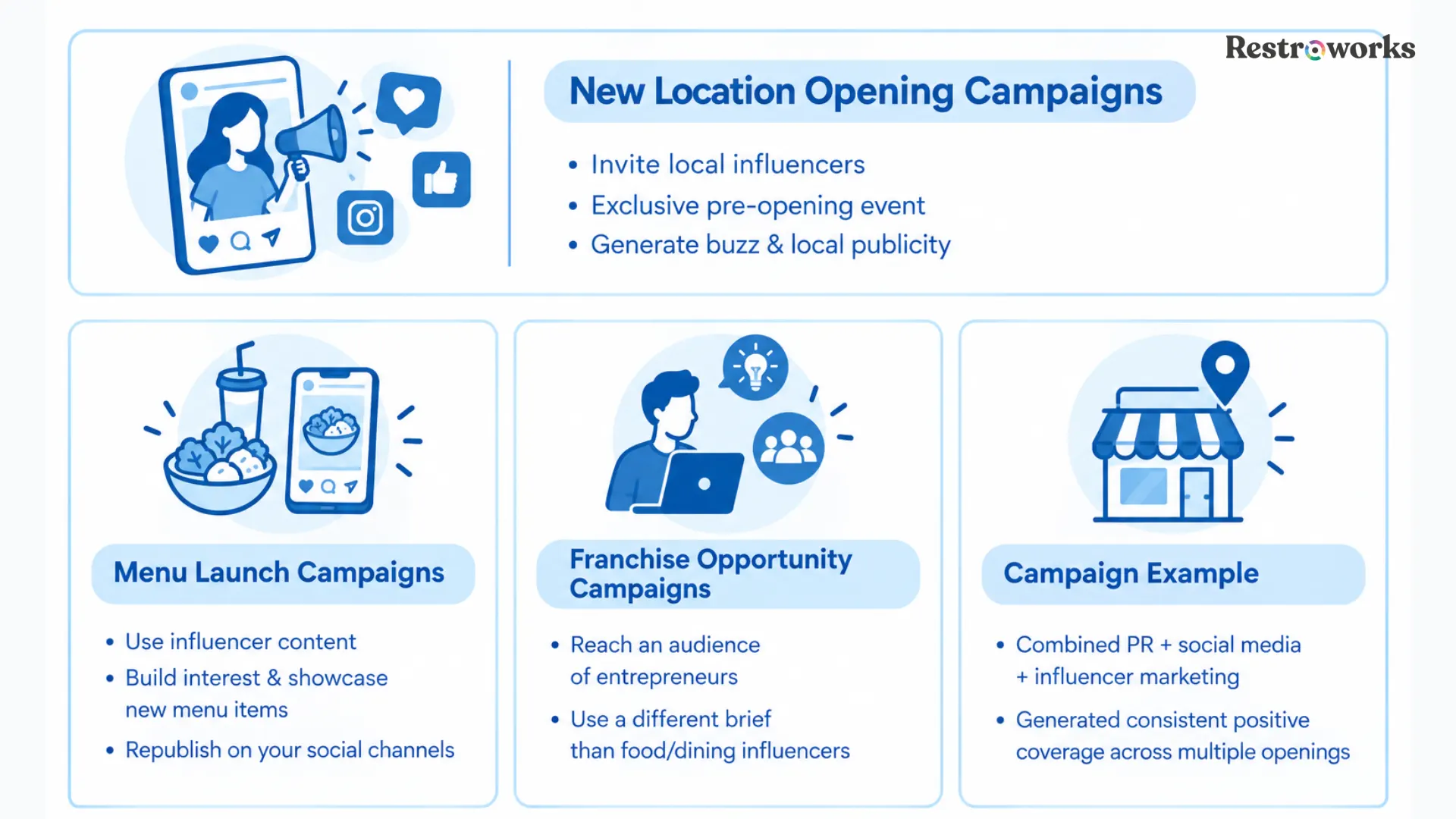
New Location Opening Campaigns
New franchise locations are one of the most organic uses of restaurant influencer marketing campaigns. By inviting local influencers, food and lifestyle creators with strong local influence, to an exclusive pre-opening event, you ensure a flurry of authentic content created as your new location introduces itself to locals.
You can’t achieve this kind of buzz, social media coverage, brand visibility, and local publicity through paid advertising in the same amount of time.
Menu Launch Campaigns
Launching new menu items requires influencer-generated and sponsored content to build interest and showcase the food creatively. Restaurant reviews and taste tests of new menu items by micro-influencers in the target market build interest and drive desire to try the dishes, especially if something about them is unique.
The brand can republish content created by the influencer during the campaign on its own social media platforms.
Franchise Opportunity Campaigns
Franchise development marketing uses influencer marketing techniques to reach an audience of entrepreneurs. This influencer isn’t the same as those in the food and dining industry; therefore, the brief must be different.
Linhart PR developed an integrated public relations and social media strategy for Chipotle to generate excitement for multiple locations in a competitive media market. The campaign combined traditional PR tactics with social media amplification and influencer marketing to maintain consistent positive coverage across numerous openings.
Campaign Success: Measuring Influencer Marketing Performance
To effectively measure the success of influencer marketing campaigns, brands should track key metrics such as engagement rates, website traffic, and direct conversions through unique promo codes or landing pages. Successful influencer marketing for franchise restaurants relies on balancing broad brand consistency with highly localized, compelling content.
Setting this up before launch is also important, because attribution is where most brands struggle. In Linqia’s 2026 State of Influencer Marketing report, 79% of marketers said they struggle to measure ROI, and 48% named attribution as the biggest gap in their measurement.
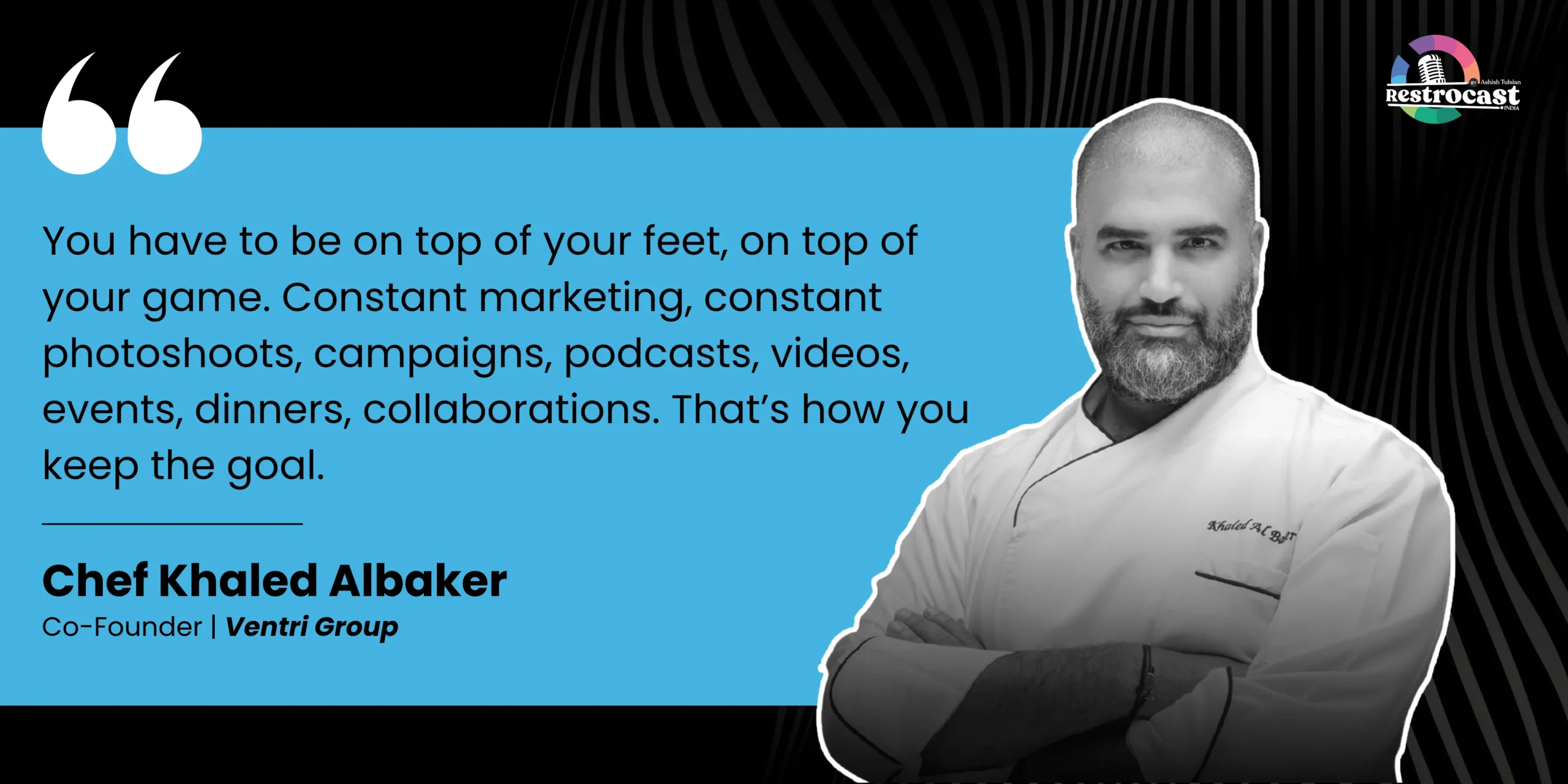
Chef Khaled Albaker, Co-Founder of Ventri Group, advises everyone on the Restrocast to stay on top of their marketing.
Key Metrics for Franchise Influencer Marketing
The major influencer marketing campaign performance evaluation parameters for franchises include the following:
- Reach,
- Engagement rate,
- Footfall increase,
- Booking/Reservation increase,
- And an increase in followers on the franchise locations’ social media accounts due to influencer activities.
Any URLs used in campaigns should have Google Analytics UTM parameters added to measure website traffic and online order conversion resulting from influencer content.
Post metrics such as reach and engagement rate can be obtained from Instagram Insights and TikTok Creator Marketplace. The influencer can add up metrics from all posts to measure total reach and engagement from the entire campaign.
Campaign performance should always be measured against pre-set benchmarks for the campaign type prior to the launch of a campaign, not benchmarks created after-the-fact. Set the target cost per thousand, engagement rate, and foot traffic uplift as a percent for each campaign type.
Influencer Relationships: Building Long-Term Partnerships That Compound Over Time
The most effective influencer marketing programs for franchises are built on long-term relationships with a specific set of influencer partners; this isn’t about engaging different influencers for an opportunistic one-time post in each new campaign.
Leading brands have already made this shift: according to Later’s 2025 State of Influencer Marketing report, 70% of leading brands now prioritize ongoing creator partnerships over one-time activations.
Most of the market hasn’t caught up yet, though. The Influencer Marketing Factory’s Brand Deals Report 2026 found that an average of 63% of US brand-influencer relationships are one-off, which gives franchises that commit to long-term partners a clear edge.
Long-term influencer relationships will have cumulative benefits. An influencer who builds a long-term relationship with your brand creates authentic content that reflects a genuine connection, not just a transaction. His audience becomes familiar with the brand, making them more likely to convert after seeing a post featuring it.
You can build these kinds of relationships by treating your influencer partners as collaborators and not just service providers, giving them access to new products of your franchise, sharing results of campaigns with your influencer partners, and communicating with them not only when you need some new activation but all the time.
These people who sincerely love your product are your most valuable marketing tool.
KEY TAKEAWAYS
- Micro-influencers deliver the highest engagement rates and the most relevant local audience for marketing a franchised restaurant.
- Brand guidelines need to be clear but also allow for creative flexibility.
- Measure influencer campaign success with key metrics from the outset; reach, engagement rate, foot traffic increase, and online order conversion rate are key for franchise influencer marketing.
- The value of authentic partnerships with influencers grows the longer they last; long-term partnerships where the influencer is genuinely connected to your franchise brand produce more authentic content and better conversion.
Frequently Asked Questions
1. How does influencer marketing work for franchise restaurants?
Influencer marketing involves working with local food creators to promote a restaurant’s offerings through social media content.
2. How much does influencer marketing cost for a franchise restaurant?
It can be as cheap as providing meals for micro-influencers or as expensive as a couple hundred or a thousand dollars per campaign.
3. How do you find local food influencers for franchise locations?
You can find them on Instagram, TikTok, and YouTube by searching local food hashtags, looking at competitor collaborations, and using influencer marketing sites.
4. What results can franchise restaurants expect from influencer marketing?
Franchise restaurants can expect increased local awareness and engagement, traffic, online orders, and sales.
5. What legal considerations exist for franchise restaurant influencer partnerships?
Ensure clear advertising disclosure, comply with relevant advertising and consumer protection laws, obtain permission to use content, and follow franchise brand guidelines.
6. How do you create an influencer marketing contract for restaurant partnerships?
Deliverables, payments, deadlines, disclosure policies, content usage, metrics, exclusivity, and cancellation clauses should be outlined.