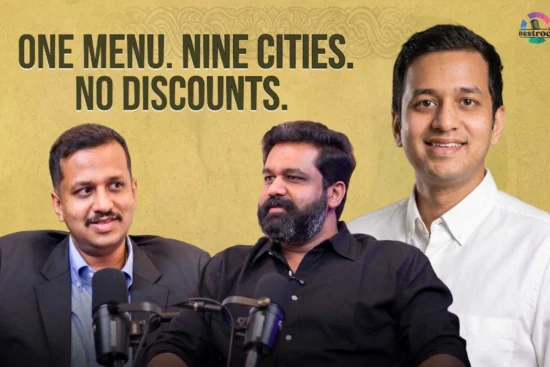


In this interview, Ashish Tulsian speaks with Sudhin Siva, Chief Asset Management Officer at Shamal, about the career moves and operating principles that shaped his leadership across hospitality and food and beverage. From his early corporate role at Jumeirah to building an owner-side perspective and scaling brands without dilution, Sudhin reflects on how his thinking evolved, from execution to enablement, and what that means for building high-trust teams.
Sudhin, what do you do today at Shamal, and what brands are you running across F&B?
Sudhin Siva: I am the Chief Asset Management Officer at Shamal. Shamal is a diversified investment holding company, so my role is to oversee and grow assets across hospitality and F&B, maritime businesses like marinas, and our leasing portfolio across retail, residential, and commercial, while also supporting future real estate planning.
On the F&B side, we run a strong portfolio: we are the UAE franchise owner for Five Guys; we own Sushi Samba globally, operating some locations directly and licensing it in select markets; we operate Duck and Waffle in London; we acquired Espresso Lab in the UAE and are expanding its roastery capacity and retail footprint; and we have Zero Gravity, one of Dubai’s original beach clubs, which we are relocating and evolving with new programming.
What did you start as in Jumeirah?
Sudhin Siva: I took a corporate role in quality management, planning, and strategy, deliberately. It gave me exposure across the business: restaurants and bars, rooms, operations, distribution, loyalty programs, and more. At that age, you want to absorb as much as possible. A central role helped me understand how the whole system fits together.
What fundamentals from those formative years still guide you?
Sudhin Siva: Two things stand out. First, hospitality can be very regimental: you get instructions, and you execute. I used to believe that was the right way, but I found collaboration works better. When you bring people in, ask what they think, and work as a team, you get better outcomes than ordering people around. That approach has stayed with me throughout.
Second, you can do a lot of gimmicks in hospitality, design, experiential dining, and theatre. But if you do not get the basics right, you fail. In restaurants, food quality and presentation are the basics. In hotels, basics like a great bed, good coffee, a good shower, and a strong breakfast matter more than fancy marble. Innovation is great, but the basics are non-negotiable.
Everyone says “customer experience matters.” How do you make the human element real, especially at scale?
Sudhin Siva: It comes from culture and empowerment, not just SOPs. You can prescribe consistency, but the extra touch cannot be manufactured. It has to come from the heart, and that comes when values are strong and people feel trusted.
A simple example: we run Five Guys in the UAE. I knew an ex-colleague’s son visited the same outlet every year on his birthday. I only told my operations head that it was his birthday, and it might be worth doing something special. The team went beyond expectations: they organized a cake, created a moment around it, prepared for his arrival, and made it memorable. That kind of care spreads, because when people see it, they want to replicate it.
You moved from the management company side to the owner side. What changed in how you understood the business?
Sudhin Siva: Jumeirah gave me a deep understanding of how a hotel management company and a large organization work. Over time, I also worked on development, which exposed me to owners and how differently they think.
When I moved to Meraas, I was working for the owner of the assets, not the brand, managing them. That shift helps you see both perspectives clearly. Owners often have financial objectives and sometimes “trophy asset” motivations, while management companies also think about brand equity and long-term brand value. Making partnerships work requires bridging those objectives with trust and collaboration. You need a real win-win, and getting there is not always straightforward.
Can you explain that owner versus management company difference in one clean idea?
Sudhin Siva: Management companies can sometimes take a longer view, even absorbing short-term negatives to build brand equity. Owners feel performance at the unit level, so the downside is immediate and tangible. That is why bridging the gap takes discussion, trust, and collaboration. The goal is to optimize an asset to its best capability without “over plundering” it. Sometimes that means reinvesting, like refurbishing outlets, to protect consistency and longevity rather than extracting short-term gains.
When you acquire or back a brand, how do you scale without diluting what made it special?
Sudhin Siva: The reason you acquire a business is that someone created something attractive. Our role is not to disrupt the creator’s process. With Espresso Lab, for example, Ibrahim is the creative mind, and we want him to keep driving product quality, R&D, and the front-facing brand. Shamal supports growth through back-end infrastructure, governance, and scale support. It is the same principle as Sushi Samba: there is a capable management team, and we do not want drastic changes that dilute what works. Our job is to facilitate growth and consistency at scale.
Give me an example of partnership-driven innovation with an international brand.
Sudhin Siva: In Dubai International Airport Terminal 3, we explored a licensed concept for Five Guys, meaning alcohol licensing. That was not typical for the brand. But we aligned with them, explained the location context and the value, and they supported it. Similarly, deliveries were tested collaboratively and later scaled across markets once the model proved itself. The point is, you do not force change onto a brand. You collaborate, pilot thoughtfully, and scale what works.
Dubai is one of the most competitive F&B markets. What actually makes a concept win here?
Sudhin Siva: You have to focus on the core experience: food and beverage quality first. Design and experiential elements help, but repeat customers build the business. Then you have to understand micro markets within micro markets: pricing, accessibility, location behavior, customer routines, and how the concept fits a community. We spend a lot of time studying this before committing to locations, and every launch teaches you something new.
You mentioned personal growth over the last decade. What changed most in your leadership style?
Sudhin Siva: Early on, I did a lot myself because I wanted everything perfect and wanted to do the final check. Over time, I learned delegation and trust. Trust takes time, and it is easier when you have long-term colleagues and strong two-way relationships. I also learned that I do not have all the answers, so listening more matters. Today, my role is often to provide guidance early and enable teams to do things better than I did.
What advice would you give aspiring hospitality professionals who want to build a career like yours?
Sudhin Siva: Use your early years to learn deeply. University gives you access to knowledge and mentors, with the time that you will not have later. Also, be patient. Hospitality takes time to grow in. Do the grunt work and understand every level of the operation. I have done bar work, cleaning, inventory, floors, all of it. If you do not understand what people at the ground level do, you cannot lead them well. Patience, persistence, hard work, and using the learning window early are the biggest differentiators.
Conclusion
Sudhin’s journey across hotel management, ownership, and asset management reinforces a simple truth: hospitality rewards those who master the fundamentals, build trust-driven teams, and scale brands through collaboration rather than control. Whether it is elevating guest moments, aligning owners and operators, or expanding iconic concepts without dilution, the work comes back to consistency, reinvestment, and doing the basics exceptionally well.