

Expansion sounds exciting when your first location is doing well. And why not? Your sales are strong, customers love the food, and the brand is going viral online. But this is also where things get trickier.
You see, restaurant expansion has a way of exposing gaps that you weren’t aware of. The moment you open a second location, you may see cost inefficiencies, inconsistent quality, or even mismanagement. So, what works in one location may not always work across multiple units.
That is why you need a strategic approach to restaurant chain expansion with replicable systems, strong financial planning, and a deep understanding of your market. This guide breaks down various restaurant chain expansion strategies and how to approach them for rapid growth.
What you will learn
- Factors to look at when planning a restaurant expansion strategy
- The various restaurant expansion models to explore based on your goals
- Step-by-step process of restaurant chain expansion
Is Your Restaurant Ready to Expand?
There are 143,000 businesses in the Chain Restaurants industry in the United States, which has grown at a CAGR of 2.2% between 2021 and 2026.
Expanding your restaurant is a strategic decision, one that comes with serious financial, operational, and competitive challenges. You may see a full-house restaurant or a few good months of revenue and think it’s time to expand.
In fact, sales for the top 500 chain restaurants in the U.S. restaurant industry surpassed $450 billion in 2025, which can be a motivating factor for you to expand. But can your current restaurant perform the same way under the pressure of growth? Are you truly ready for the leap?
Before planning a successful restaurant expansion strategy, assess your restaurant on the following basis-
1. Financial Performance

Your financial stability and performance are the biggest indicators of whether you’re ready to expand your restaurant or not. If your restaurant’s books show stable sales growth and profits over the past year or more, expansion can be a good idea.
However, looking at only revenue isn’t enough. Cash flow and capital investment are equally important. You need enough capital and operating surplus to support a new outlet without affecting existing operations.
A simple way to assess this is to ask yourself: can your current restaurant business cover at least 30-40% of the new outlet’s setup cost through internal accruals?
2. Operational Efficiency and Readiness
Running a single location is already complicated. Add in more outlets to the mix, and your operations become increasingly complex. Which means that if your current locations run well only because of constant supervision, scaling will create inconsistencies across locations.
So, start by evaluating if your team and operations are prepared for growth-
- Are recipes, portion sizes, and prep methods documented and followed consistently?
- Do you have clear SOPs for service, kitchen operations, and inventory handling?
- Can you train a new team using structured programs instead of shadowing?
Restaurant expansion requires you to create and document repeatable processes and onboarding systems to ensure that every outlet performs the same way. As you add outlets, a dedicated restaurant chain management system makes it far easier to standardize and replicate these processes across locations. As Kamran Khan, CEO of Arabian Entertainment Co. Ltd., puts it, “Standardization is the biggest thing… I don’t strive to be the best. But I strive to be consistent.”
Hattan Bakor, former CEO of Dhahia Juice and Abu Zaid, doubles down on being operationally ready as well. In a conversation on Restrocast, he mentions, “You have to have a brand that is stable at least for five years because in our market, we’ve seen a lot of brands just pop out and shine and suddenly disappear because people are looking for new experiences. If you don’t have something solid enough to maintain and retain these loyal customers, you’ll be out of business.”
3. Customer Experience and Demand
Strong customer demand for your existing restaurant is another signal that expansion could work. But only if it is consistent. Think about it. Are customers coming back frequently? Are they bringing others? Does your restaurant drive steady footfall without relying heavily on discounts or promotions?
If demand consistently exceeds your current capacity, restaurant expansion is a smart way to capture new opportunities and target new locations.
Key Factors to Consider Before Building a Restaurant Expansion Strategy
Another thing to do before you move ahead with expansion is to step back and evaluate your position clearly.
A structured SWOT analysis, which examines your strengths, weaknesses, opportunities, and threats, can help ground your decisions in reality. It forces you to assess where your brand can perform well or where it might struggle in a new market.
1. Target Market and Customer Demand
Understanding your existing and potential customers is a great starting point to see what worked for your restaurant and what more you can do at the new location.
For this, use your point-of-sale data to identify sales patterns and best-selling menu items to understand customer demographics, behavior, and dining habits.
You can also talk to them about any changes or suggestions they may have for the new location. This will help you meet customer expectations more effectively.
2. Market Competition
Study existing players closely with a comprehensive SWOT analysis. Evaluate their pricing, positioning, menu item variety, and customer loyalty to identify opportunities for your restaurant to offer something new.
At the same time, focus on any challenges that you may encounter if you expand your restaurant into a new market.

3. Changing Trends
Customer preferences evolve quickly. Whether it’s health-focused menus, regional flavors, or convenience-led formats, staying on top of relevant trends is a strong entry strategy.
But also remember that not every trend is worth adopting. Simply focus on what fits your brand and what your target customers will actually pay for. Short-lived trends can create noise, while the right ones can help you remain competitive and relevant over time.
4. Compliance Requirements
Licensing, food safety requirements, and local regulations differ by region. Missing these details can delay launches or increase costs. You also need to account for ongoing compliance as your operations continue.
Since regular inspections, documentation, and renewals will only become harder to manage as you scale, having clear compliance processes in place from the beginning reduces operational risk.
5. Legal and Tax Structure
Your business structure affects taxation, ownership, and scalability. Choosing the right business entity structure — sole proprietorships, partnerships, LLPs or LLCs, private limited or corporate structures — helps avoid complications as you expand your restaurant into multiple locations.
It also helps you manage risk, structure ownership across outlets, and handle compliance as you grow.
Many hospitality groups also move toward more structured setups, such as holding companies or separate entities for each outlet as they grow, because it helps manage risk and streamline finances across locations.
Restaurant Chain Expansion Strategies and Models
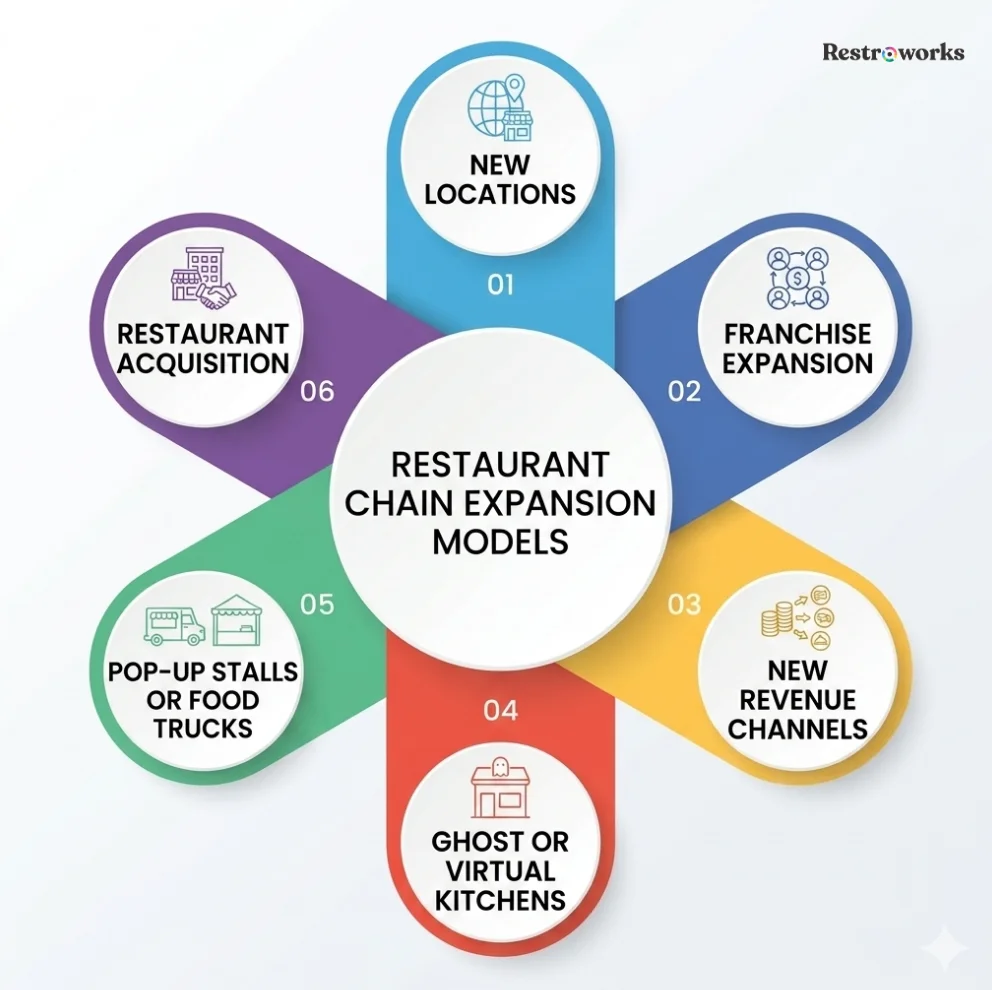
Before you choose how to grow, decide what restaurant expansion looks like for your food business. More locations are a good way to scale, but it’s not the only one. For some brands, expansion means entering new cities. For others, it’s about increasing revenue per outlet or adding revenue streams.
The right approach depends on your capital, operational maturity, brand strength, and your team. Let’s explore the major restaurant chain expansion models and strategies for your business-
A. Expanding a Restaurant to New Locations
Starting with the most common model, opening new outlets is a good strategy if you have strong unit economics and brand recognition. In fact, so many restaurant owners plan to open 20% more new locations in the next two years than during the last two, despite 73% being concerned about economic conditions.
Why? Location expansion not only gives you direct control over the new outlet’s operations, staff, and customers, but it is also a good way to boost profitability.
However, while it is the most direct form of expansion, it’s also the most resource-intensive. Launching a new restaurant site requires high capital investment in rent, staffing, interiors, and equipment. As a result, you’ll need-
- A solid restaurant business plan
- Repeatable and scalable processes, from menu and kitchen prep to staff training
- A loyal customer base to encourage visits to your new location
B. Consider Franchise Expansion
If you don’t mind losing direct control over new locations, franchising is the way to go. With a new franchise opening every 8 minutes and over 3000 unique franchises in the U.S., this is a growing business model that allows you to expand quickly with low capital investment.
In a franchise model, you can delegate the outlet management to someone else and get access to regular cash flow through the franchise fee. It’s most effective when your brand, processes, and training systems are already well-defined with detailed brand guidelines and clear quality and compliance standards.
Talking about franchising a brand, Hattan Bakor shares-
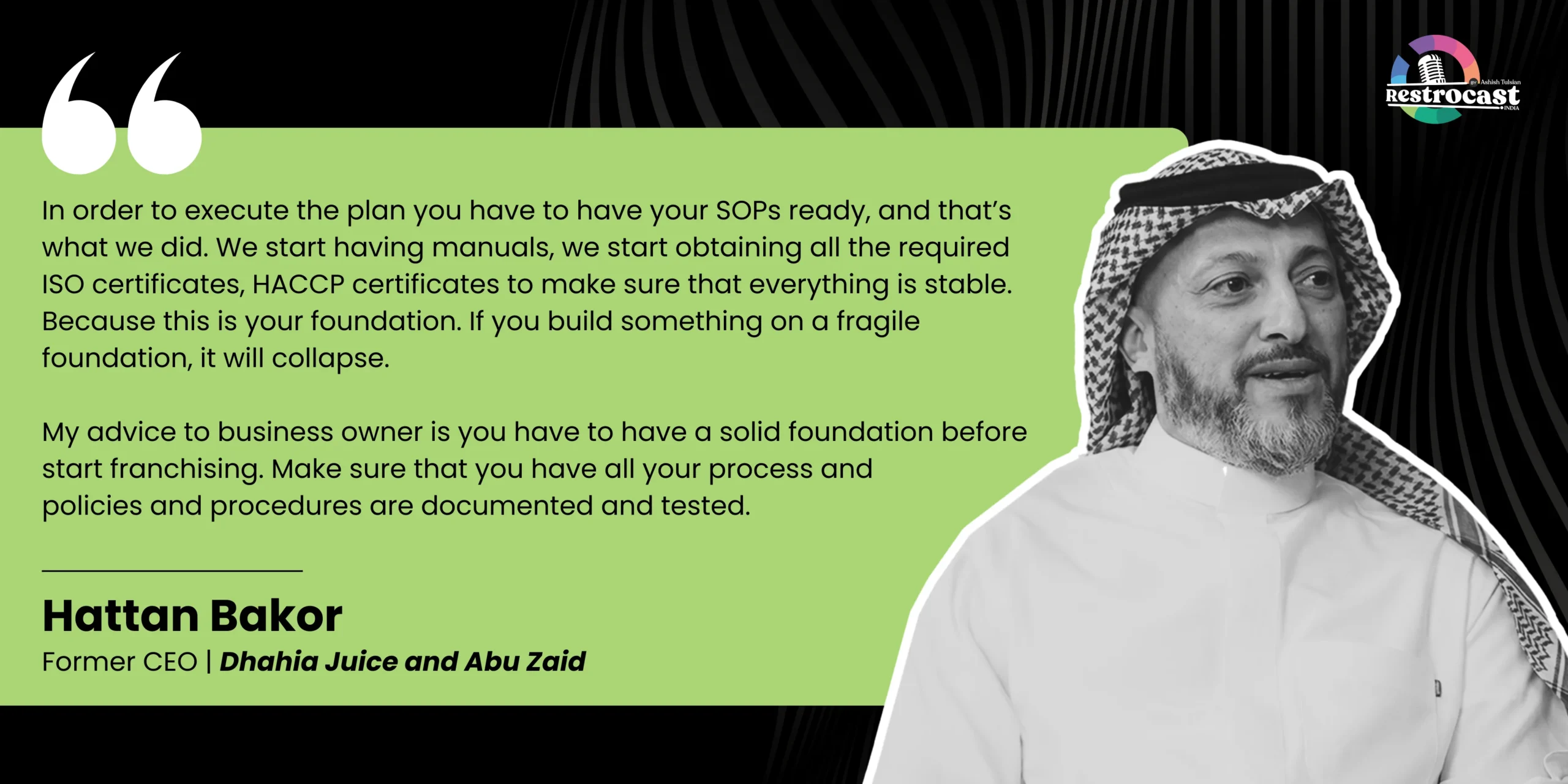
Hattan Bakor talks about the realities and economics of scaling a restaurant business in Saudi Arabia in this conversation with Ashish Tulsian. Listen here-
C. Add New Revenue Channel to Existing Restaurant Operations
Expansion does not always mean new outlets. Increasing revenue per location can be just as impactful, especially in high-cost markets where investing in a new location can be financially draining for your business. You can explore new revenue channels and cost-efficient models in the existing space, such as-
- Off-premise dining with food delivery and takeaway options
- Catering, bulk orders, or corporate tie-ups
- Branded merchandise
- Renting your space for events
D. Try Virtual or Ghost Kitchens
Ghost kitchens offer a flexible way to enter new markets with lower upfront investment — probably why 51% of restaurant owners had shifted to ghost kitchens by May 2020, as compared to a mere 15% pre-pandemic.
This approach is useful for testing demand in areas where opening a full-scale outlet may be risky. Plus, it also gives you an opportunity to expand into food delivery services, without burdening your existing kitchen operations.
But while the cloud kitchen model is cost-efficient, it depends heavily on strong delivery operations and brand recall. Plus, high competition on food delivery apps can also affect visibility.
E. Open Pop-ups or Food Trucks
Pop-ups and food trucks are useful for short-term market testing and brand building. They allow you to experiment with restaurant locations, menu items, and customer segments without long-term commitments.
- Test new neighborhoods before signing leases
- Build buzz through limited-time offerings
- Gather real customer feedback with minimal risk
F. Acquire an Existing Restaurant
Most expansion conversations focus on opening new outlets, but acquiring an existing restaurant can be a faster way to scale — if done right. For starters, you’re not starting from zero. The restaurant location, infrastructure, and even the customer base are already in place, which reduces setup time.
Under this model-
- Look for underperforming restaurants in strong locations with good demand
- Evaluate financials such as revenue trends, costs, and any hidden liabilities carefully
- Assess if you can rebrand or adapt the space to your new concept
That said, this approach comes with its own risks. Existing teams, processes, and customer expectations may not align with your standards, so you need a clear transition plan to minimize risks.
How to Expand Your Restaurant Business?
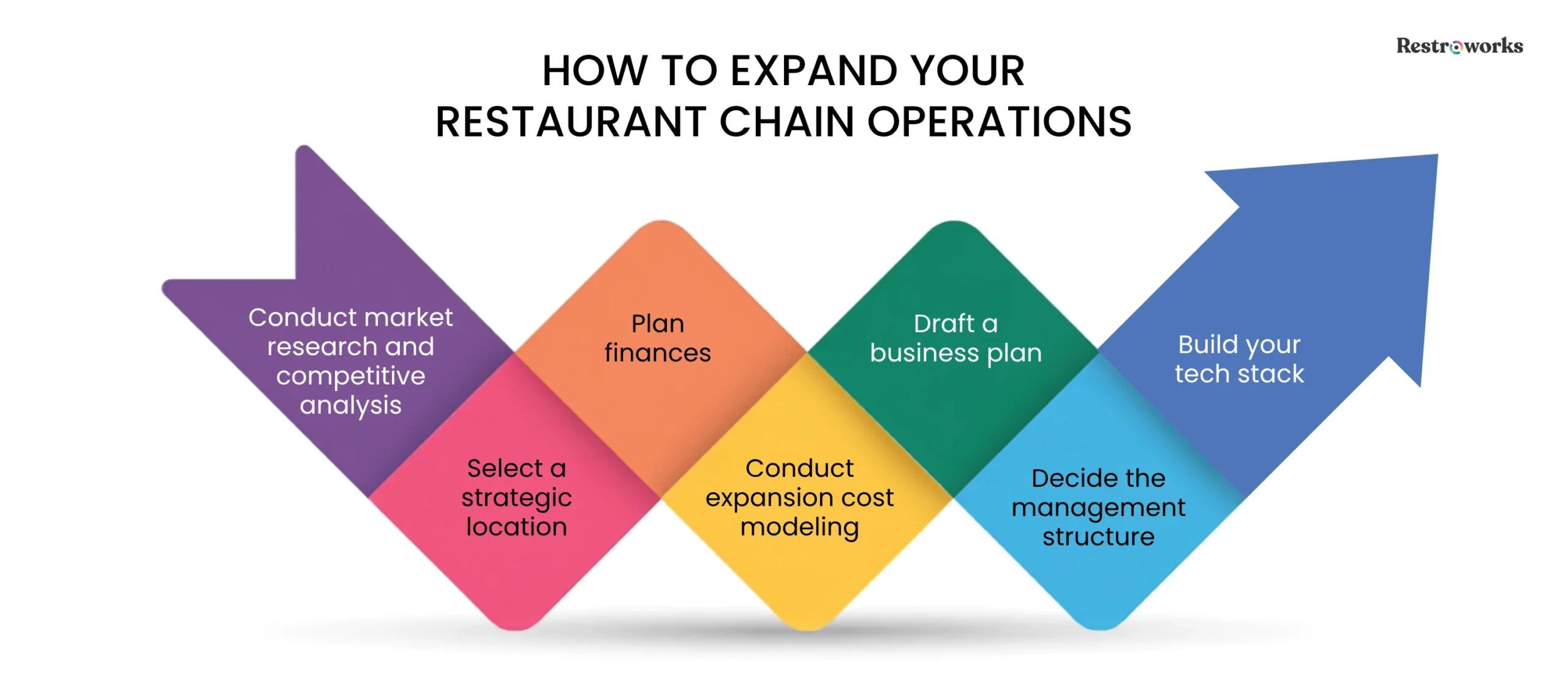
At this stage, your focus should shift from whether to expand your restaurant business or not to how to do it right.
1. Conduct Market Research and Competitive Analysis
As mentioned before, understanding your restaurant’s target market is essential for successful expansion. Only this time, you need to analyze the market and competition for the next location. Start by-
- Understanding who your customers are in that area, along with their demographics, income levels, spending behavior, and customer preferences
- Studying competitors across pricing, menu ideas, and customer reviews
It’s easy to assume that a busy restaurant industry means opportunity. It doesn’t always. But it definitely means a competitive space where everyone is fighting for the same customer.
And if you see people complaining about pricing, slow service, or lack of variety, that’s your entry point.
2. Select a Strategic Restaurant Location
Your next step is to find a new location for your next outlet. While it may be tempting to just pick a high-traffic restaurant location, it’s not always the smartest idea. It may offer you high visibility, but it also comes with the pressure to manage costs and stay competitive.
A good way to approach location selection is to look beyond footfall and proximity to your target customer. Additionally, consider a location that’s close enough to your original one.
Why? Because word-of-mouth marketing works great for restaurants, a nearby location can bring both existing and new customers.
3. Plan Finances and Cashflow
This is where you have to decide how you want to fund expansion and how fast you can realistically grow without putting pressure on the business.
Are you opening one outlet a year using internal profits, or planning a faster rollout backed by external funding? Each path changes how much risk you carry and affects control.
For instance, bringing in investors can allow you access to more capital for growth, but it also comes with expectations around scale and returns. Similarly, traditional loans may be easier to access, but will feature repayments that can impact your cash flow.
4. Conduct Expansion Cost Modeling
A cost model is simply a way to understand how much the new outlet will actually cost you, and what it needs to earn to justify the investment. For this, calculate your total investment per outlet and then work backward from expected returns.
- Build a detailed cost structure for each outlet before expansion
- Use standardized templates to compare locations and formats
- Create projections across best-case, expected, and worst-case scenarios
Also, determine your expected payback period, internal rate of return, and the sensitivity of your model to lower-than-expected restaurant sales to understand the ROI. This will help measure the feasibility of your new restaurant location.
5. Write a Restaurant Business Plan
You must have created a business plan for your existing restaurant, so an expansion plan needs one too. Think of it as a working blueprint. It should give major stakeholders like investors a complete overview of your restaurant business, its positioning, location, operations, finances, and future plans.
Include the following in your restaurant expansion business plan-
- Clarify what you’re trying to achieve with expansion
- Map out how many restaurant outlets, where, and in what timeline
- Define expected costs, returns, and key risks
Writing things down forces you to think through the trade-offs and goals of the restaurant business. It also makes it easier to stay consistent when you’re making similar decisions across multiple restaurant outlets.
6. Decide the Management Structure
Expansion puts immediate pressure on your team. When staffing is an already complicated process in one restaurant, you need a systematic approach to it as you grow. So, before you even launch-
- Plan hiring needs for each outlet, depending on their individual daily operations.
- Build structured training and onboarding programs
- Define clear roles across store, area, and central leadership
- Offer competitive salary, benefits, and learning opportunities to retain your employees
At the same time, establish a management structure to define who runs each outlet and who oversees multiple locations. This is where you need to set clear responsibilities and reporting lines to build a team that can operate without constant supervision.
7. Pick the Technology Stack for Chain Operations
When you have one outlet, you may be able to manage things manually. Once you have several, that approach will no longer work. With manual processes, you may have to deal with isolated data, inaccurate forecasts, or inefficient operations.
A good technology setup fixes that. It gives you a clear view of what’s happening across all locations at any point. Reliable POS systems, inventory management software, kitchen production systems, or reporting tools help you stay on top of your restaurant performance. Together, these systems-
- Centralize restaurant sales, inventory, and reporting data across locations
- Track performance without relying on manual updates
- Leverages restaurant data to help you compare outlets and analyze growth
It also changes how you make decisions. Instead of asking managers for updates, you can spot patterns yourself. Maybe one outlet is selling more of a certain item, or another is seeing higher wastage.
That kind of visibility takes the guesswork out and helps you act faster, which becomes critical as you scale.

Restaurant Expansion Risk Management: What are the Common Operational Challenges?
Here are the common operational challenges that come with expanding your restaurant chain-
- Inventory and Supply Chain Management: As you grow, handling inventory and vendors across locations becomes difficult. You may have different vendors, get varying quality, or have poor stock visibility, which impacts both food costs and customer experience. So, it’s crucial to standardize suppliers, track inventory centrally, and have backup vendors to stay in control.
- Managing Multiple Locations: Each outlet will start operating differently if there’s no structure in place. This leads to inconsistent performance and makes it harder to track what’s working. Define clear roles and ensure regular reporting and audits to establish consistent processes across locations.
- Maintaining Consistent Customer Experience: Same brand, different experience. That’s the easiest way to lose loyal customers. Differences in staff training or restaurant processes can lead to fluctuating service levels and food quality on every visit. To fix this, implement SOPs and standardized training schedules in your restaurant.
- Cost Control: Managing costs requires location-level visibility into finances. Leverage your POS and inventory management systems ot track key cost metrics like food cost, labor cost, and overheads per outlet to identify variations and correct them quickly. Otherwise, small inefficiencies like wastage can easily grow into bigger losses.
- Staffing Gaps and High Attrition: Hiring gets harder when you’re expanding. Teams change, people leave, and new hires take time to settle in. If you don’t have a standardized way to hire and train, it will start affecting service and overall operations pretty quickly.
Expanding a restaurant chain involves careful planning and execution, both in terms of financial and operational aspects of the business. And this starts with evaluating if your restaurant and teams are ready to expand and choosing the right expansion model for smoother expansion.
Once you’re ready to expand, study your market, potential customers, and competition, assess your legal structure, and see where you can fill in the market gaps.
Finally, always keep quality and customer satisfaction at the top of your priorities to ensure your new restaurant location is as successful as the first restaurant.