

Open APIs enable seamless integration between restaurant management software and various third-party applications, allowing for efficient data exchange and streamlined operations.
A “right” restaurant API helps operators in creating a unified view where data flows automatically across every function of the business.
The easiest example to understand this concept would be –
When a customer places an order online, the API will push it directly to the kitchen display, update the inventory, and record the sales in the accounting software. You won’t need to do anything manually.
Isn’t it super interesting? The ability of restaurant management software to manage menus, monitor industry trends, track inventory, process payments, handle reservations, and analyze employee performance from a single dashboard. All the credit goes to APIs.
But, really, how does this actually play out across your technology stack?
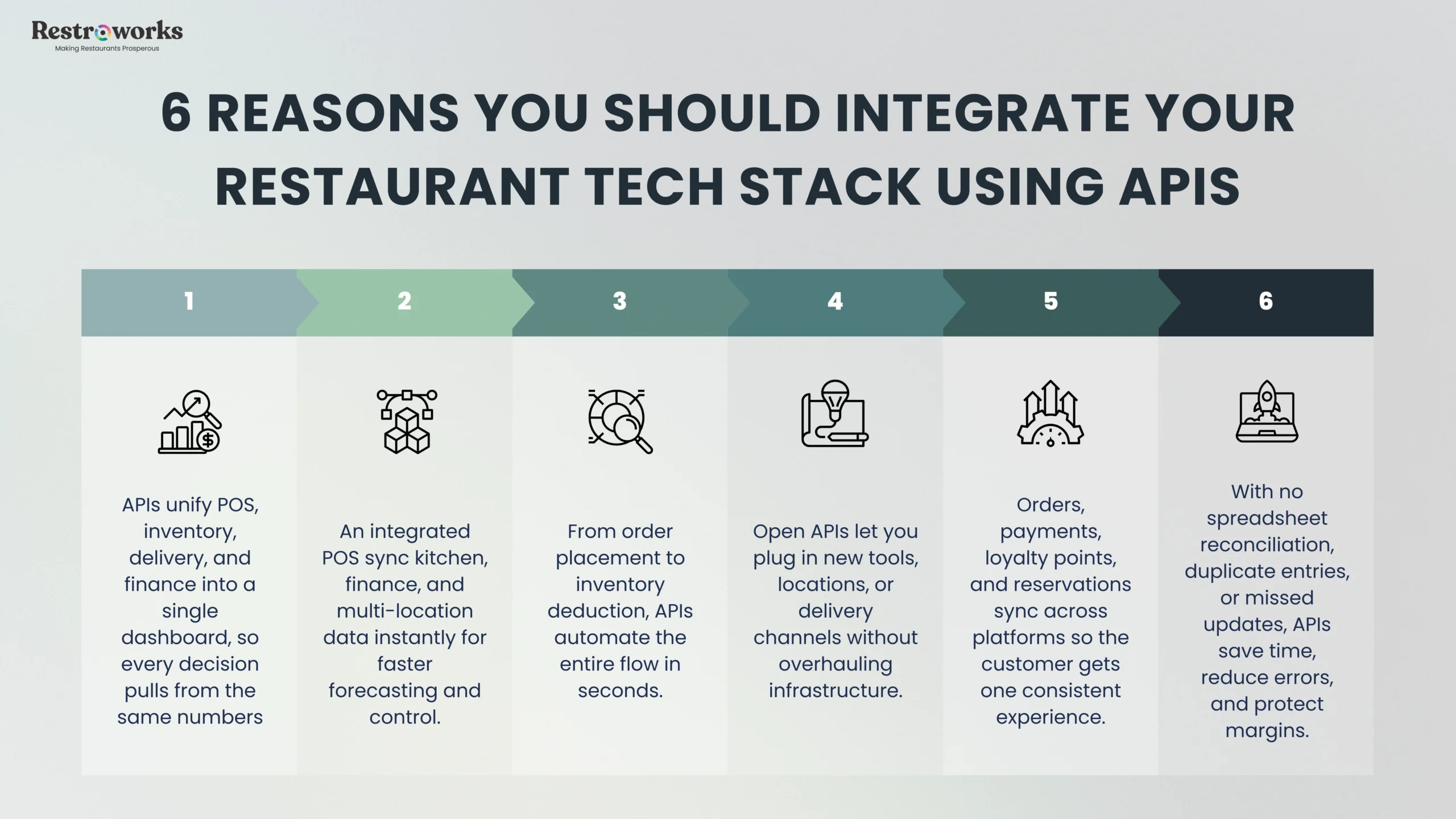
1. POS Systems + Relevant POS Integrations to Boost Efficiency
It won’t be much of an exaggeration if we say that POS is the operational heartbeat of restaurants. Now, integrate your POS with other platforms through restaurant APIs, and it becomes an absolute command center.
Integration with other systems enables real-time data flow between the front of house and the kitchen, between individual locations and corporate headquarters, and between daily sales and financial reporting systems.
Modern POS systems can also connect inventory, accounting, loyalty, and employee management tools into one centralized environment. This makes it much easier to manage daily workflows and improve overall restaurant performance. Instant access to sales, inventory, and staff data allows for faster and smarter decisions in back-of-house operations.
Through it, chains can even consolidate sales trends across hundreds of outlets instantly for much faster and more accurate revenue forecasting.
Data-driven decision-making is crucial for multi-location restaurant operations, as it allows operators to analyze performance metrics across all locations and optimize strategies accordingly.
Without a flexible integration, daily financial reports often require error-prone manual work like emailing spreadsheets, manually reconciling data, and trying to spot discrepancies on our own.
Look at this case, for example –
One of the large restaurant chains with nearly 2,000 franchise outlets used restaurant APIs specifically for revenue forecasting, pricing and promotions management, and digital ordering integrations.
As a result, they saw a massive improvement in their operational efficiency and data consistency. They also reported that switching to the “right” API distributor accelerated integration development by 70%.
Platforms like Restroworks, Oracle, Revel, etc., offer open APIs that allow restaurants to connect their POS systems to ERPs, BI tools, self-ordering kiosks, and mobile payment systems. One of the biggest advantages here is that modern open API architectures enable chains to quickly integrate new technologies and create future-proof solutions without overhauling their existing infrastructure.
2. Online Ordering and Delivery Platform Integrations
Customers expect restaurants to offer a complete online ordering system and delivery with their e-commerce sites and digital applications, as they have little patience for clunky transfers to different platforms during the ordering process.
Implementing a unified digital ordering system can enhance customer experience and operational efficiency for multi-location restaurants by reducing order errors and improving service speed.
Whether guests place orders through a website, mobile apps, or third-party marketplace, an integrated API suite helps maintain a user-friendly ordering experience across all channels.
This way, using custom ordering API integrations can create a seamless user experience by fully integrating third-party ordering and delivery vendors, which is essential for modern restaurant operations.
Not to mention, APIs enable restaurants to adopt advanced ordering trends through online interfaces, delivery applications, and mobile orders, providing unprecedented ordering flexibility.
Several integration platforms, in fact, specialize in delivery aggregation. To name a few –
- Deliverect offers broad market coverage and strong multi-location support.
- Checkmate offers cost-effective order processing for small restaurants.
- Chowly focuses on automated order flow, which helps in reducing errors at all levels. Restaurants that implement automated order management systems can centralize data and operations, reduce errors, and improve customer satisfaction by ensuring accurate and timely order processing.
- KitchenHub is very well-known among ghost kitchens and multi-brand operators for its branded partner dashboard and POS-independent restaurants API.
POS integrations with delivery platforms can significantly reduce manual errors by automating order flow directly into POS systems, streamlining daily operations, and improving efficiency. Bi-directional communication allows for sending order status updates back to customers, enhancing guest experience.
This level of visibility especially matters in some of the best software systems because customers increasingly expect reliable updates throughout the ordering process, from confirmation to final delivery.
3. Real-Time Inventory Management and Supply Chain APIs
Managing inventory is one of the most critical (and perhaps one of the most complicated) aspects of running restaurant groups.
After all, without real-time visibility, restaurants end up with overstock in some stores and shortages in others, leading to food waste, missed sales, and frustrated customers.
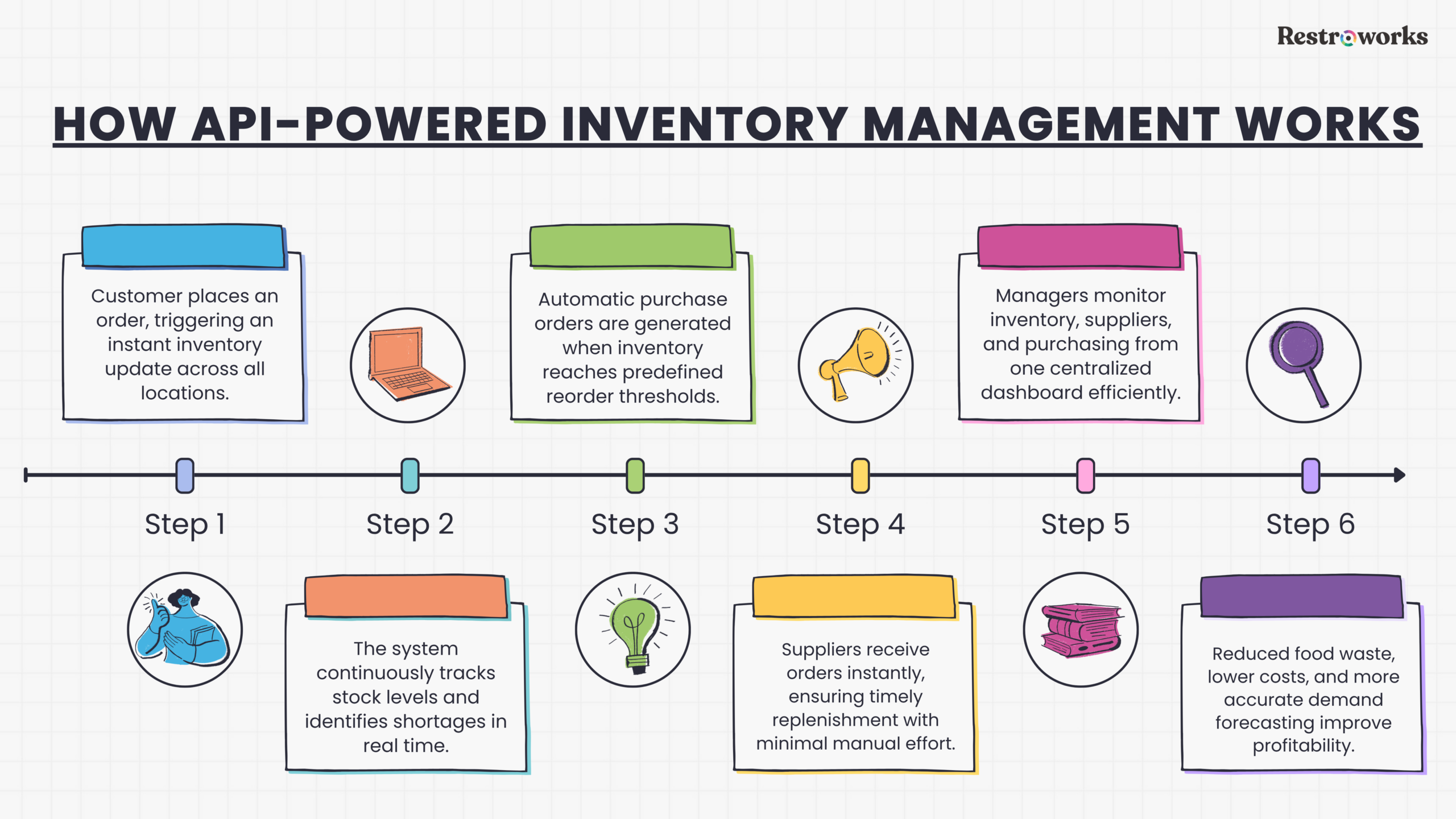
Real-time inventory management through APIs allows restaurants to monitor stock levels continuously, ensuring efficient supply and workforce management and quick order preparation. Every time an order is placed, real-time inventory tracking helps food and beverage companies avoid overstocking, reduce waste, and improve forecasting accuracy, which is essential for maintaining profit margins.
For multi-unit restaurants, the fact that you can easily manage suppliers and automate purchasing through APIs is, in a way, transformative.
Restaurants can operate more efficiently when suppliers’ information, inventory data, and vendor communications are synchronized within a single integration workflow. This also helps control food costs and improve purchasing decisions.
Think about it – The system automatically tracks levels, flags shortages, and can even automate purchase orders to suppliers based on predefined thresholds. Managers benefit from a user-friendly interface that provides visibility into delivery orders, stock levels, purchasing, staff scheduling, and supplier performance.
Instead of manually creating purchase requests, managers can automate tasks to maintain optimal stock levels while strengthening relationships with key suppliers.
INDUSTRY INSIGHT
4. Payment Gateway and Accounting Integrations
Payment gateway integration through APIs allows restaurants to offer customers a wide range of payment options. Like, they can include credit cards, mobile wallets, UPI, and more to better streamline operations & the checkout process and reduce costs related to friction at the point of sale.
Accounting & Financial Software automates reconciliation, syncing daily sales, expenses, and tax data with financial records and saving significant time. Real-time data synchronization with accounting software like QuickBooks automates tracking of cost-of-goods-sold (COGS) and payroll calculations.
Payment gateway integration also simplifies accounting by automatically reconciling transactions and generating detailed reports.
It also gives foodservice operators the ability to access detailed business financial insights without increasing administrative load on accounting teams, helping restaurants make faster business decisions.
5. Customer Experience: Point of Sale, CRM, Customer Loyalty, and Reservation APIs
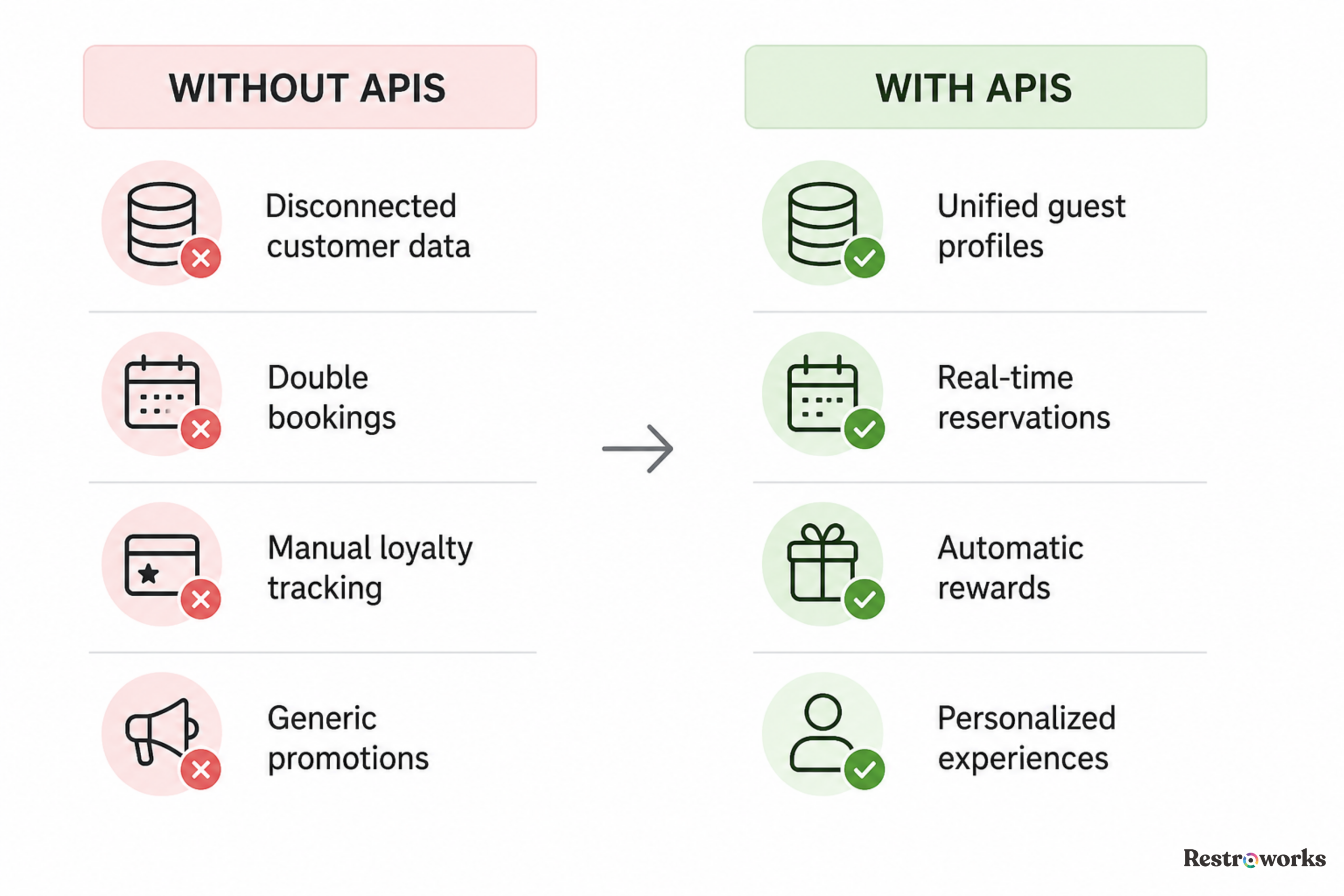
APIs improve the guest experience by ensuring seamless and faster service, accurate orders, and personalized interactions, which can lead to increased customer satisfaction and loyalty.
Customer Relationship Management (CRM) & Loyalty Programs integrate customer data directly into the POS (Point of Sale), enabling personalized marketing and better tracking of customer preferences.
Loyalty program APIs connect with restaurant POS systems so customers can earn and redeem rewards seamlessly, whether they are ordering in-store, online, or through a third-party delivery app like Uber Eats. Hyper-personalized marketing enables automated retention campaigns that can increase customer retention by up to 25%.
Reservation system APIs equally matter for sit-down chains.
These technologies help restaurants connect customer interactions across multiple locations while enabling an employee to process reservations and loyalty programs for a more reliable process.
When a customer makes a reservation through a booking app, the system automatically updates table availability in real time. This eliminates any chances of double bookings and helps employees plan the seating and their service more effectively during peak hours.
6. Menu & Order Management
Centralized Multi-Location Management allows large chains to manage pricing variations and consolidate reporting for deeper insights.
For restaurants, keeping menu items consistent across hundreds of locations and multiple platforms is a major operational challenge.
In such a case, Multi-location restaurant operations can benefit significantly from centralized management systems that streamline operations across all outlets, ensuring consistency and efficiency. Their direct integrations with devices in the kitchen can lead to faster service and higher throughput during peak hours.
Whether you want to add new dishes, adjust prices, or highlight seasonal promotions, restaurant APIs ensure that digital menus are always “current” across all platforms. This also simplifies creating and launching menu updates across multiple channels at the same time.
This is one of the most practical examples of how restaurants use the right” tools and technology to automate their day-to-day business operations while helping chains scale their menus and achieve profitability.
Imagine how big a blessing this is for the chains that have their profile on more than 2 delivery platforms (DoorDash, Uber Eats, etc.). Real-time syncing of menu items automatically pushes updates across all integrated platforms, so your employee doesn’t have to do it all manually, and your customers always see accurate information, whether they are ordering through a restaurant’s app, website, or a third-party delivery service.