

Franchise accounting is one of the most complex financial environments in the restaurant industry. Restaurant franchise owners have to keep an eye on the financials at their multiple locations, satisfy the franchisors’ demands in terms of reporting, calculate royalties and marketing fees, and maintain the financial state of their business all at once.
Inaccurate or incomplete financial reporting can do more than increase risk; it can obscure the franchisee’s financial performance.
And there’s very little room for error. According to the National Restaurant Association, 42% of restaurant operators said their restaurant wasn’t profitable in 2025. In this environment, franchise businesses operate on tight margins, so financial accuracy and proper reporting are key to franchise success. In this environment, franchise businesses operate on tight margins, so financial accuracy and proper reporting are key to franchise success.
What You Will Learn
- Financial statements a restaurant franchise should keep and what each statement shows
- Proper accounting procedures for franchise management in different places
- Structuring franchise fees, royalties, and marketing funds
- Internal control and software used for accurate financial reporting
Why Accurate Financial Data Reporting Matters for Restaurant Franchises
Financial statements play a vital role in decision-making within franchise organizations because they help franchisees identify early financial risks, demonstrate financial soundness to creditors, comply with franchisor requirements, and make unbiased decisions about staffing, inventory management, and expansion.
Plus, restaurant franchise accounting involves complex transactions such as royalty fees, advertising costs, and franchise fees.
Royalties alone carry real weight: across franchise industries, royalty fees range from 3% to 13% of gross revenue, with a median of 5.00%, according to FRANdata and BizBuySell. At the median, a location doing $1 million in annual sales pays $50,000 a year in royalties alone, so even small reporting errors add up.
Consolidating financial data from different units into a single entity gives corporate management immediate insight into the organization’s performance, enabling it to identify profitable and unprofitable units. Franchise organizations that do not adopt consolidation accounting will be condemned to react to unit performance rather than act.
INDUSTRY INSIGHT
Franchise output in 2026 is forecast to surpass $920 billion, with nearly 845,000 franchise establishments operating.
Key Financial Statements Every Franchise Must Maintain
Every restaurant franchise must maintain four key financial records: a profit and loss (P&L) statement, a balance sheet, a cash flow statement, and accurate income tax and sales tax filings.
1. Profit and Loss Statements
The P&L statement, also called an income statement, shows a franchise’s revenue, costs, and net profit for a specific period, and it’s the financial statement restaurant franchise accounting reviews most often.
These statements analyze revenue, cost of goods sold, labor costs, operating expenses, and net profit for a specific period.
For multiple units of franchises, the income statements should be prepared for each location as well as on a system-wide basis. The location-by-location income statement helps identify underperforming locations, while the system-wide income statement helps identify system-wide trends.
Franchised restaurants tend to post stronger numbers on these statements. Franchised restaurants generate 1.4x higher average sales than comparable independents ($3.5 million vs. $2.3 million a year).
2. Balance Sheet
The balance sheet reflects financial status at a specific point in time and shows assets, liabilities, and equity. In restaurant franchises, the balance sheet covers major elements like equipment values, deferred revenues, leases, and any unpaid franchise fees. Regularly updated balance sheets help owners understand their businesses’ financial status and demonstrate their ability to pay debts and become solvent before funding growth.
3. Cash Flow Statement
The cash flow statement reflects actual cash receipts and payments, while the P&L statement recognizes income when it occurs, regardless of when cash is received. Cash flow is critical to the operation of a restaurant franchise business; many profitable franchises have failed because of poor cash flow management.
Analyzing your cash flow helps determine when expenses will exceed revenues, so the franchisee can handle working capital in advance. Cash flow statement analysis is critical when opening a new restaurant, purchasing new equipment, or paying sales taxes.
4. Income Tax Filings and Sales Tax Compliance
Restaurant franchises must file income taxes accurately and collect and remit sales tax correctly in every location they operate. Prepare your tax return forms correctly and systematically. Sales tax rates differ from one state or city to another, and failing to comply can lead to audits.
Set guidelines for how long tax documents should be retained, typically seven years. The IRS recommends different retention periods depending on the situation:
| Documents | Keep records for |
|---|---|
| Most tax records (standard) | 3 years |
| Employment tax records | At least 4 years after the tax is due or paid |
| Unreported income of more than 25% of gross income | 6 years |
| Claims for bad debt deductions or worthless securities | 7 years |
Modern accounting software can significantly streamline financial processes for franchises by automating tasks such as data entry, reporting, and compliance, which reduces errors and saves time.
Specialized accounting software designed for franchises often includes features like POS integration, automated royalty calculations, and customizable dashboards to improve financial reporting accuracy and efficiency. Monthly financial reviews help analyze trends in net profit margins and cash flow to inform long-term strategy.
Franchise Accounting Best Practices Across Multiple Locations
Standardize the Chart of Accounts
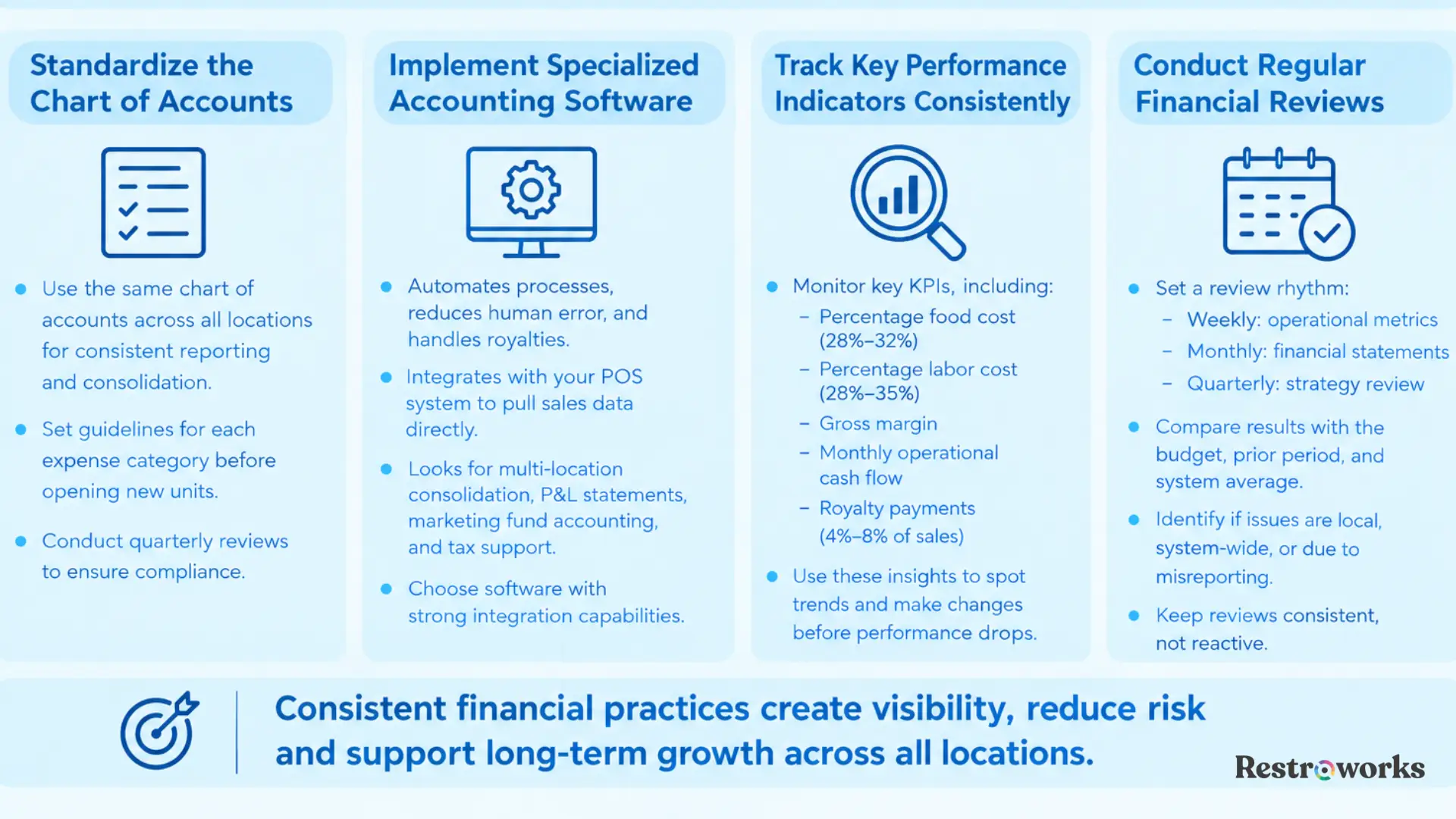
The best way to handle multi-location franchises from an accounting standpoint is to standardize the chart of accounts across all franchises. Once all units account for revenue and expenses the same way, consolidation will produce valid results. Differences in how franchises treat labor cost, food cost, and marketing expenses make the system’s financial analysis invalid and complicated.
Establish guidelines for how each expense category should be accounted for before opening any new franchise, and conduct quarterly reviews to confirm compliance with the standards.
Implement Specialized Accounting Software
Specialized accounting software for restaurant franchise accounting reduces human error, automates royalties, and produces the required financial statements. Specialized accounting software improves financial processes, reduces human error, and makes it easier to access financial information for decision-making.
It integrates with your POS system to pull sales data without manual entry. That integration is still missing for many operators: in a survey of 1,254 restaurant leaders by Oracle Restaurants and Informa TechTarget, 48% said their systems aren’t fully integrated.
The accounting software you choose for your restaurant franchise needs to consolidate multiple locations, create profit and loss statements at the location and system levels, automate marketing fund accounting, and support income tax filing.
Track Key Performance Indicators Consistently
Proper financial reporting leads to informed decision-making only if you measure the right Key Performance Indicators (KPIs). The appropriate KPIs in a restaurant franchise include:
- Percentage food cost: Ratio of total food cost to total revenue (should be between 28%-32%)
- Percentage labor cost: Ratio of total labor cost to total revenue (should be between 28%-35%)
- Gross margin: Difference between total revenue and cost of goods sold divided by total revenue
- Monthly operational cash flow: Total cash generated from restaurant operations every month
- Royalty payments as a percentage of sales made by the franchise owner: Between 4% and 8%
By monitoring these KPIs, franchise owners can spot trends and make necessary changes to prevent poor performance.
Conduct Regular Financial Reviews
A regular financial review program, including weekly operational metric reviews, monthly financial statement reviews, and quarterly strategy reviews, provides the decision-making rhythm necessary for franchise success. Financial reporting safeguards financial health only when it is consistent, not reactive. Franchise owners who review their financials only after a problem occurs will always play catch-up.
Formulate a strategy for reviewing financial figures monthly and comparing them with the budget, previous period figures, and the system average. This process will help determine whether the franchise location’s financial performance has been affected by local issues, system issues, or misreporting.
Franchise Fees and Royalty Reporting
Franchise fee and royalty reporting means recording every fee in the franchise relationship correctly, including the initial franchise fee, ongoing royalties, and marketing fund contributions, so both franchisee and franchisor stay compliant and transparent.
On the franchisor’s side, initial franchise fees are typically recorded as deferred revenue and recognized over the franchise agreement term, ensuring financial transparency and compliance with revenue recognition standards.
Private-company franchisors have some flexibility here: under FASB’s ASU 2021-02, they can immediately recognize the portion of upfront fees charged for pre-opening services, such as training and site feasibility studies.
Accurate financial reporting is essential for compliance with federal and state regulations, including the Franchise Disclosure Document (FDD) requirements governed by the FTC, which mandate audited financial statements prepared under US GAAP standards for franchisors. In general, franchisors must include three years of audited financial statements in their FDD, with a phase-in period for new franchisors.
Standardizing accounting procedures across franchise locations enhances the accuracy and reliability of financial reporting, reducing the risk of errors and ensuring compliance with established industry best practices.
Initial Franchise Fee Accounting
The initial franchise fee is the one-time fee a franchisee pays to join a franchise network, and it’s normally capitalized and then amortized over the life of the contract. The fee generally ranges from $10,000 to $50,000, though the most popular brands can charge more. The details of such a fee can be found in your franchise disclosure document.
Ongoing Franchise Fees and Marketing Fund Contributions
Record ongoing franchise fees, such as royalties based on a percentage of gross sales, marketing fees, and technology fees, separately in the accounting system.
| Ongoing fee | Typical rate | How to record it |
|---|---|---|
| Royalty fee | Average 4%-12% of your revenue | Separate expense account, calculated from reported sales |
| Marketing fund contribution | Typically 1%–4% of gross sales | Separate account, with records showing payment to the marketing fund |
| Technology fee | Often a flat monthly fee; 61.9% of franchisors charge one | Separate account for franchisor-required tech fees |
Most franchise agreements require the franchise owner to record marketing fees to the marketing fund, proving the money was used for approved marketing. You must record all royalty calculations, franchise fees, and marketing fees paid within a period because they are needed for franchise reports and income tax.
This will protect the franchise owner in case of any discrepancies in royalty underpayment. Clear, accurate accounting records and accurate royalty calculations help solve problems quickly.
Internal Controls and Financial Accuracy
Internal controls protect a franchise’s financial accuracy by preventing errors, theft, and fraud before they show up in the numbers. Implementing robust internal controls, such as maintaining meticulous records of all financial transactions and establishing a regular schedule for financial data recording, is essential for safeguarding financial data and ensuring compliance.
The stakes are significant: according to the Association of Certified Fraud Examiners (ACFE), organizations lose an estimated 5% of revenue to fraud each year.
Robust Internal Controls That Protect Franchise Finances
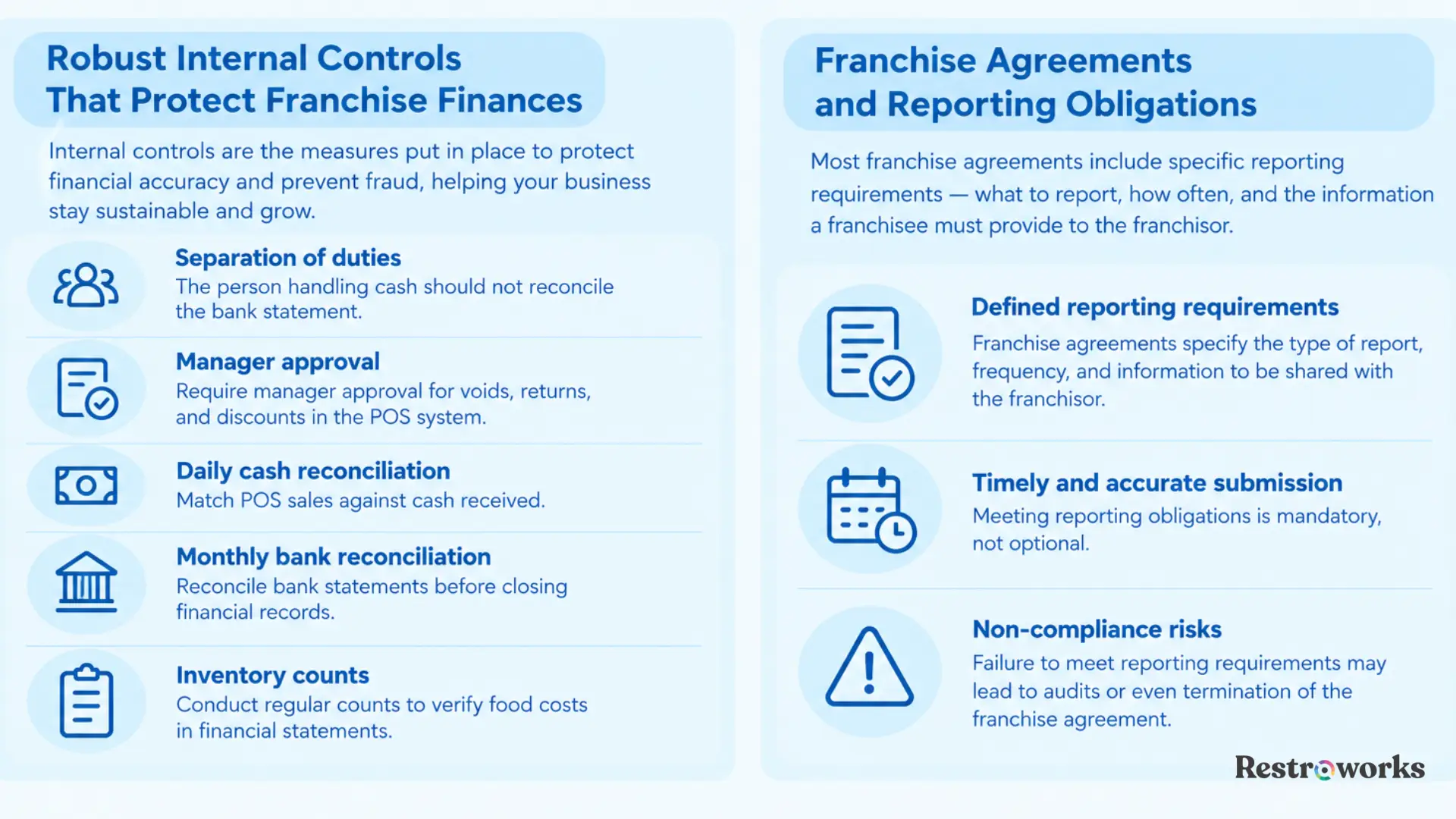
Internal controls are the measures put in place to protect financial accuracy and to prevent fraud. Strong internal controls help prevent future financial discrepancies. This helps keep your business sustainable and growing. For the restaurant franchises, some of the internal controls are:
- Separation of duties: the person handling cash is not allowed to reconcile the bank statement
- Approval by manager for voids, returns, and discounts in the POS system
- Daily cash reconciliation based on POS sales against the cash received
- Monthly bank statement reconciliation prior to closing of financial records
- Inventory counts for verification of food costs in financial statements
Franchise Agreements and Reporting Obligations
Most franchise agreements include explicit provisions for reporting requirements: what type of report, how often, and what information a franchisee must include in the financial statement they provide to a franchisor. Meeting these franchisor reporting requirements is not optional. Failure to meet them may result in audits or even termination of the franchise agreement.
EXPERT OPINION
“Running a restaurant franchise involves much more than serving great food; it requires maintaining operational excellence and financial transparency across every location.”
— Renee Pogue, Content Author, Sage
Knowing the difference is key to franchise owners building profitable, scalable businesses rather than learning about financial problems only after they are already in crisis. The restaurant franchise companies making headway in 2026 are those that take their finances as seriously as their business and marketing activities.
KEY TAKEAWAYS
- Good financial reporting at various locations demands standardization of chart of accounts, accounting system software, and a rhythm of financial review at both location and system levels
- Four primary financial records have to be maintained by franchise restaurants. These include a profit and loss statement, balance sheet, cash flow statement, and income tax and sales tax supporting information
- Franchise fee computation, which includes the amount of the franchise fee, royalty fee, and marketing fee payments, should be made in different accounts with proper royalty computation based on the franchise agreement
- Internal control procedures, which incorporate separation of duties, cash reconciliation, physical inventory, and manager approvals, constitute the operational foundation of accurate financial records and successful franchises
Frequently Asked Questions
1. What financial metrics should restaurant franchises track across all locations?
Monitor sales growth, food and labor costs, gross and net profit margins, average ticket price, prime cost, cash flow, inventory variances, and comparable sales.
2. What software do franchise restaurants use for multi-unit reporting?
Common options include restaurant management software, POS analytics software, accounting software, and business intelligence tools like Power BI and Tableau.
3. How do you standardize reporting templates across franchise locations?
Standardize the chart of accounts, KPIs, reporting periods, data formats, and deadlines across all locations.
4. How do you create a franchise reporting dashboard for real-time visibility?
Combine point-of-sale, accounting, inventory, and labor systems into one dashboard that tracks sales, expenses, profit, and performance of each branch.
5. What are common reporting compliance issues in restaurant franchises?
Common compliance problems include inaccurate sales reports, late reporting, poor accounting, missing documentation, incorrect tax reports, and failure to meet franchise reporting requirements.
6. How do franchise disclosure requirements affect internal reporting practices?
Disclosure laws, such as US FTC laws on franchisees, require franchisors to maintain accurate, reliable information for disclosure.