

First of all, let us congratulate you on bringing in a new restaurant management platform, because you wouldn’t have looked for this article if you hadn’t, right? So, everything’s set – your vendor must have already sent you a 47-page PDF called “Onboarding Resources,” and you must have forwarded it to every manager of your brand’s outlet across 14 states, while scheduling a 45-minute Zoom demo for the next day or so.
Sorry to break it to you, but that’s absolutely not how employee training is done.
And, believe it or not, a platform doesn’t fail a restaurant, but how your employees are trained to use it does. Research shows that 96% of businesses have struggled with poor software adoption, while only 37% rate employee adoption of new software as “excellent.” Even worse, 88% of companies say their software implementations fail to meet business goals more than half the time.
Basically, no matter how well-designed your POS system is, or how clean your inventory tools are, or how intuitive the scheduling dashboard is – none of it’s gonna work if your entire team doesn’t know how to use it, or even if they know how to use it, but don’t realize the “why” behind it.
Want a way out? This guide will walk you through the ins and outs of building reliable employee training modules for new restaurant chain software.
What You’ll Learn
- How to roll out new restaurant software training without disrupting day-to-day operations?
- Why role-based training, bite-sized learning modules, and mobile accessibility work better for restaurant staff?
- How to use restaurant LMS tools, digital SOPs, and post-launch support to maintain consistency across multiple locations?
What Challenges Come With Training Staff on New Restaurant Software?
Do you know what the exact difference is between when you say, “We’ve updated our POS software,” vs when you say, “Team, we’re switching our POS vendor”?
Obviously, in both of these cases, your staff training process will require adjustments. But in the latter, you’re basically asking your staff to undo everything they’ve gotten comfortable with so far and start over while still serving their daily operations, which is a lot.
Because when you introduce a genuinely new restaurant chain software, be it a new learning system, inventory platform, employee scheduling tool, or restaurant training software, your team members aren’t starting from zero anymore. They have existing habits, workarounds, and a totally valid suspicion that this new training platform you’re planning to implement chain-wide is going to make their job much harder, not less, at least for the first few weeks.
And honestly, we can’t blame them, can we?
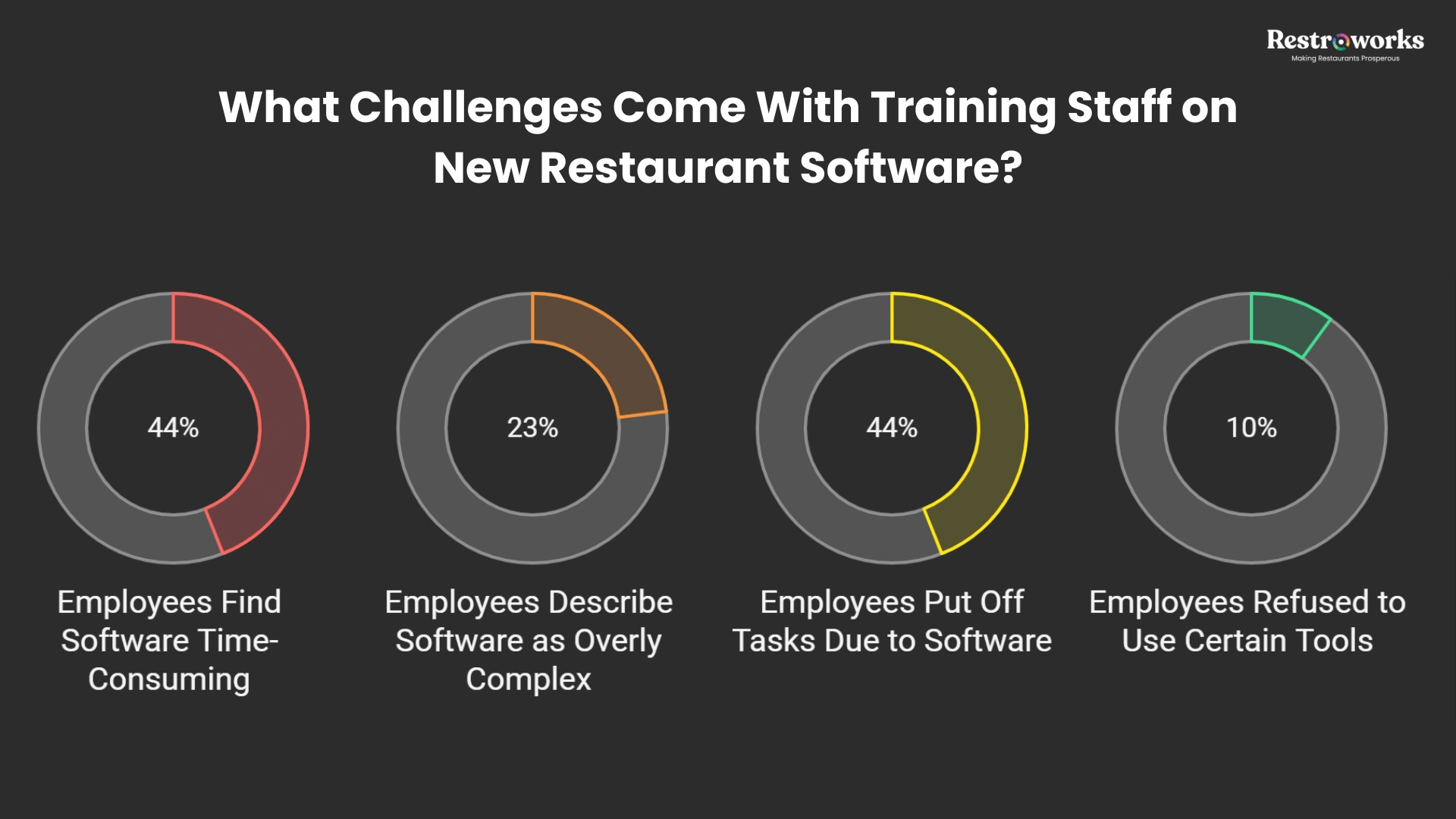
Research found that 44% of employees said that using software is time-consuming and difficult, while another 23% describe it as overly complex. Not only that, but atleast 44% have put off an important task because of software issues, and 10% outright refused to continue using certain tools altogether.
In a restaurant environment, the people you most need to adopt the training software are also the people with the least patience for a clunky onboarding experience and the most power to just not use it or use it wrong. Both of which can cost you a hefty amount, to say the least.
And since the restaurant industry sees high turnover rates, which usually come around 75% annually. That means the team you train in January might just not be working with you by April. So your training process has to be designed not just for the current team, but for the next team, and the team after that. It has to be fast, it has to stick, and it has to work across multiple locations simultaneously, in standardized form, without a dedicated trainer flying from city to city. Basically, you need to implement a structured training. Traditional staff training methods often struggle to keep up with this level of high turnover, which is exactly why interactive modules and restaurant LMS tools are becoming far more effective for hospitality businesses trying to maintain consistent staff training.
However, this is exactly where chains usually break down. They tend to overload their “best people” during rollouts. Bain’s research found that companies with successful transformations were significantly less likely to overload top performers, because burnout among key operators kills momentum. In fact, data showed that large-scale transformation efforts achieve 24% more planned value when a dedicated transformation leader oversees the process instead of adding the responsibility onto already stretched managers.
“Transformations are ever-present in business, but the vast majority do not achieve their intended outcomes. One of the first mistakes companies make is failing to focus on their critical strategic roles and getting the right people in them. They too often overload top talent, burning them out and overlooking other worthy team members. True transformation is a long-term endeavor. Winning companies invest in the talent they will need to sustain it. For many, this includes hiring a dedicated chief transformation officer.” – Melissa Burke, Practice Executive Vice President, Bain & Company |
Now layer restaurant complexity on top of that. You’re not just training employees on procedures they can physically practice on the floor. You’re training them on systems that look completely different depending on the role. A line cook, server, shift supervisor, and regional director may all be using the same training platform while interacting with entirely different workflows, permissions, dashboards, and decisions.
POS training becomes especially high stakes here. A confused server during dinner rush means you’ll likely get a complaint for delayed table turn. Similarly, inventory systems create food safety and compliance management risks when restaurant staff misunderstands logging procedures.
That’s why generic “software onboarding” doesn’t work in multi-location restaurant groups. Every training platform requires different training paths, different pacing, and a different definition of what successful adoption actually looks like. Effective restaurant training has to integrate hands-on, role-based training directly into real workflows so employees understand how the system affects the tasks they actually perform every shift.
What Should Every Employee Training Module for New Restaurant Software Include?
Okay, we have somehow lost count of how many times we have personally seen restaurant operators go through the vendor’s onboarding documentation, record a screen-share, and then add it to one of their many Google Drive folders named “Employee training resource – final – final”, and call it a day.
It’s not. Not even close, honestly.
Any good restaurant staff training has to start way before “guys, here’s how to use the dashboard.” Like, way before that. Before anyone learns what to do with the system, they need to feel comfortable just being in it. What does the interface look like? Why is this screen red? Did I break something? What happens if WiFi cuts out? What even counts as an error vs. normal loading? Like, there’s so much more to figure out.
This is why we advocate using bite-sized training modules (two to five minutes, video-based, with an interactive quiz at the end) because they genuinely improve knowledge retention. Microlearning works particularly well when short modules focus on a single feature at a time. Interactive video training platforms also give restaurant staff on-demand access to training materials, allowing new hires to learn at their own pace and fit restaurant training around shifts without disrupting daily operations.
Interactive elements like simulations, interactive quizzes, and short exercises also improve employee engagement and help employees retain information better than passive training alone. The best restaurant training content usually combines video tutorials, role-specific walkthroughs, and interactive modules so employees can practice tasks they’ll actually perform during service.
And yes, there’s actual evidence this works. Which Wich reportedly reduced training time by 80% using blended e-learning and role-based training modules across 10 of its locations. Flix Brewhouse also saw a 100% training completion rate after rolling out 71 mobile-friendly custom courses with gamified learning, with staff averaging 8.75 hours of e-learning per person.
INDUSTRY INSIGHT
The biggest problem most restaurant chains face is during the rollout of their training. It’s often inconsistent training across locations, and what happens then is that, by month two, location X is using the system differently than location Y, and nobody’s sure whose data is right.
So the perfect solution is to pick a pilot location first.
Keep in mind that whatever location you choose should have a stable, experienced management team. That’s the priority. If you thought you’d choose either one of your highest-volume stores or the struggling one, both are not right. One has too many operational risks, the other has too many compounding variables.
Now, roll out the training at this particular location, and see for yourself –
- What were people still confused about even after they completed training?
- Where did people go back to doing things the old way?
- What questions kept coming up again and again that the training content didn’t answer?
- What words, terms, or background knowledge did the vendor assume your team already knew?
Use the feedback you’ll get from here to revise your restaurant training content before full deployment.
Now, roll out the modules chain-wide “progressively.” When we say progressive, it means the rollout should be done in a way that doesn’t overwhelm people while offering them a comprehensive solution so they can understand things on the get-go. So, pick one concept at a time.
Let’s say you start the core compliance training module, and only after members get comfortable with it, you switch to the next.
Plus, you should keep an eye on your learning management system dashboard to track which locations are lagging or consistently receiving low assessment scores. Those locations might need targeted support from your end. After all, effective compliance tracking systems provide real-time visibility into certification tracking, training completion, employee progress, and training gaps, making it easier for managers to intervene before operational problems escalate.
Many chains also use a train-the-trainer approach during this stage, where managers and shift leads receive advanced training first so they can support frontline staff directly during rollout. This works especially well in restaurants because employees are often more comfortable asking quick questions to someone on their own shift rather than escalating every issue to corporate trainers.
What Are the Key Features of Effective Learning Management Systems?
An effective restaurant LMS is one that makes training easy, fast, and trackable across all locations. A strong learning platform should simplify the learning process for managers, team members, and new hires alike.
It should have at least these basic features:
- Staff should be able to access training on their phones because almost everyone has a smartphone and most prefer to “learn” between shifts, during breaks, or on the go.
- It should work offline. Even if internet access is weak at a moment, progress tracking should be going – it should still be saved and synced later.
- The learning system should automatically handle compliance tracking and completion tracking.
- Managers should be able to instantly see which employees completed training, whose certifications are expiring, and which locations are falling behind. Some chains also support training with quick-access reference materials such as QR code guides, digital SOPs (standard operating procedures), or terminal-side cheat sheets that employees can pull up instantly during service if they forget a workflow step.
- It should enable automatic renewal reminders and keep digital records audit-ready. Automated compliance management helps restaurants manage food safety certifications, alcohol service requirements, and other food safety obligations across multiple locations more efficiently.
A strong restaurant LMS also makes it easier to standardize training across hundreds of locations while still meeting local compliance management rules. For example, A&W Canada used Absorb LMS to train more than 45,000 employees across 900+ locations.
What Separates Good Compliance Training Software From a Generic Learning Platform?
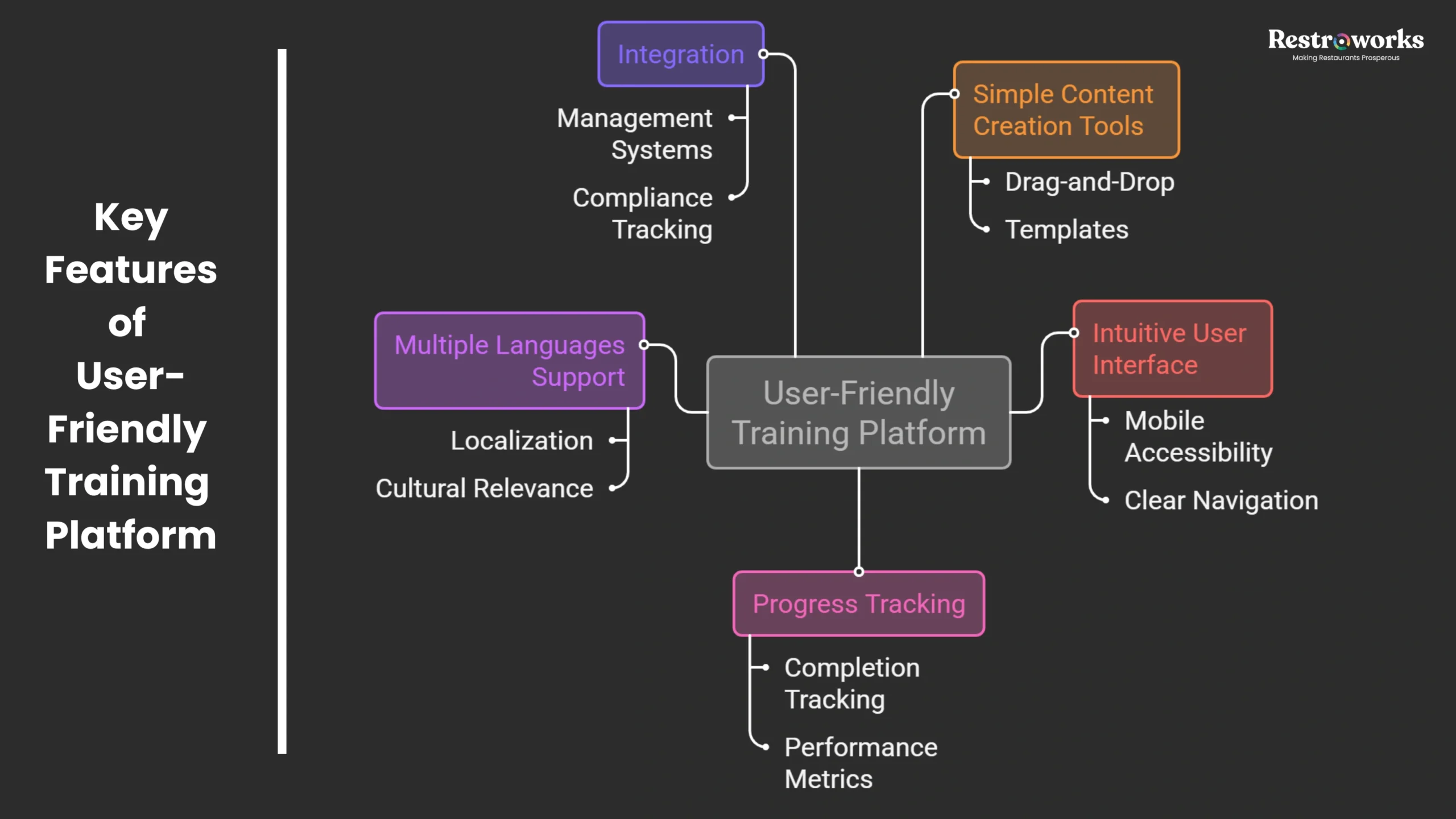
Here are a few key features that you should consider when investing in any restaurant training software:
1. Simple Content Creation Tools:
You shouldn’t need a technical background to update your training content as software changes.
Look for platforms where creating or editing modules is genuinely fast because your vendor will push updates, your menu will change, etc., and your training materials need to keep pace.
We recommend looking for AI-powered features that can create courses from existing documents or translate content into multiple languages easily.
2. Intuitive User Interface & Mobile Accessibility:
This is pretty obvious – If your manager can’t figure out how to navigate the admin side of the platform, they won’t use it. And if the learner-side interface is confusing as well, completion rates will automatically drop.
Plus, of course, this all should be as intuitive on mobile as on laptop/desktop. user-friendly interface and strong mobile accessibility are no longer optional for restaurant LMS tools serving multi-location teams.
3. Progress Tracking and Completion Tracking:
Yes, you should be able to see not just whether X has finished the module, but also their score, exactly where they struggle most, and how they rank compared with the location’s average.
Employee progress data at the individual, team, and location level gives you the information you need to improve training effectiveness before problems compound. Better progress tracking also helps operators manage training across departments without relying on spreadsheets or multiple tools.
4. Multiple Languages Support:
If your training content is only in English and 40% of your kitchen staff primarily speak Spanish, you haven’t actually trained 40% of your kitchen staff.
The best learning platform options (and several reviewers on G2 have explicitly called this out) offer translation into the end user’s preferred language, ensuring that restaurant staff training is delivered correctly and effectively across your workforce.
5. Integration with Existing Management and Compliance Tracking Systems:
Your restaurant LMS should be in sync with your employee scheduling software, your HR systems, and your POS system. This is what allows training data to connect to performance data, which in turn lets you measure training effectiveness in greater detail.
Platforms like Trainual and Connecteam are often used by hospitality businesses for managing digital SOPs, restaurant training content, and operational documentation alongside software onboarding.
How Do You Lower Training Costs While Maintaining Quality Across a Multi-Location Restaurant Group?
Yes, training employees does cost money, but given that the average cost per hire in the restaurant industry can reach $1,070, it’s still worth it.
Digital training saves money because once a training module is built, it costs nothing to deliver it to the hundredth location or thousand new hires. The larger the chain, the lower the per-employee cost of training becomes. Automated training software also helps restaurants onboard new hires faster, often reducing onboarding timelines from weeks to just days by giving staff on-demand access to consistent training materials before their first shift.
But, again, more training content does not always equate to better training. 30 short, useful modules people actually finish are better than 200 long modules nobody completes without you nagging them for days. You can only impart the same quality, or, in other words, high-quality training at scale if it’s easy to understand, role-specific, and practical.
The best approach is usually a mix of:
- Digital training for learning the basics
- In-person practice for hands-on skills
- Peer or manager support for real-world help
If you only give them digital training, it will feel too theoretical, while only in-person training costs too much time and money. So, a mix of both usually works best for restaurants. This blended learning approach accommodates different learning styles across restaurant teams, making training more accessible and effective overall.
Investing in strong employee training systems can also improve staff retention over time because employees who feel supported in their development are generally more likely to stay with the company.
For multi-location restaurant groups, the real value of a restaurant LMS is the ability to scale training quickly while maintaining consistent staff training standards across every store.
How Do You Measure Whether Your Training Is Actually Working?
If you only check whether your employees have “finished the training,” that alone won’t tell you if the training was actually fruitful. Like someone can complete every module 100% and still make mistakes on the job.
What really matters is whether restaurant operations improve after training, and by how much.
So, before you launch any new software, always track numbers like:
- Order accuracy
- Table turn time
- Inventory mistakes
- Food safety violations
- Guest complaints
- Compliance audit scores, etc.
Now, after training starts, track the same numbers again. If order accuracy goes up at locations where training completion rates are high, that’s a signal. If food costs are creeping up at locations where managers skipped the inventory module, that’s also a signal, and it’s a fixable problem once you can see it.
Business outcomes are ultimately what training is supposed to move. Not just “did people finish the modules,” but “are we running better?” That connection between training data and operational performance is what separates a learning platform that’s genuinely integrated into your management systems from one that’s just a checkbox compliance tool.
Restaurants that consistently train new hires on food safety workflows, inventory accuracy, and guest recovery standards are far more likely to deliver exceptional service and keep the guest experience consistent across every location.
What Does Post-Training Compliance Management Look Like for Restaurant Chains?
So, finally, you go live. The training modules are complete. Completion rates look good. Everyone seems to be functioning with the new system.
And then six weeks later, you somehow hear that location Z has been doing something wrong with the end-of-day reporting, all because a particular staff member couldn’t really understand one point in your module, and guessed his way through.
That’s exactly what makes post-implementation training support a must. That means restaurant chains should continue training their employees through:
- Refresher courses
- Quick pre-shift learning sessions – Even five-minute refresher sessions before shifts can reinforce specific software key features without pulling employees away from operations for long training blocks.
- Updated modules whenever the software changes
- Easy guides employees can revisit anytime
After all, the restaurant management software market is expected to grow by over $9.12 billion between 2026 and 2030, at a CAGR of 19.4%. That growth means there’ll always be more software, more updates, and more new features to train your employees on. The chains that build ongoing training infrastructure now are the ones that won’t be constantly scrambling to catch up later.
Another important step is asking employees for feedback. Like, what they wish they’d learned differently? The people using the software every day know:
- Which parts are confusing
- Which workflows slow them down
- Which training sections were unclear
That feedback is free, it’s current, and it’s the most useful input you’ll get for improving your training content.
The process is simple:
- Build training before rollout
- Update training when systems change
- Check if employees are actually using the system correctly
- Improve the training based on feedback
- Repeat consistently over time
That’s it. That’s the whole thing.