
Equipment Based on Your Bakery Format

What you bake should decide what you buy. Equipment needs change significantly depending on your core products.
- Bread Bakeries: Bakeries specializing in breads like sourdough handle heavier doughs, which require stronger mixers and proofing equipment. You’ll need to invest in baking tools like dough sheeters, rack ovens, or cooking racks.
- Cake Shops/Patisseries: Here, you need equipment to handle batters, cooling, and frosting. Basic tools will include convection ovens, refrigeration units for creams or fillings, turntables, and icing equipment.
- Donut or Fried Product Setups: These setups revolve around frying, so you need equipment that can handle continuous batches. Key baking tools include commercial fryers, doughnut cutters or depositors, proofing cabinets, and proper cooling racks to keep production moving smoothly.
- Mixed Bakeries: If you offer a mix of breads, cakes, and other baked goods, your equipment needs to be versatile. You’ll typically need mid-capacity mixers, combination or convection ovens, refrigeration units, and a range of prep and finishing tools to support different product types without overcomplicating your setup.
Must-Have Tools and Equipment for Your Bakery
When starting a bakery business, you don’t need to have every single tool out there. All you need are a few key items to get started. The idea is to find what works best for your setup and menu prep without spending too much time on finding the latest equipment.
That said, here are the essential tools and equipment that you should have in your bakery kitchen-
A. Prep and Measuring Equipment
The taste, consistency, and quality of your baked goods rest on accuracy. Every cake, bread, or cookie recipe needs to follow an accurate, measured recipe to deliver a consistent experience for customers.
It’s also the stage where having the right tools saves the most time, because these tasks repeat constantly. With a reliable setup, you can prep multiple items at once, switch between most recipes easily, and keep things organized.
1. Digital Kitchen Scale
When precision is everything, being off by even a half-teaspoon of baking soda in your cake recipe will turn your cake bitter. That’s why you need a digital kitchen scale to weigh your ingredients accurately for tasty and consistent recipes.
2. Measuring Cups and Spoons
In addition to a digital scale, you need measuring spoons for your dry ingredients, like flour or sugar, and measuring cups for your liquid ingredients, or cookie scoops for drop cookies. Spoons made of quality stainless steel are durable and efficient options.
3. Mixing Bowls
A set of stainless steel or glass mixing bowls is absolutely essential for mixing, whipping, and proofing. Having a set of 5-10 bowls in different sizes is a good idea when things get busy in your bakery, and you need to prep different elements quickly.
4. Spatulas, Whisks, and Chef’s Knife
These are your everyday tools for different baking processes — spatulas for mixing, folding in ingredients, or scraping the bowl, chef’s knives for cutting, and whisks to aerate batters for fluffy cakes. Look for high-quality, heavy-duty silicone spatulas, stainless steel whisks, and knives for durability.
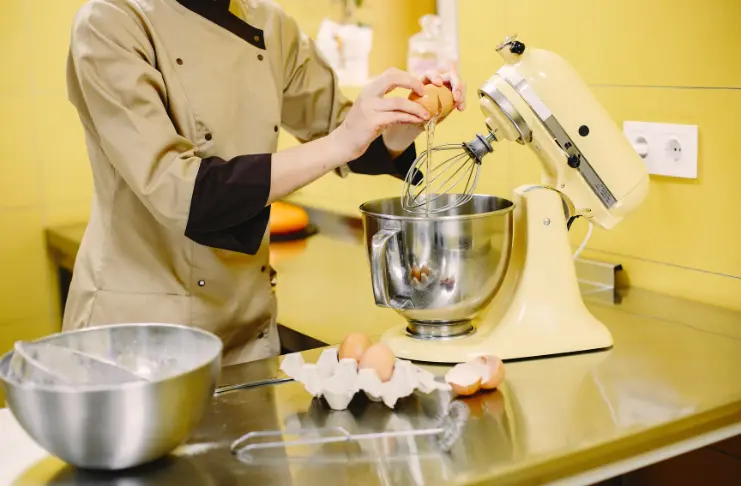
5. Electric Mixer and Hand Mixer
While you may use whisks and spatulas for mixing at a small scale, it can quickly become tiring and inconsistent. A hand mixer will manage tasks like kneading dough or whipping cream better, giving you better control over texture while saving time and effort.
6. Additional Tools
You will also need other tools like rolling pins, fine mesh sieves, cookie cutters, pastry brushes, baking sheets, and cookie scoops to standardize baking and presentation.
B. Essential Baking Tools
To bake that fluffy, moist bread, or get buttery, gooey cookies, you need to invest in high-quality, durable baking equipment. The right setup will standardize baking flow and generate consistent results.
1. Dough Sheeter
Useful for baking cookies, pastries, and laminated doughs, a dough sheeter speeds up the process and gives you uniform thickness.
2. Baking Pans, Cake Pans, Mats, and Cooling Racks
Depending on the products, you can invest in different types and sizes of bakery and cake pans, such as round/square cake pans, muffin pans, or baking pans. Cooling racks prevent moisture from getting trapped underneath and prevent baked goods from getting soggy.
Plus, baking mats allow even baking and minimize waste.
3. Commercial-Grade Oven
This is the heart of your bakery. A reliable oven maintains a consistent temperature across batches, which is critical when you’re baking multiple items back-to-back. It also determines how much you can produce in a given time, so quality is important here.
4. Proofing Cabinet
A proofing cabinet gives you control over temperature and humidity, so your cookie dough or bread ferments properly regardless of external conditions.
5. Oven Thermometer
Oven thermostats can often be inaccurate, which can affect your final product. An oven thermometer is a nice addition to ensure your oven is at the right temperature and bakes perfectly.
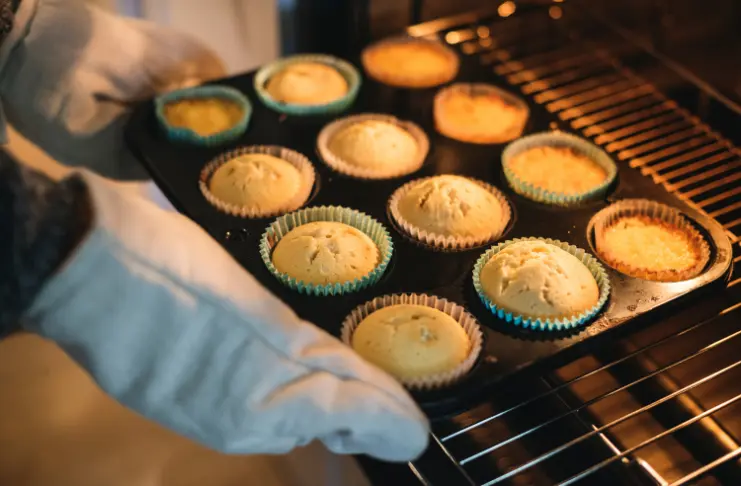
6. Oven Mitts and Gloves
Good-quality mitts or gloves reduce the risk of burns and make it easier to work quickly and confidently around hot equipment.
C. Frosting and Decorating
If your menu includes cakes or pastries, presentation will matter a lot. Finishing tools help you add detail, improve presentation, and offer quality products to customers. At the basic level, you’ll need-
1. Piping Bags
Piping bags can be used to fill donuts or decorate cakes, from rosettes to cupcake swirls. They’re essential for both portioning and presentation.
2. Cake Turntables
Frosting a cake without a turntable can get uneven and time-consuming. A rotating base lets you work smoothly around the cake, helping you achieve cleaner finishes with less effort.
3. Smoothers and Spatulas
These tools help refine your final product, like leveling frosting, creating clean edges, or smoothing out layers. They may seem like simple tools, but they make a big difference in presentation.

D. Storage and Packaging
Proper storage helps maintain freshness, while good and sustainable packaging ensures your products reach customers in the right condition. This part of your baking setup also affects how easily you can manage inventory and serve customers efficiently.
1. Bakery Cases and Displays
Your display is often the first thing customers interact with. Clean, well-arranged cases make it easier for people to see what’s available and decide quickly. You can also highlight bestsellers and improve overall presentation.
2. Commercial Refrigerators
You’ll need reliable refrigeration for storing ingredients like cream, butter, and fillings, as well as finished products that require cooling. It gives you the flexibility to prep ahead and manage inventory without compromising freshness.
3. Bakery Boxes and Disposable Pastry Bags
Packaging plays a direct role in how your products travel. Cakes, pastries, and breads need boxes and disposable pastry bags of the right size and structure, parchment papers, etc., so they don’t lose shape or get damaged before reaching the customer.
Budget Considerations and Cost Breakdowns
Investing in a reliable kitchen setup requires serious cost planning. The majority of your budget will go into core appliances and equipment like ovens, mixers, refrigeration, prep tools, etc.
These are non-negotiable and directly affect your daily production. You can’t cut corners here because replacing or upgrading these later will be expensive and disruptive.
The rest of your budget goes toward baking tools such as baking sheets, racks, trays, smallwares, displays, and packaging. Also, factor in the extra costs like installation, wiring, ventilation, and basic setup to get the right budget estimate.
For a small to mid-sized bakery, equipment costs typically range from $15,000 to $50,000, while larger setups can easily exceed $100,000 depending on scale and automation. Here’s what the bakery equipment costs will include-
- Ovens: They can range anywhere between $2,000 to $20,000+ for convection ovens and $5,000 to $30,000 for deck ovens, depending on size and capacity.
- Mixers: A small countertop model can start around $100-$500, while commercial planetary or spiral mixers range from $3,000 to $20,000+.
- Proofing and Dough Equipment: Smaller proofing cabinets can cost around $1,000, with full-size models around $6,000+, while pastry and cookie dough sheeters range from $3,000 to $18,000+.
- Refrigeration and Storage: Basic commercial refrigerators start at $1,000-$3,000, while larger or walk-in units can go up to $10,000+.
- Smallwares and Prep Tools: Baking essentials like mixing bowls, trays, whisks, racks, and other utensils can cost $1,000+.
Should You Lease or Buy Bakery Equipment?
Once you’ve mapped your equipment list and planned your budget, the next natural question comes: Should you buy or lease the core appliances?
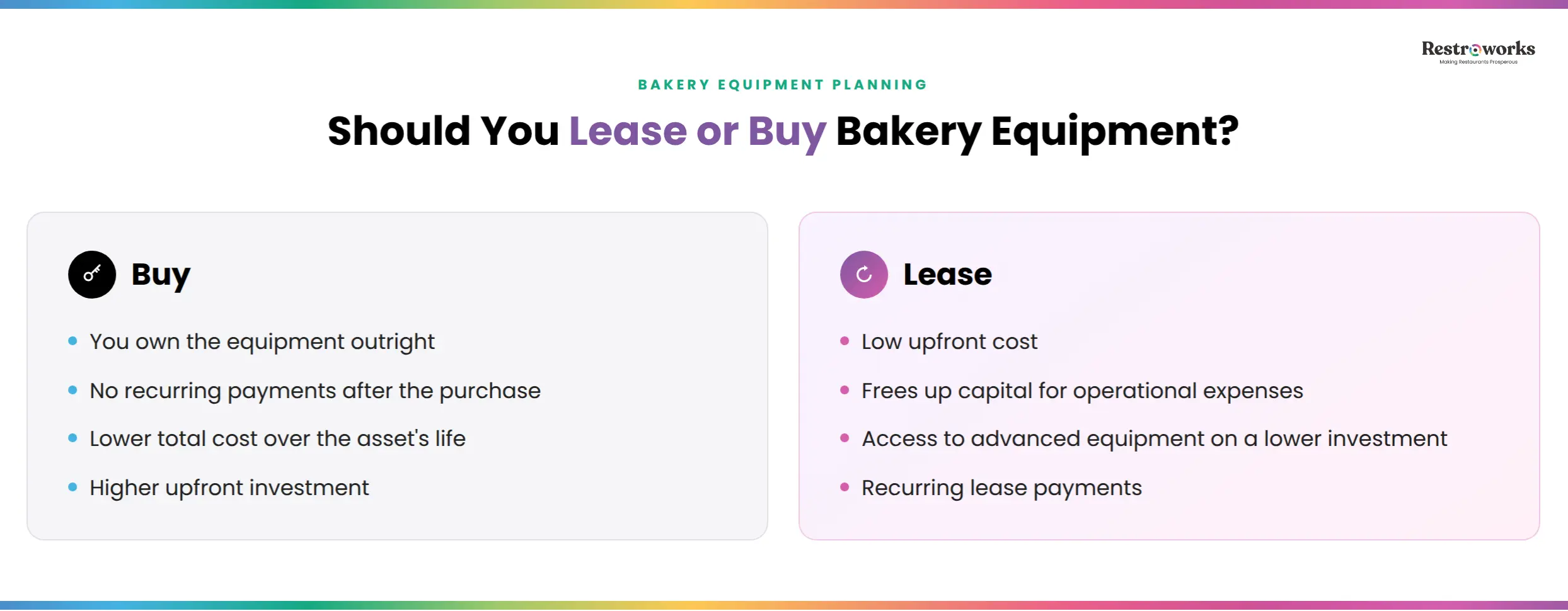
So here’s the deal. Buying equipment means you own everything outright, albeit at a higher upfront cost. Plus, there are no recurring payments, which will make it cheaper over time.
On the other hand, leasing reduces the burden of an initial investment and lets you purchase better equipment without exhausting your capital. This matters early on because you can use that capital towards rent, interiors, staffing, and raw materials.
But again, it will mean regular recurring payments, which will make the equipment expensive over time.
A practical way to approach this would be to-
- Buy the smaller essentials like electric mixers, half sheet pans, a kitchen scale, prep equipment, and smallwares.
- Lease or finance expensive equipment like commercial ovens, refrigerators, proofing cabinets, and cookie dough sheeters.
New vs Used Bakery Equipment: Which to Choose?
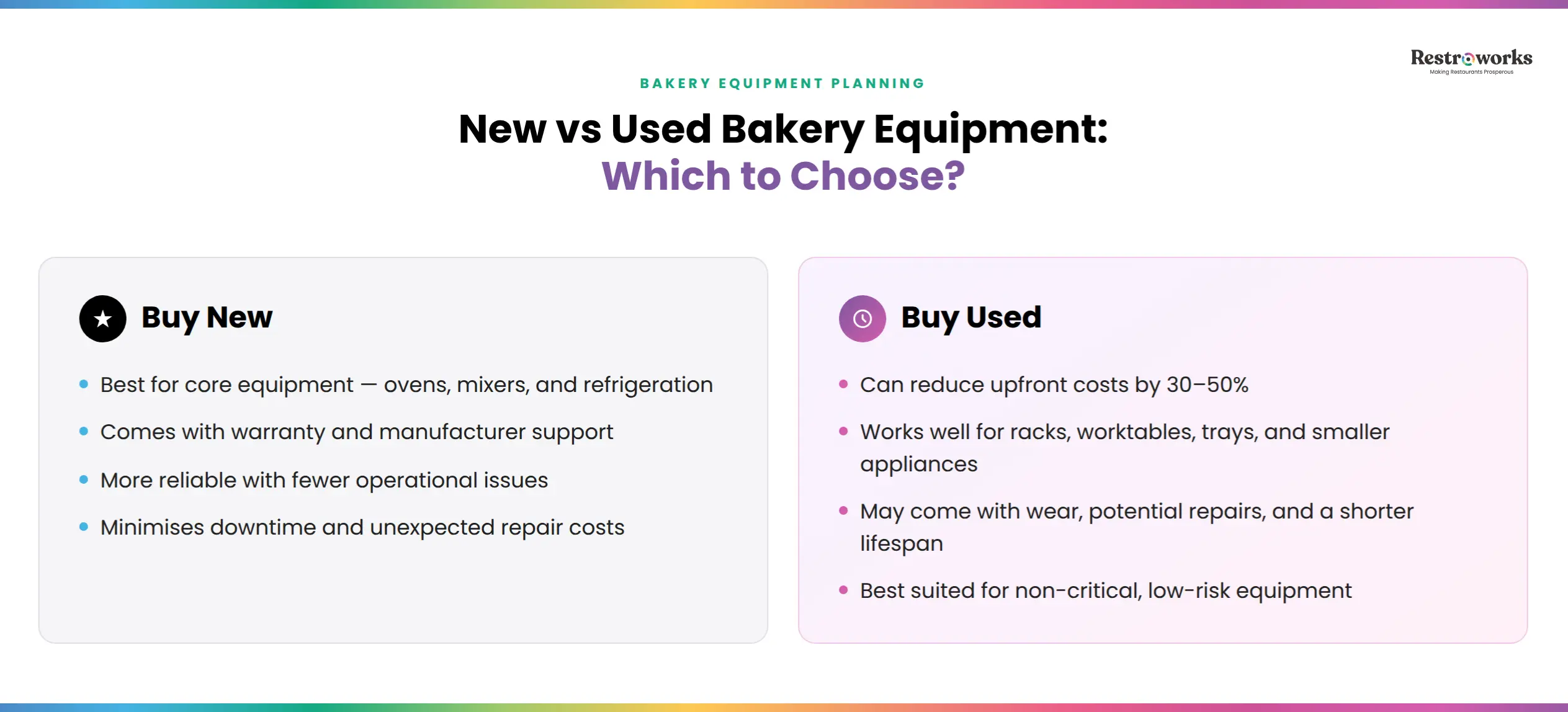
Another important decision with your bakery equipment comes down to buying new or used equipment. For core equipment like ovens, mixers, refrigeration, and essential baking tools, buying brand-new is the safer bet. A new machine offers reliability, warranty support, and fewer operational issues, minimizing downtime.
Alternatively, used equipment can reduce upfront costs by 30-50%, which is a significant savings when you’re starting out.
But at the same time, you may have to deal with wear and tear, potential repairs, and a shorter lifespan. So, things like racks, worktables, trays, or even smaller appliances can be bought second-hand without affecting the output.
How to Evaluate Your Bakery Equipment Vendor?
The equipment you buy is only as reliable as the support behind it. Vendor selection often gets overlooked, but it makes a big difference when you need installation help, replacements, or quick service during a breakdown.
Here are a few factors to consider when choosing bakery equipment and vendors-
- Pricing: Don’t go for the lowest price available. Always compare pricing and charges for installation and servicing to understand the total value of the equipment.
- Service Response Time: Ask how quickly they respond to repair or service requests to avoid disruptions to your bakery operations.
- Warranty Coverage: Check whether the equipment warranty covers common issues such as wear and tear or manufacturing faults. Knowing what’s included helps you avoid unexpected repair costs later.
- Installation Support: A reliable vendor helps with proper installation and offers after-sales support to ensure the equipment runs smoothly from day one.
- Training and Guidance: Many vendors offer training documents to help users understand how to use and maintain the equipment properly. This can reduce misuse and extend the life of your equipment.
- User Feedback: Check for user reviews for the equipment quality and vendor support to make an informed decision.
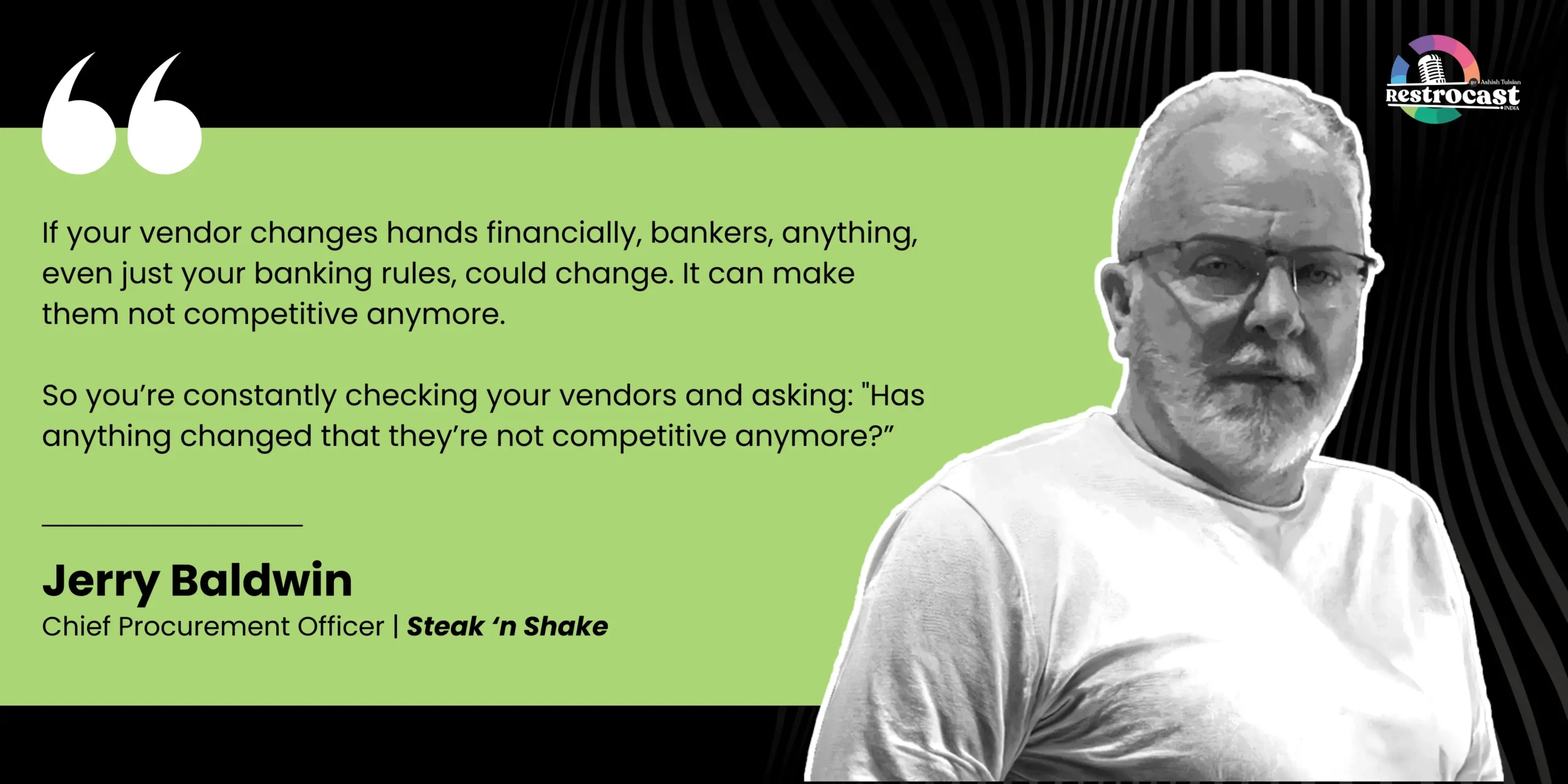
Once you’ve chosen a vendor and invested in equipment, it is still important to regularly review the vendor relationship and service. Even if everything works well in the beginning, things can change on the vendor’s side, such as pricing, service quality, or response time.
Vendor relationship is something Jerry Baldwin, Chief Procurement Officer at Steak ‘n Shake, discusses on Restrocast-
Catch up on this full conversation: