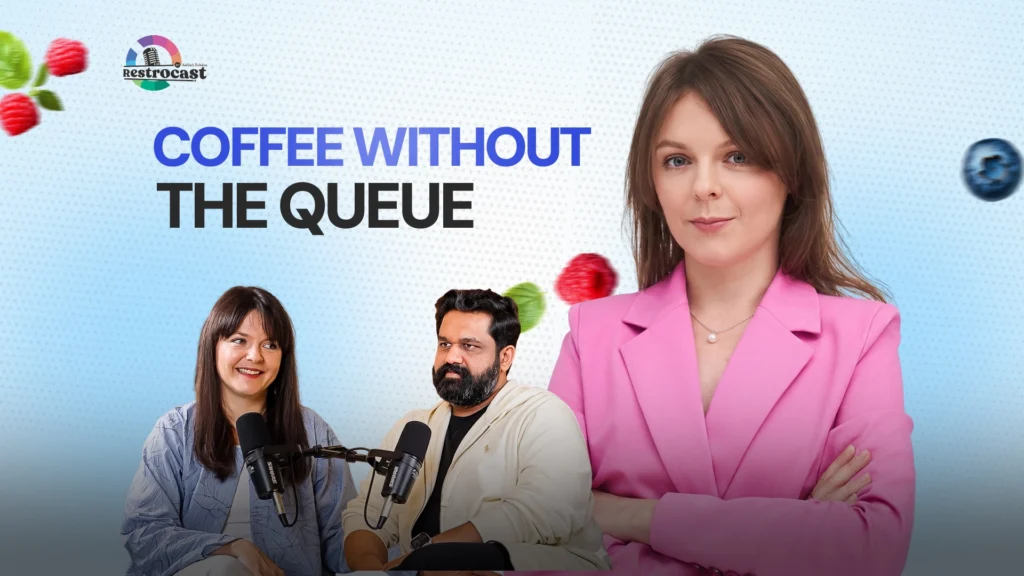

Most people launching a new brand in Dubai arrive with a team, a budget, and a plan. Katerina Borodich arrived with two suitcases. No legal entity, no premises, no staff — just a conviction that the city was ready for a completely different kind of coffee experience. Three years later, DrinkIt has eight locations in the UAE, 50% year-on-year growth at stores that have been open for three years, and a franchise pipeline that is just getting started. In this Restrocast, Ashish Tulsian talks to Katerina about the science of consumer insight, what it really takes to enter a market you don’t know, and why she built her own community when none of the existing ones felt right.
Tell us what DrinkIt is and why you’re calling it a revolution?
Katerina Borodich: What we say in our company is that DrinkIt is not a coffee shop with the app. It’s the app with a coffee shop. In our locations, 97% of orders go online. We simplified the entire ordering experience. In a regular coffee shop, you wait in the queue to order, you say your whole order out loud—double shot, coconut milk, don’t stir—you pay, and then you wait again to collect. You’re waiting twice and talking a lot. In DrinkIt, you order from wherever you are. By the time you walk down from your office, your coffee is ready. There’s no queue, no confusion, and no searching for your name on a cup because we have a smart takeaway display showing your name and order number. When I announced in Dubai that this would be the new way to order coffee, almost everyone said I was crazy. People want to talk to the barista, they said. Fine, I said, let’s see the numbers. 97% of people, it turns out, don’t want to.
What does the tech-first model mean for the human side of the business?
Katerina Borodich: It focuses on it. There’s a customer at our Bay Avenue location who comes every day at 7 am for a cortado. Some days, he forgets to place his order. Our team makes it anyway, because they know. He walks down, expecting to have to wait, and there it is. That’s a human thing. The technology handles the transaction so that the people can handle the relationship. Our baristas know when regulars are going on holiday. They know who’s expecting a baby. When a favorite barista comes back from vacation, guests genuinely miss them and are happy to see them return. It’s all about people; the technology just clears the noise so those moments can happen.
You came to DrinkIt from Dodo Pizza in the UK. How did you end up running a coffee chain in the UAE?
Katerina Borodich: The honest version is that I started as an electrical engineer in Russia, realized fairly quickly that being a young woman in that field meant waiting ten years to be taken seriously, regardless of performance, so I made a spreadsheet of every profession, crossed out everything that didn’t fit, and ended up in marketing. I joined Dodo Pizza through a networking conversation at a conference on agile marketing, became head of marketing for Europe, then moved to the UK to launch a corporate chain, which required both marketing experience and engineering knowledge. My boss told me they needed someone with an engineering background, and I said I had a postgraduate degree in electrical engineering. He didn’t believe me. It turned out to be a perfect match, and I launched a full new pizza concept within five months, during the second wave of the pandemic. Then, in early 2022, after we had to close the UK business, our founder, Fyodor, invited me to build DrinkIt in the UAE. He said it didn’t matter that I didn’t know the difference between a cappuccino and a flat white. What mattered was that I knew how to build a business internationally from zero.
You’re known for going unusually deep on consumer research. What does that actually look like in practice?
Katerina Borodich: When I was working on Dodo Pizza in the UK, I ran three focus groups on day one and got nothing useful. British people told me everything was “nice” while sales were terrible. The second day, I came back and just left them alone: food, leaflets, stickers, and a room to themselves. When I came back, the whole space was covered in stickers. “This garlic bread doesn’t taste like garlic.” “This offer isn’t a good deal.” Suddenly, I had everything. I also used Airbnb to live with local families for two weeks at a time, young couples, single women, single men, just to experience how they actually live, how they spend an evening, what they order, and why. I hosted informal pizza comparison dinners where friends came over, we ordered three or four different brands, had a beer, and talked. You get completely different answers in a friend’s living room than in a formal focus group.
Here in Dubai, I can’t do the Airbnb approach; the expat population is 90% experts on everything, which is actually useful in a different way, but it’s not the same as understanding the local culture. So instead, my team and I stand in competitors’ queues and talk to customers. Not as marketers, just as people waiting in line. I’ll try a new item at a nearby coffee shop and ask the person next to me what they usually order and why they like it. One woman told me she loved a particular pastry because she could taste the butter. That’s the kind of thing that doesn’t show up in a spreadsheet. We also have a team chat where everyone shares what they heard, including when they chose to go somewhere other than DrinkIt and why. If someone went to a competitor because they wanted a nice view, and we don’t have that kind of location, that goes straight to the property search team.
What’s the growth story so far, and where are you taking it?
Katerina Borodich: We opened the first location in January 2023, in a corner of a Dodo Pizza outlet, because I knew getting standalone locations from major developers would take time, and I needed to prove the concept first. I brought leasing managers from AMR and Dubai Holding to see it there. Our sales are publicly visible on the Dodo Brands website in real time, which is how the whole group operates, with complete transparency. So when developers asked about performance, I could just show them. Our stores now show 50% like-for-like growth, including locations that have been open for three years. We have eight stores, six corporate and two franchises. We’ve signed seven franchise partners for next year, and we’re launching in Abu Dhabi. The goal is close to 20 stores by year four. And beyond the UAE, I’m actively looking for strong local partners in nearby markets, people who grew up there, who feel it intuitively, not just understand it intellectually.
What has changed in you over the last ten years?
Katerina Borodich: Three things. First, I now understand how important your surroundings are, the people you build your circle with, and I’ve learned how to build that circle deliberately, even in a country where you start from nothing. Second, ten years ago, I believed hard skills were everything. Now I’m certain that mental stability, focus, and energy matter more. Hard skills are learnable. The third thing is that who you do something with matters more than what you’re doing. I think those are the three biggest shifts.
You also built your own community here from scratch. How did that happen?
Katerina Borodich: I went to a few business clubs in Dubai and didn’t connect with any of them. So I created my own, a ladies’ circle, because I’m surrounded by men all day in F&B, and I wanted something different. I met people, and after each conversation where I felt genuinely energized, I would meet them again. By the third meeting, if our values and approach to life felt aligned, I invited them in. For the first few months, we met every Saturday, an hour of high-intensity training, then breakfast, then a workshop or lecture from one of us. Six hours, every week. Nobody was obligated. It just happened naturally, like a river. Now it’s about twenty people, mostly C-level or founders, and we know each other’s wish lists. When one of them gave a public speech, she was terrified, but we all showed up without coordinating in the group chat—just person to person—and cheered for her like football fans. That kind of support is something you build slowly, and I think it’s one of the best things I’ve done since moving here.
Conclusion
Katerina’s story is ultimately about doing more homework than anyone expects you to. From standing in competitors’ queues to living with strangers in London to building a community from scratch in a city where she knew no one, her approach is the same everywhere: assume you know nothing, go find out, and move faster than the market expects. DrinkIt’s 97% digital order rate is not a product of technology alone. It’s the result of someone who spent years learning exactly what people actually want and then building the machine to give it to them.