
Growth is exciting. Adding a third outlet to your restaurant chain is amazing. But what you will only realize after becoming a multi-unit operation is that outlet one vs outlet three are completely different leagues.
What used to be easy to control is now creating bottlenecks—costs are rising, every team operates differently, and the restaurant experience is not the same across outlets. Scaling to multiple locations introduces a different level of operational and financial complexity that no one prepares you for.
So, you need a systematic approach that helps you achieve operational excellence and ensure consistency. This blog explores such best practices for managing multiple locations efficiently.
What you will learn
- How do multi-unit restaurants operate?
- Unique challenges facing multi-unit restaurant operations
- Best practices to manage your restaurant operations seamlessly
Understanding Multi-Unit Restaurant Management
Once you move beyond a single restaurant outlet, the way you manage the business starts to change in subtle but important ways. In one location, you have direct visibility, which is important for maintaining consistency and performance.
But across multiple units, that’s not an option anymore. Every location, every team member, and every cost performs and behaves differently. A big reason why restaurants today also rely on large chain restaurant software for better visibility.
Biggest Challenges Multi-Unit Operators Face
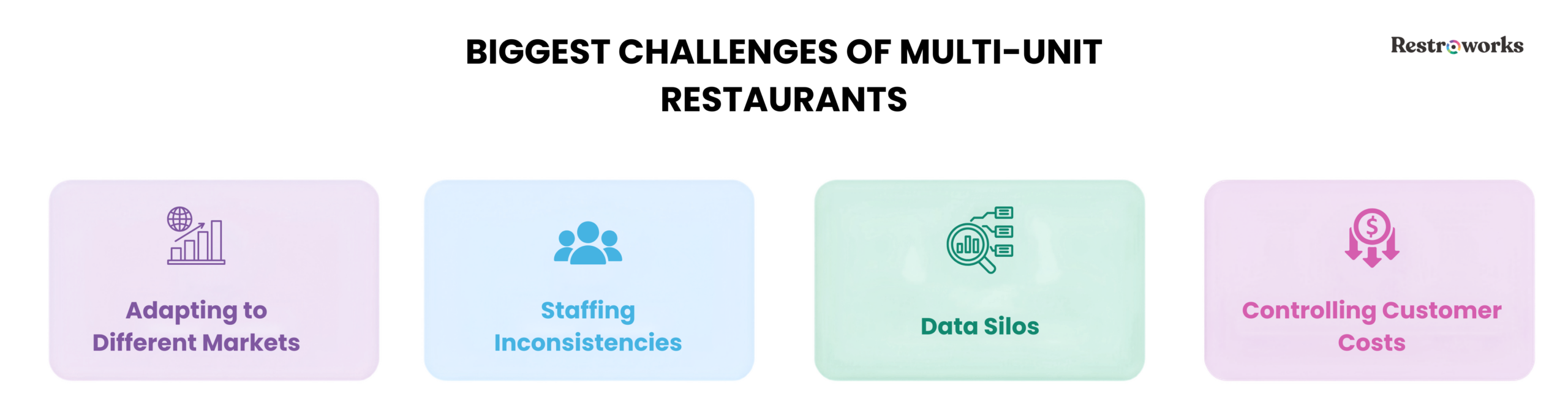
The most common challenges that multi-unit restaurant operators face are-
- Adapting to different markets: Customer preferences, demand patterns, and pricing sensitivity vary by location. What works well in one store may underperform in another, which makes standardization harder than it seems.
- Staffing inconsistencies: Each location operates with a different team, which leads to variations in service quality, productivity, and cost control. This can create uneven performance across units over time.
- Data silos: When information is scattered in different restaurant locations, it becomes difficult to get a clear, unified view of performance. This delays decisions and makes it harder to identify issues early.
- Controlling supplier costs: Managing vendors across multiple restaurant locations often leads to price variations, inconsistent supply quality, and higher procurement costs if not standardized properly.
The thing is, whenever a customer visits a chain restaurant, they expect a predictable and consistent customer experience. To achieve that, you need to create standardized, replicable processes. Let’s dive into the best practices for multi-unit restaurant operations to do so.
Operational Management for Successful Multi-Unit Restaurants
Here are the best practices for managing multi-unit restaurant operations-
1. Implement Standard Operating Procedures (SOPs)
Creating consistent restaurant service, food quality, and taste starts with nailing your SOPs. These are your documented guidelines that tell how every task, from greeting and seating guests to food preparation, cleanliness, service, and payments, should be performed.
Your SOPs need to be clear and detailed, easily accessible, digitally available, and supported with visual elements where needed.
- Clearly define non-negotiables such as portion sizes, prep standards, and service flow to avoid variation across locations
- Make them easy to follow.
- Update SOPs regularly based on operations across locations.
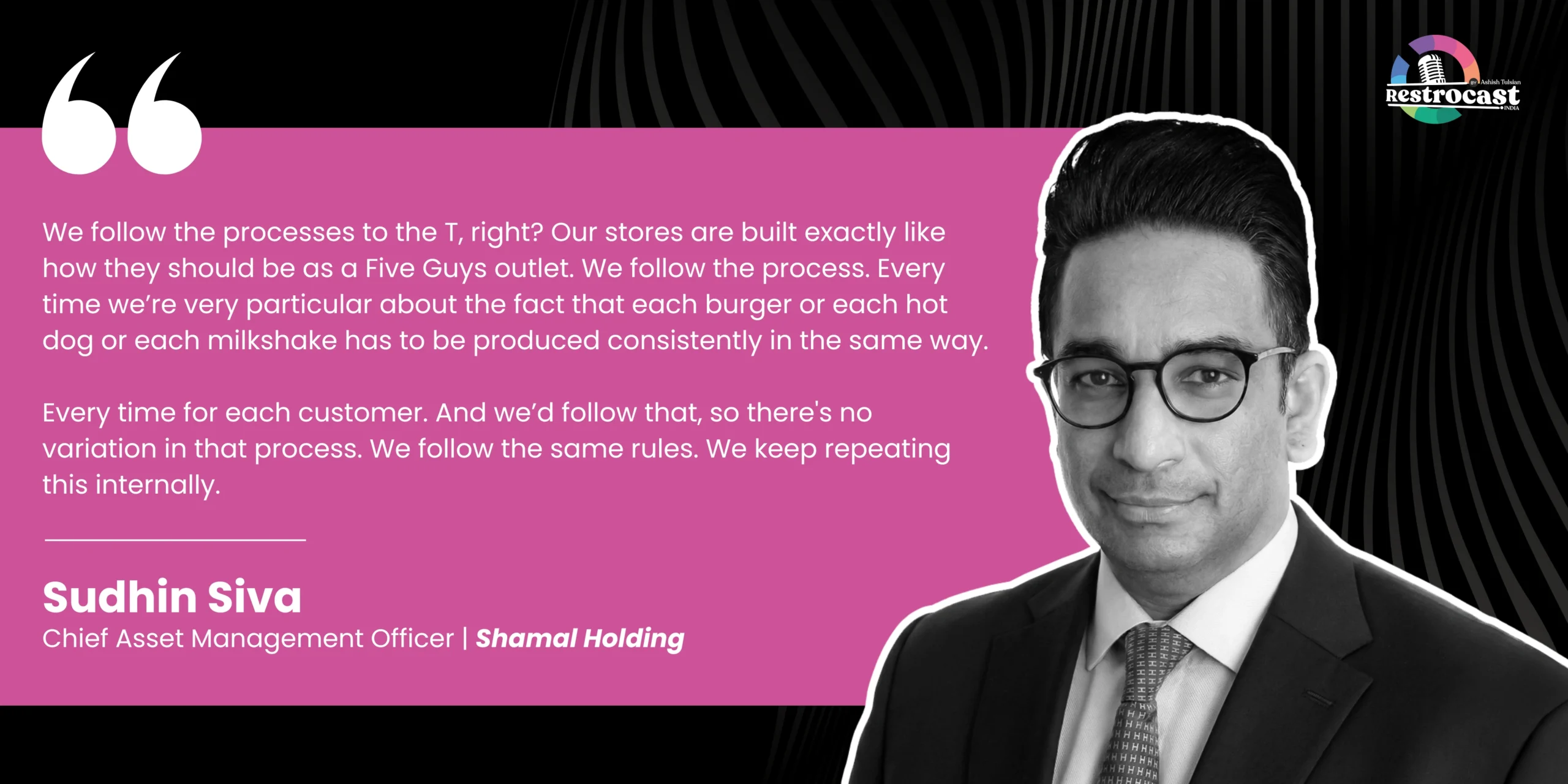
Discussing consistency in recipes and processes across outlets on Restrocast, Sudhin Siva, Chief Asset Management Officer at Shamal Holding, mentions-
2. Centralize Purchasing and Vendor Management
One thing that can become easier with multi-location restaurants is negotiating pricing with vendors. With a centralized approach to inventory management and supply chain, you can lock in pricing and secure better cost terms due to high volume.
Plus, centralizing purchasing gives you more control and better visibility into ingredient quality and price changes to keep food costs stable.
3. Encourage Open Communication
As you scale, communication flow becomes complicated. Unless you can be everywhere, you may not get the full picture. So, it is important to build a system where information moves quickly, clearly, and without distortion across locations.
- Set up structured reporting to receive the same updates
- Create direct feedback loops with location managers
- Encourage cross-location conversations so team members can share what’s working
- Reduce communication gaps between central teams and outlets
4. Unify Employee Training Programs
If you want to keep performance and procedures consistent across all units, you need a unified staff training program. This not only lets you communicate your brand values but is a good way to track employee performance.
- Standardize training modules so every employee learns the same core processes, expectations, and brand standards to deliver the same customer experience.
- Focus training on execution and decision-making.
- Use repeatable onboarding systems to reduce dependency on individual managers for consistent training quality.
5. Conduct Regular Internal Audits
Internal audits are important for compliance, reviewing areas like food preparation, food safety and hygiene, inventory handling, service flow, and adherence to your defined processes. They give you a ground-level view of execution that reports alone can’t capture.
- Follow fixed audit checklists across locations so you can compare results meaningfully.
- Rotate auditors or conduct cross-location audits to reduce bias and generate more honest observations.
- Track recurring issues across stores and identify patterns.
Routine, objective internal audits also prepare your teams better for third-party audits for restaurant compliance processes.
6. Monitor Performance and Standardize Reporting
You can’t manage multiple locations if every store reports performance differently. Without a comprehensive view, it becomes difficult to compare, identify issues, or act quickly.
- Define a fixed set of key metrics that every outlet should track, such as sales, food cost, labor cost, and wastage.
- Use the same reporting format across all stores for easy comparison.
- Focus on outliers, such as any outlet performing significantly above or below average, and take corrective actions
Leveraging Technology Infrastructure for Multi-Unit Success

With a single restaurant, you may be able to make do without technology. But for multi-unit restaurant management? It is a necessity for seamless operations, customer experience, and growth.
Because if each new location runs on separate systems, you lose visibility, delay decisions, and spend more time reconciling data. A strong tech stack brings everything into one place so you can track performance, control costs, and respond faster.
This includes-
- Integrated POS systems to simplify billing, transactions, reservations, customer details, and more.
- An inventory management system to simplify inventory tracking and procurement, waste management, recipe costing, standardization, and ingredient mapping.
- Kitchen display systems to streamline order communication from front-of-house to the kitchen.
- Unified dashboards for reporting and analytics to track sales trends, food costs, labor costs, variance, and so on.
- Software tools for scheduling staff members, attendance, payroll, etc.
When evaluating a restaurant management system for multi-unit operations, keep in mind certain factors-
- Cloud-based system to allow real-time access across locations and devices.
- The system should be easy to use and learn.
- It should integrate with your existing systems so that information flows seamlessly.
- Multi-location control that lets you update menu items, pricing, and configurations across outlets.
- Vendor support for implementation and post-purchase configurations
Leadership Structure and Regional Management
After standardized operations and tech automation, what can ensure the success of multi-unit restaurant operations is the people you put in charge. Here, you move from managing stores to managing layers of multi-unit restaurant management.
As Sudhin Siva puts it, “I think when I started out, I did a lot of things myself, right? But when you grow in your role, the one thing I learned that I needed to do more of is delegate and trust.”
So, a clear structure is necessary to make smarter decisions, simplify communication, and establish accountability. Your goal should be to design a structure where you can clearly distribute responsibility without impacting control. A good way to go about this is-
- Group stores into territories based on proximity, volume, and operational complexity.
- Define a clear span of control by limiting how many stores report to one manager.
- Keep reporting lines simple, so store managers know exactly who to go to for decisions and escalations.
Role of Multi-Unit Restaurant Manager
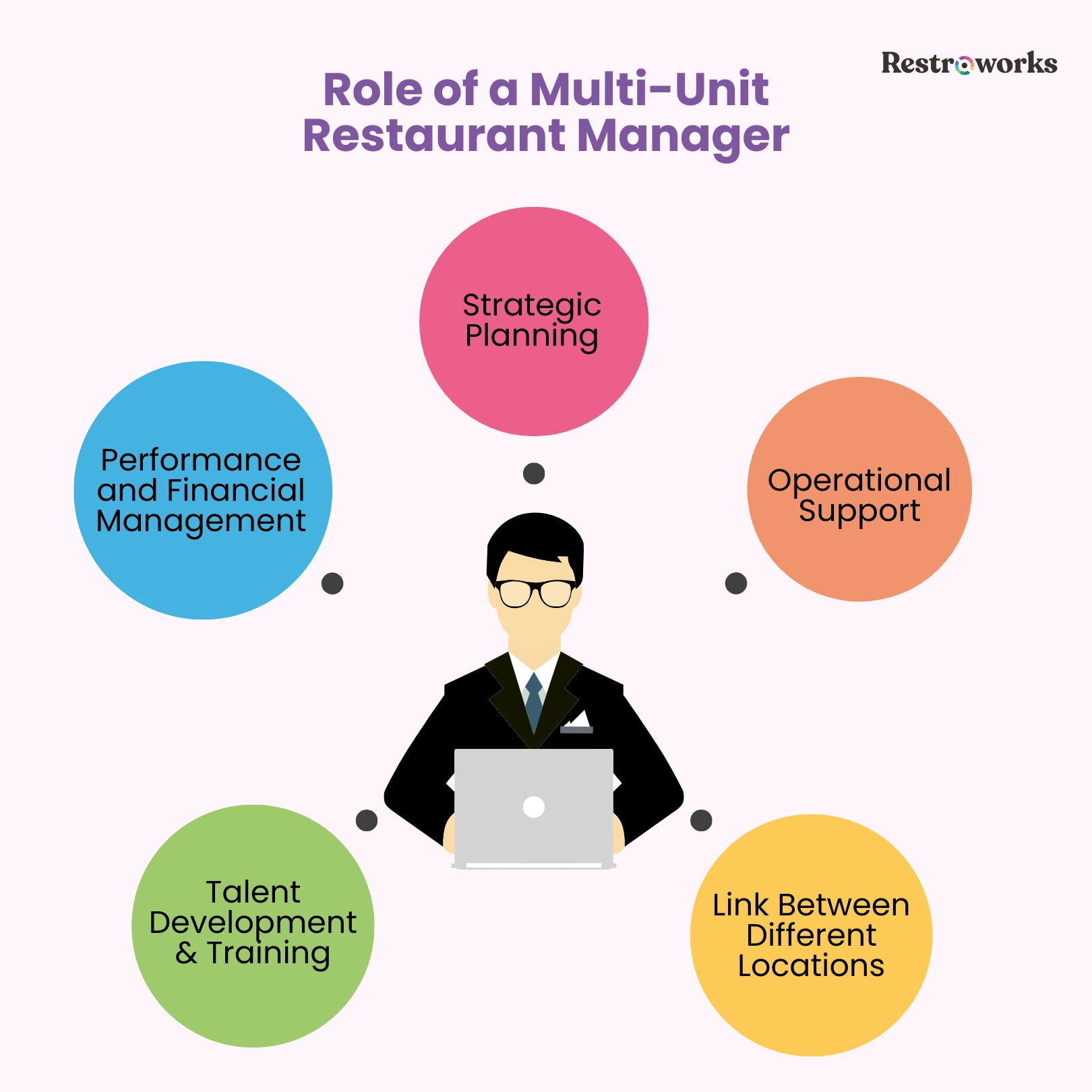
Within this structure, the multi-unit restaurant manager acts as the link between individual outlets and central leadership. They don’t step in to run day-to-day operations. Instead, they focus on high-level strategy, financial analysis, and coordination between outlets.
Their responsibilities should include:
- Managing a fixed group of stores so they can track performance and identify issues early.
- Overlook financial and cost control processes
- Accountability for regional outcomes, including sales, cost control, and consistency across all locations in their territory.
- Coaching store managers to improve execution and maintain operational standards across outlets.
- Ensuring SOPs are followed while allowing practical adjustments based on local demand and conditions.
With clearly defined responsibilities, you can ensure smoother operational efficiency and coordination for effective multi-unit restaurant management.
Cost Control and Financial Management for Multi-Unit Operations
The real challenge in cost control for multi-unit restaurants is that small differences in recipes, ordering, or inventory handling across stores can quickly lead to big financial losses if left unchecked.
This means that centralizing financial oversight is another thing you have to take care of to boost profitability for your multi-unit restaurants.
Manage Recipes and Food Costs
Food cost variation usually starts at the recipe level. If portion sizes, ingredient usage, or pricing differ across locations, even high sales won’t help control profit margins. To manage this, you can standardize recipes and map ingredient usage to each dish.
Plus, you’ll also need visibility into how ingredient costs change over time. Track food costs at the recipe level, so you can adjust pricing or portions early. When updates are made, apply them across all your locations to prevent any cost differences.
Forecast Sales to Streamline Inventory and Labor Planning
Food (25-35%) and labor (30%) are two of your highest costs. And managing these based on assumptions and intuitions just won’t cut it. Demand and sales forecasting use historical sales data, seasonal factors, customer spending behavior, and even weather patterns to predict future sales and demand.
With these insights, you can see exactly which days or periods will be busy and schedule staff and kitchen prep accordingly. This helps you reduce excess inventory, avoid shortages, and keep labor costs closer to actual restaurant demand.
Track Internal Inventory Transfers
In multi-unit operations, inventory doesn’t just come from vendors. It often moves between your own locations. If you don’t track these transfers properly, your inventory and cost data become unreliable.
Use inventory systems to record every internal transfer with clear quantities and cost values, just like you would with a supplier order. This keeps your usage and food cost accurate at each location. Tracking these movements also helps you identify stock imbalances and outlet-level waste, which are critical for cost control.
Scaling your restaurant to multiple locations changes the way things work. Without the right systems and structure, consistency, cost control, and visibility become harder to maintain. As you streamline operations, align teams, and use data effectively, you can manage complexity better and grow your multi-unit restaurants efficiently.