
Restaurant Accounting Software Integration With POS for Chains

Restaurant Accounting Software Integration with POS for Chains: Streamline Finances & Operations

Home / Blog /  

Restaurant Accounting Software Integration with POS for Chains: Streamline Finances & Operations

Read summarized version with

Operating a restaurant chain while not linking your point-of-sale system with your accounting system is like driving in a car with a fogged-up windshield. It’s possible to move forward, but what you react to is not really the information that is before your eyes.

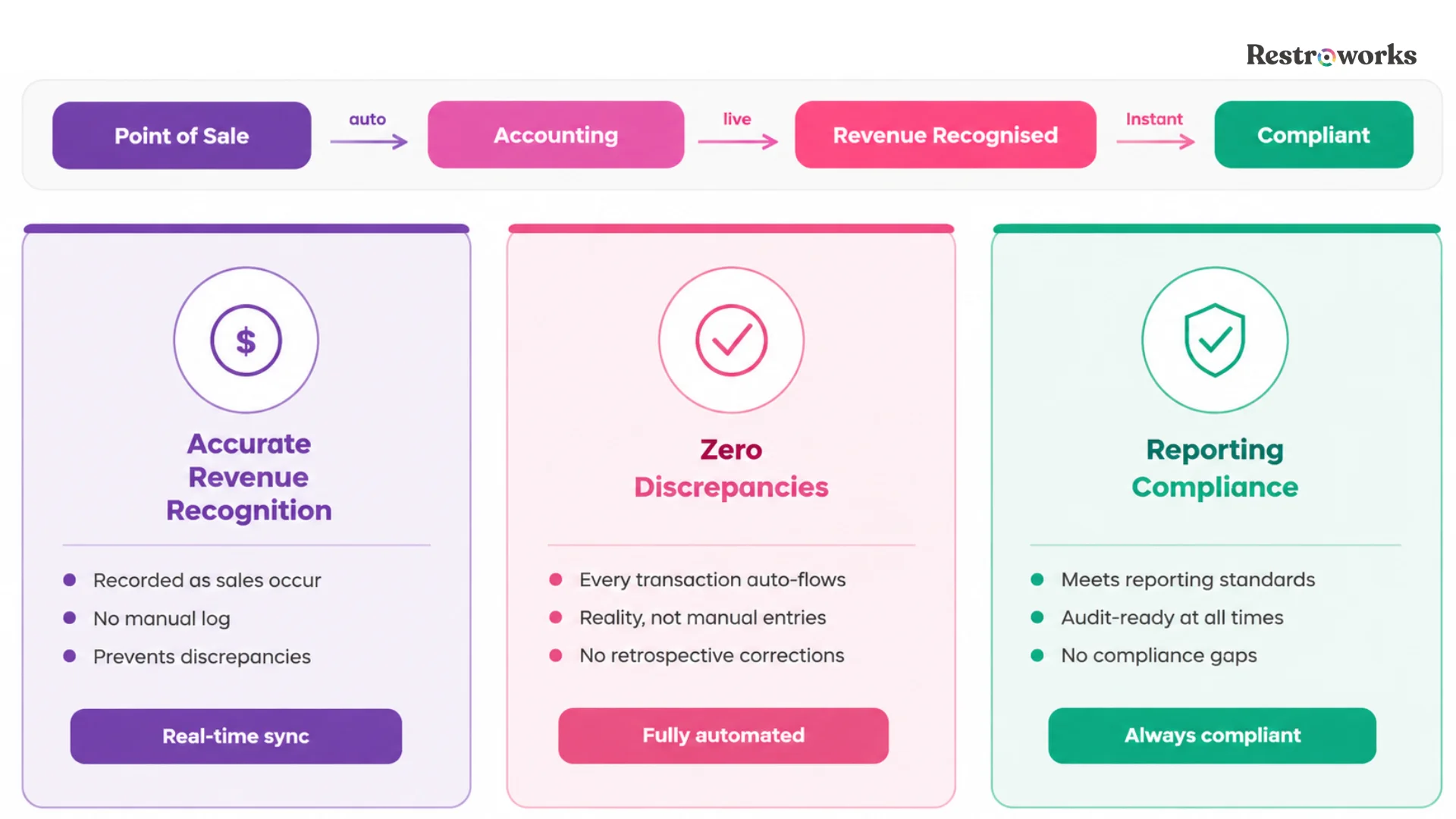
Restaurant accounting software integration with POS for chains is not a luxury upgrade. Integrating a POS system with accounting software eliminates the need for manual data entry, significantly reducing the risk of errors in financial tracking. Real-time data synchronization between POS and accounting systems ensures that every sale, refund, or adjustment is instantly reflected in financial records, providing an up-to-date picture of financial health. An integrated POS system ensures that revenue is recognized as soon as sales are made, which helps prevent discrepancies and ensures compliance with financial reporting standards. For any multi-location operation trying to make data-driven decisions, maintain profitability, and close monthly financial tracking without a week of manual reconciliation, it is the operational foundation on which everything else depends.

A 2023 study found that using a restaurant POS system improved order accuracy by 25% and reduced customer wait times by 30%. Deloitte’s 2025 SMB Technology Study found that automated accounting sync reduces month-end close time by 4.2 days on average. Those are meaningful numbers. At the chain scale, they compound across every location, every month.

What You Will Learn:

  • How the integration actually works
  • What it costs
  • What fails when chains get it wrong
  • How to implement it in the right sequence.

Accounting Software: Understanding the Tech Stack
Restaurant Accounting Software Integration With POS for Chains

Before getting into integration mechanics, it helps to understand that the accounting software market for restaurant chains is not one-size-fits-all. The platform that works for a three-unit independent restaurant group will not serve a 50-location franchise operation, and choosing the wrong tier is one of the most expensive mistakes a growing chain can make, because reversing it means a forced re-implementation 12 to 18 months later.

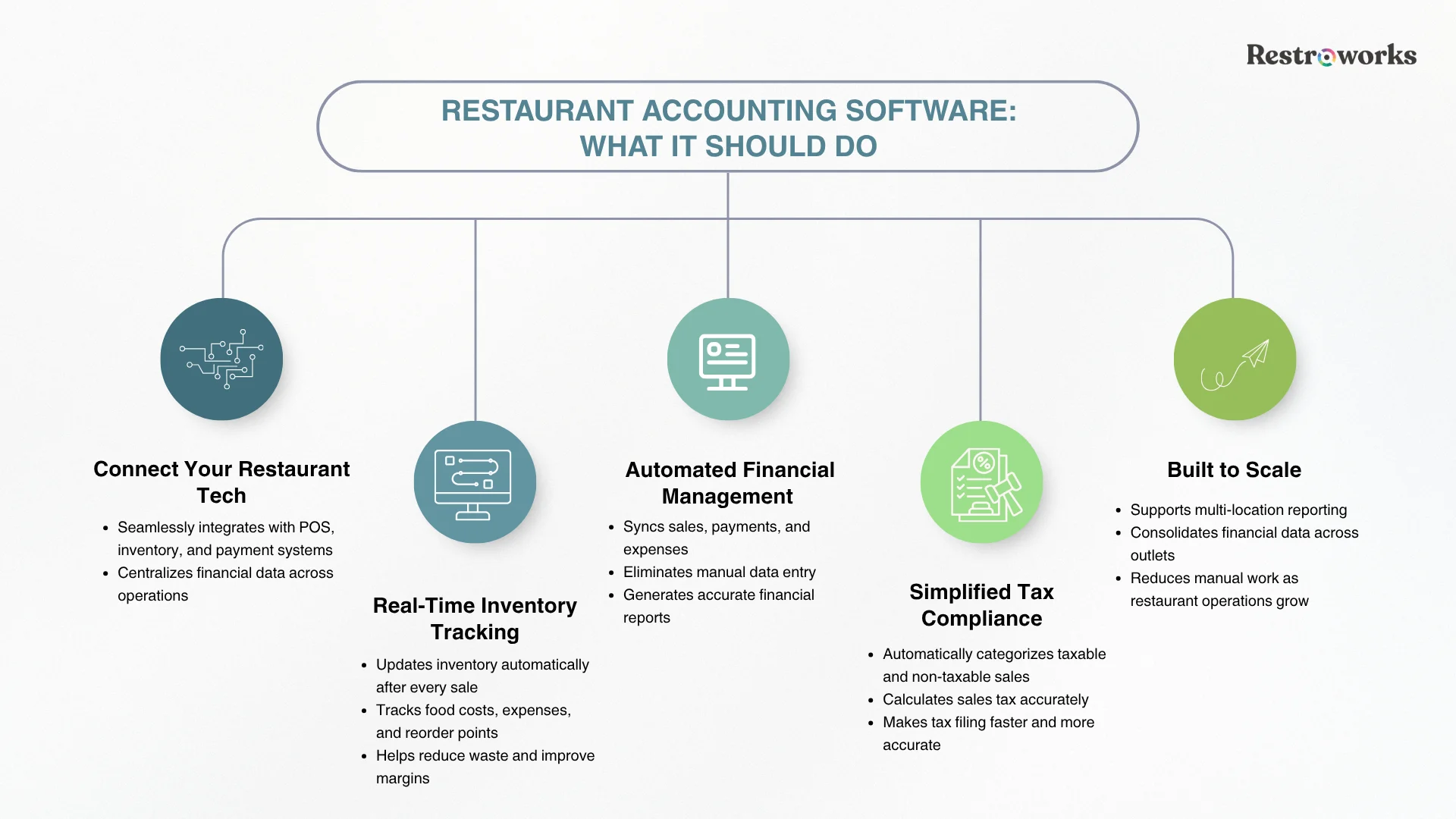
Integrating accounting software with POS systems is an advanced functionality that enhances inventory management by providing real-time tracking of inventory levels, which helps monitor expenses and manage reorder points effectively. Automated inventory updates based on sales data and operational data can significantly reduce waste and improve profit margins for restaurants. Integrating a POS system with accounting software simplifies tax reporting by automatically categorizing and calculating sales tax for each transaction, ensuring compliance with tax regulations. With integrated systems, managing inventory and maintaining organized records of all taxable and non-taxable sales makes the end-of-tax-period filing process more efficient. Hence, it becomes important to choose the right accounting software.

Here is how the tiers break down by location count:

QuickBooks Online works reasonably well for chains with under five locations. It is accessible, affordable, and connects to most modern POS systems through native integrations or middleware. The limitation is that it was not built for multi-location consolidation. As locations scale past five, the manual workarounds required to produce consolidated financial reporting start consuming more staff time than the integration saves.

Sage Intacct and NetSuite serve chains with over 50 locations, particularly those with complex franchise structures, multi-entity consolidation requirements, or international restaurant day-to-day operations. These platforms require more technical expertise to implement and maintain, but provide the enterprise-grade architecture that large restaurant groups need for accurate financial reporting at scale.

EXPERT INSIGHT

Nicole Gralapp, CPA at SVA Accountants, summarized the core value clearly: “This integration saves time and ensures that your revenue recognition is aligned with your accounting systems, providing more accurate financial reporting.”

Inventory Management: Where Integration of Point of Sale Pays Most Directly

The most immediate financial benefit of connecting your restaurant POS system to your accounting software on a chain scale is in inventory management. When a sale is processed through the point of sale, integrated systems automatically update inventory levels, calculate the cost of goods sold, and flag variances between theoretical and actual usage, without anyone manually entering the data.

This is not a minor operational nicety. Cloud-based POS systems are essential for multi-location restaurant management, as they allow for real-time data access and centralized control over restaurant operations, inventory control, vendor management, customer interactions, and loyalty program management. Real-time visibility into inventory and labor allows for immediate adjustments to staffing levels, menu engineering, and menu pricing, maximizing profitability. Effective inventory management is crucial for restaurants as it helps prevent over-ordering and reduces food waste, which can significantly impact profit margins. Real-time inventory tracking allows restaurant operators within the food service industry to monitor stock levels and make informed purchasing decisions, ultimately improving cash flow management. Automated inventory management systems can provide valuable insights into inventory costs and usage patterns, helping restaurants optimize their supply chain and reduce operational inefficiencies. 

Multi-Location: Choosing Your Accounting Integrations Architecture

It’s not as simple as connecting the POS system to accounting software and getting consistent and accurate data out of it. The type of integration you pick will influence the quality of data across the entire network of restaurants.

Native integration is when two applications communicate directly using their own API and don’t require middleware to be involved; the data transfer is instant and doesn’t require additional costs. Such integration can be achieved in Restroworks, Restaurant365, and Toast. Middleware integration solutions, such as MarketMan and Shogo, enable communication between applications that normally can’t exchange information; they cost around $100-$300 per platform monthly. CSV exporting will work, but it isn’t scalable enough for multi-site restaurant businesses.

A restaurant chain operating multiple concepts may run a system at some locations, Aloha at others, and an older Micros system elsewhere. Each requires a different integration path, different maintenance, and different failure modes. LinkToAny’s platform saved merchants 40-plus hours per month per location through automated accounting integrations at $15 per month, demonstrating that the time savings from eliminating manual data entry make even middleware costs easy to justify. 

Financial Reporting: Centralized Visibility Across Locations

For a restaurant chain, the real value of POS-accounting integration is centralized financial reporting, a single dashboard where financial management can compare food cost percentages, labor costs, and contribution margins across all locations in real time. Without it, a location running 3% over on food cost at the line level looks fine in the monthly summary until the quarterly review, by which point weeks of avoidable losses have already occurred.

A popular restaurant management system provides over 200 reports for data-driven restaurant success with seamless ERP integration for enterprise chains, managing multiple locations with centralized reporting while maintaining location-level detail across 500-plus available integrations. Buffalo Wild Wings uses it for data-driven growth across chain locations. Howard Johnson Plaza cut checkout time by 50% by integrating this POS with another system.

Online Ordering: The Customer Engagement Gap Most Chains Miss

Online ordering through third-party delivery apps introduces financial tasks of reporting complications that most integration guides ignore entirely.

When a customer orders through DoorDash or Uber Eats, the platform collects the payment, deducts its commission, and deposits a net amount to the restaurant. That net deposit is what most chains see in their bank and book into their accounting software. The problem is that the gross sale, the sales tax component, and the commission expense are all blended into one number that, if not mapped correctly, distorts food cost calculations and tax compliance across every location.

INDUSTRY INSIGHT

For restaurant chains where third-party delivery platforms represent 15 to 30% of revenue, this reconciliation gap creates systemic inaccuracy in financial reporting that compounds over time.

Every DoorDash and Uber Eats transaction needs to be mapped to separate general ledger accounts, gross revenue, platform commission expense, and sales tax liability, before the integration produces reliable numbers.

This requires explicit configuration in your accounting software during setup, not after. It is one of the most commonly missed steps in chain-level POS-accounting integration, and it cannot be retrofitted cleanly without significant cleanup work.

As the demand for online ordering increases, providing your consumers with an option to order food helps improve customer service and satisfaction, and a synchronized hospitality software helps with successful food operations, and hence, your business expands.

Best Accounting Software: Platform Comparison for Chain Operators

Platform

Best Fit

Approx. Cost

QuickBooks Online

Under 5 locations

$35–$235/month total

Restaurant365

5–50 locations

$399–$499/location/month

MarginEdge

3–30 locations, BOH focus

~$275/location/month

Sage Intacct

50+ locations, complex entities

Custom pricing

NetSuite

50+ locations, franchise or global

$999+/month base

(Sources: Competitor pricing, R365, MarginEdge documentation)

Operational Efficiency: What the Right Integration Delivers

Month-end closing time is reduced by 4.2 days on average through automated accounting synchronization. Taco Del Mar managed to save up to 3% from its cost of goods sold after integrating the MarketMan POS system with QuickBooks. In Out the Dough, there was a 15% revenue improvement after POS-accounting integration.

Operational improvements include improved inventory tracking, better tax filing, better labor costing, and improved sales information without requiring further data entry.

Key Benefits: What to Tell Your Finance Team
Restaurant Accounting Software Integration With POS for Chains

The business case for POS-accounting integration at the chain scale is specific and quantifiable. Restaurant chains consistently report reduced food costs through real-time actual versus theoretical usage tracking, faster month-end close through automated data flow, improved tax compliance through accurate sales tax categorization, and multi-location performance visibility through consolidated dashboards.

Nicole Gralapp, CPA at SVA Accountants, captured the core benefit: accurate revenue recognition as sales occur prevents discrepancies and ensures compliance with financial reporting standards. When every transaction flows automatically from the point of sale to accounting, financial records reflect reality, not what someone manually entered days later.

Food Cost: The Pre-Integration Steps That Prevent Failure

Before integrating your restaurant POS software with any other accounting software, ensure that you have a uniform chart of accounts across all the locations. It is imperative to ensure that all the POS revenue accounts have their own unique general ledger mapping, including third-party delivery application revenue, sales commissions, and sales tax. It may take about two weeks to run both systems in parallel before the existing processes are retired.

Integration Capabilities & Key Features: Cloud-Based POS Evaluation

Integrations sync sales and inventory data, streamline operations, and synchronize transaction data in real time, eliminating manual entry and improving reconciliation accuracy. All business tools combined into a single restaurant power.

In assessing the capabilities for POS and accounting integration with the cloud, verify whether the integration is native or requires a middleware solution, how often syncing occurs, whether the accounting software or the current existing restaurant business tools manage tax compliance across multiple states, and whether it can manage both corporate and franchised stores.

Internal controls may seem like an afterthought. However, when all financial statements and records are created automatically through POS transaction data rather than manually inputting information, the auditing process becomes much more streamlined, and the risk of unauthorized adjustments is minimized.

At the end of the day, integrating your POS software with your accounting solution transforms disparate data into a single, definitive source of information for all your restaurants. For a franchise, it is not only about automating the process, but it is also about having precise, clear, and effective control. If done right, this approach will prevent manual inaccuracies, speed up financial reporting processes, and provide valuable information regarding expenses and business performance.

KEY TAKEAWAYS

  • Automated accounting sync reduces month-end close time by 4.2 days on average, a saving that compounds across every location, every month.
  • Third-party delivery revenue booked as a net deposit silently distorts food cost calculations and tax compliance across every location if not mapped correctly from day one.
  • When every transaction flows automatically from POS to accounting, financial records reflect reality, not what someone manually entered days later.

Frequently Asked Questions

1. Can a POS system integrate with accounting software?

Yes, indeed. Most POS platforms today include a built-in POS integration API for the accounting system, or third-party connectors are available to facilitate synchronization. 

2. What accounting software do restaurants use? 

Some of the restaurant accounting software packages that are commonly adopted by chain restaurants in the US include Restaurant365, which is purposefully designed for multi location restaurants; QuickBooks Online, which can be used if there are fewer than five units; MarginEdge, which is excellent for managing costs at the back of the house; Sage Intacct, which can be used by enterprise chains; and NetSuite, which is good for large franchises.

3. What are the top POS systems for restaurant chains? 

In 2025, some of the best POS systems for chain restaurants will be Restroworks (suitable for international chain restaurants with more complicated POS integration requirements), Toast (native POS integration capabilities with accounting software, highly popular among US-based chain restaurants), Oracle Micros Symphony (suitable for enterprise companies and hospitality businesses), Aloha (popular in established chain restaurants), and Square (appropriate for smaller chain restaurants).

4. What is the 30/30/30 rule for restaurants? 

The 30/30/30 formula is a financial standard for estimating that restaurants should generate around 30 percent of their revenue from food costs, 30 percent from labor costs, and 30 percent from overhead costs, which leaves them with 10 percent net profit.

Newsletter subscription banner

Talk to a restaurant expert today and learn how Restroworks can help your business.

Request Demo >

Share

Discover More Insights to Power Your Journey

Restaurant Accounting Software Integration with POS for Chains: Streamline Finances & Operations

Operating a restaurant chain while not linking your point-of-sale system with your accounting system is like driving in a car…

Managing Menu Engineering Across Multiple Restaurant Concepts with Software: Optimize Profitability & Performance

It is laborious enough to conduct menu engineering for just one restaurant. But when done for three, five, or even…

How to Integrate Online Ordering with Chain Restaurant POS for Seamless Operations

From being just a luxury to becoming an absolute necessity, the trend has come to stay. The restaurants with an…

6 Best Restaurant Management Software for Enterprise Growth- Experts Pick [2026]

Restaurant operators have never had more tech and software options than they do today.That sounds super awesome until you start…

Customer Loyalty Programs for Multi-Unit Restaurants: Increase Retention & Repeat Sales

Inevitably, every growing chain of restaurants reaches a critical moment when the decision about loyalty cannot be delayed any longer,…

How Balachandar Raju Turned a Lodging House Kitchen Into Coimbatore’s Most Trusted Restaurant Legacy

There is a version of the Hari Bhavanam story that begins with ambition, with a plan, with a young man…

Join. Learn. Grow.

Sign up to receive the latest hospitality insights and stories straight to your inbox

Streamline your operations with Restroworks