
Running a bakery is all fun and sweet treats until you realize how much time you spend on the smaller things during the day. You start with inventory checks, asking the kitchen about production status, or confirming preorder pickups at the counter.
Meanwhile, your staff is juggling between calls, handwritten notes, spreadsheets, and verbal updates to keep the daily operations moving. This may work when the business is small. But once order volumes increase and you expand? The manual way of things will only slow you down.
Bakery management software lets you bring inventory, ordering, kitchen production, and everyday functions into one place. The result is simpler business operations, more accurate inventory and production planning, and enhanced productivity.
Let’s explore the key benefits of bakery management software for US bakeries and see how it can help you run more organized, efficient, and scalable operations.
What you will learn
- Why bakeries need specialized management software?
- What are the key benefits of implementing a bakery management system?
- How can you pick the right system for your bakery business?
Why do Bakeries Need Specialized Software?
Basic billing, inventory, and management tools may work fine for a standard retail store. But a bakery, or any other foodservice establishment for that matter, works very differently.
Along with ordering and billing, you also manage production schedules, raw material use, prep timelines, custom orders, and products with a very short shelf life — all at the same time. For example, if your chocolate order is delayed, it will affect multiple cake and cookie batches planned for the day.
Or if there is a sudden rise in online orders, you’ll need to adjust production and schedule more staff. So you need your software to help you manage inventory purchase, forecast demand, and plan production to not let those issues impact bakery operations.
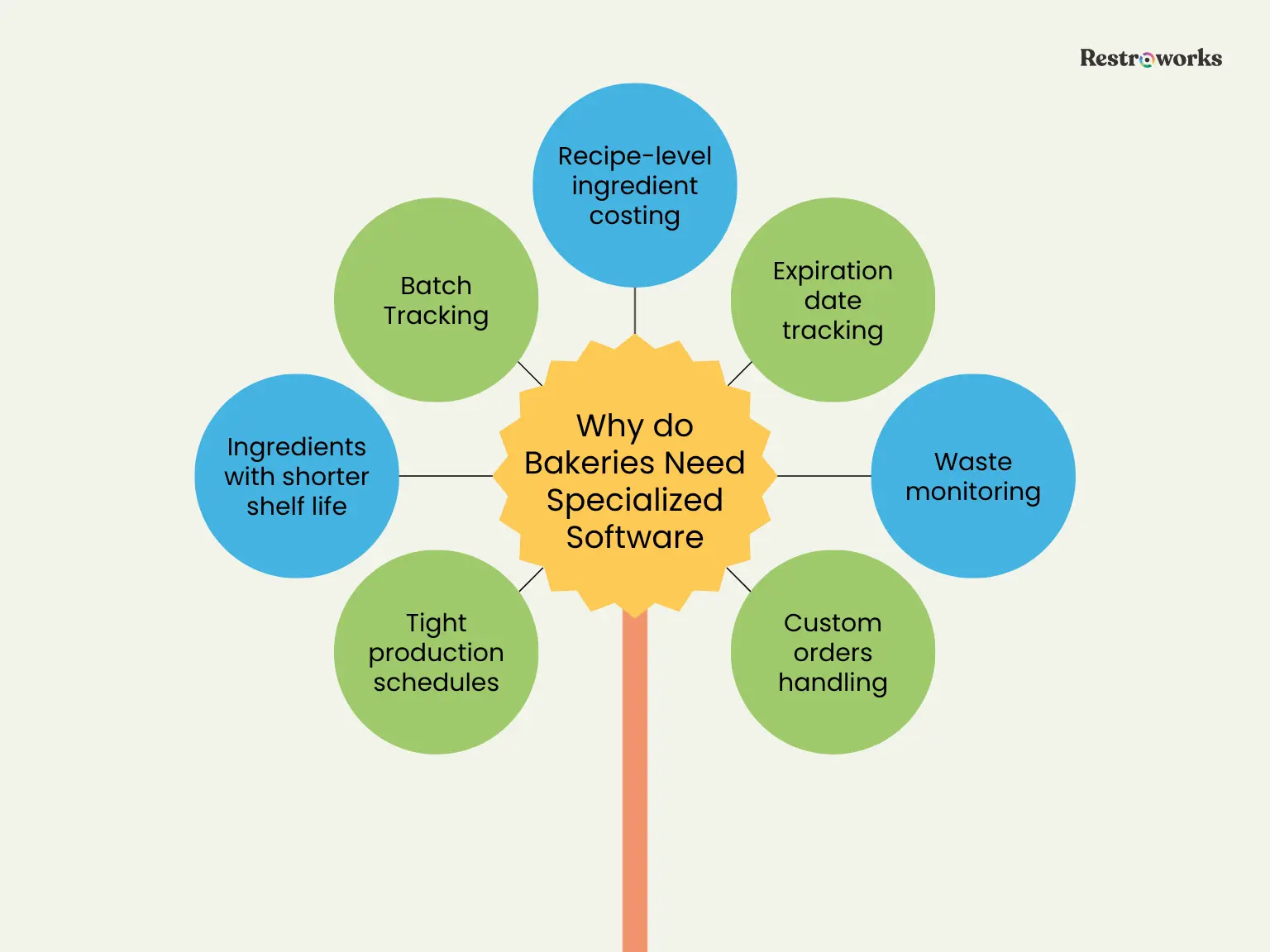
That’s why many bakeries now invest in specialized bakery management software and ERP solutions. Basic tools may help you process transactions, but they often cannot support bakery-specific operational needs like-
- Batch tracking and production planning
- Recipe-level inventory management
- Monitoring ingredient shelf-life, expiration dates, and wastage
- Managing prep and baking schedules
- Custom cakes and pre-orders
- Ingredient-level recipe management and costing
Bakery management software is designed around these day-to-day operational realities and brings you a myriad of benefits.
Let’s discuss them in detail.
Top Benefits of Bakery Management Software
What makes bakery management software a must-have for your business isn’t just automation. It’s the level of control and visibility it offers over daily bakery operations without constant manual involvement.
Here are some of the key features and important benefits bakery management software brings-
1. Simplified Ordering with Bakery POS System
Your bakery business has walk-in customers ordering at the counter, online orders coming through delivery apps or calls, or preorder pickups lining up on the side. If these orders are not feeding into one system, it can leave anyone overwhelmed.
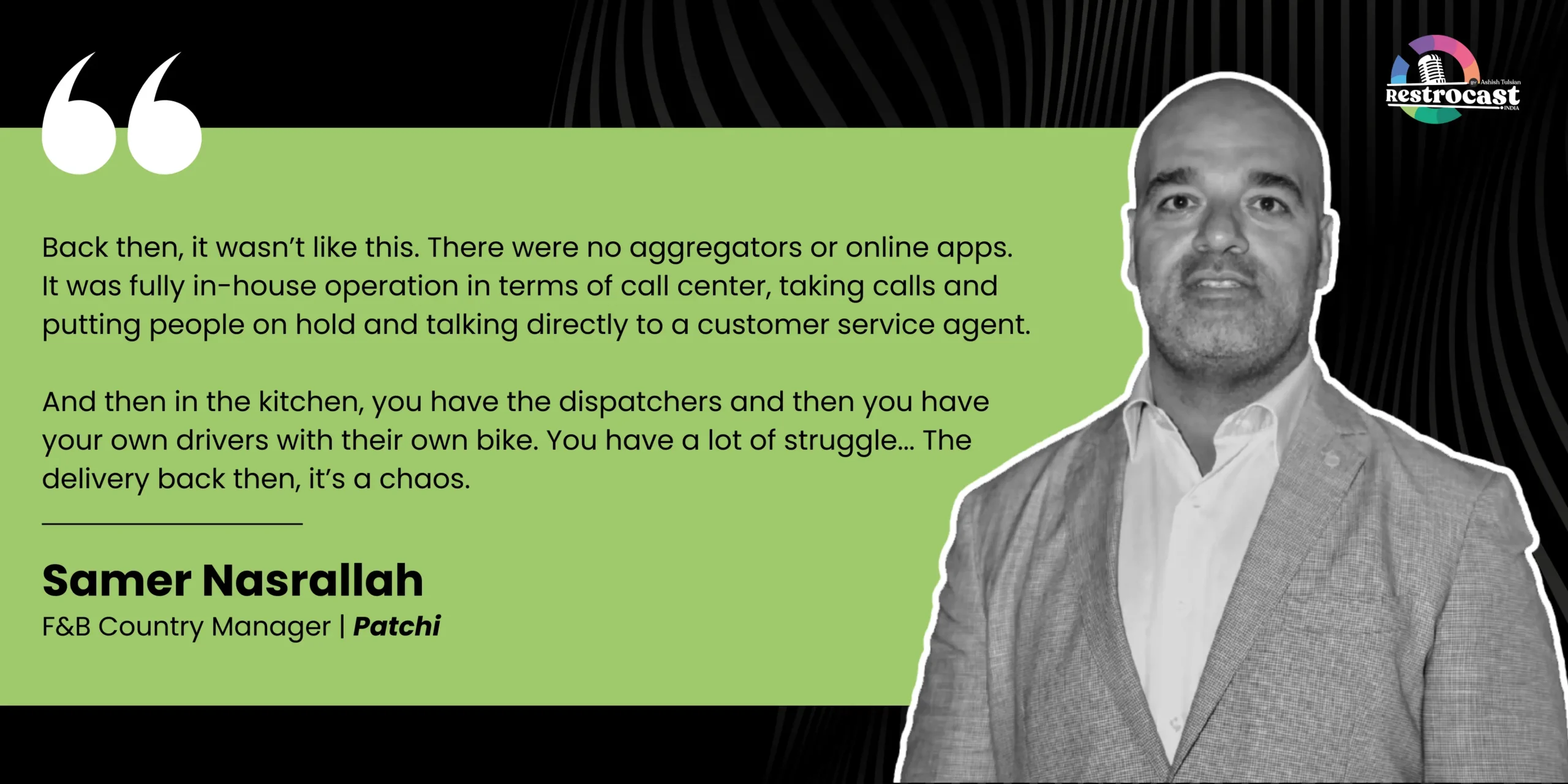
Speaking on Restrocast, Samer Nasrallah, F&B Country Manager, Patchi, described how restaurant delivery operations previously depended entirely on in-house coordination-
A bakery management system with point of sale integration helps reduce that operational fragmentation by centralizing order management across channels. One system, and all your online orders, walk-in customers, pre-orders, fulfillment, and billing get captured instantly.
This makes it easier for staff to coordinate with the kitchen, track order status, coordinate pickups and deliveries, and process payments. Plus, a connected POS system also helps you-
- Avoid duplicate order entries
- Reduce human errors in order entry or billing
- Track peak ordering periods
- Process payments quickly
- Manage order queues more efficiently
- Monitor product demand
As your bakery grows, centralized ordering improves staff coordination and customer experience.
2. Centralized Outlet Management
Scaling a bakery creates a different operational challenge altogether. The issue is no longer just managing production lines or tracking sales. It becomes coordination.
For instance, if you have a central kitchen preparing baked goods for multiple outlets, you’ll need complete visibility into production and delivery schedules. Or if one of your outlets is low on certain inventory, you’ll want a way to quickly track inventory as well as stock transfers from the central kitchen.
Bakery management software makes all of this possible. By automating processes, it helps you-
- Centrally track sales, inventory, production, and wastage across locations
- Push menu changes, pricing, discounts, and offers at the same time
- Schedule production from the central kitchen
- Track and manage food and labor costs
- Manage stock transfers from the central kitchen or one outlet to another
Bakery management software keeps up with your business growth by offering better production control, cleaner reporting, and far less operational friction between locations.
3. Accurate Bakery Inventory Management and Waste Control
Accurate inventory tracking and waste management are some of the biggest challenges for any restaurant business. If you’re doing it manually, you’ll often have to deal with stockouts, spoilage, overstocking, or waste.
Bakery management software gives you a more accurate view of-
- Ingredient usage
- Daily opening and closing stock levels
- Recipe-wise usage
- Low stock and expiry dates
That changes how you plan procurement and production decisions every day. For instance, stock levels are automatically updated in the POS system with every sale, so you don’t need to manually check storage or fill in inventory sheets.
It also handles-
- Real-time inventory usage and movement
- Automatic low-stock or reorder alerts
- Expiry date tracking and FIFO rotation
- Waste tracking
- Procurement and supply chain management to optimize purchasing
That operational visibility helps you reduce excess prep, avoid overordering ingredients, and align production more closely with actual demand. For growing bakeries, efficient inventory management also helps save costs.
4. Improved Recipe Management
Every baked good in your display follows a strict recipe. This is important not only for taste consistency and quality, but also for ingredient usage, food costs, and production planning.
Bakery management software connects your recipes directly with inventory and sales data. You can map each item recipe to specific ingredient quantities, so it automatically gets deducted from the inventory levels on item sale. This helps you-
- Standardize recipes across shifts and outlets for maintaining product quality
- Monitor actual ingredient usage against sales
- See yield variance between planned and actual production.
- Track recipe-level food costs more accurately
This becomes especially useful for products that share common ingredients across multiple SKUs. For example, if the same cream filling goes into pastries, cakes, and seasonal desserts, the system tracks usage across all linked products automatically.
5. Enhanced Demand Forecasting
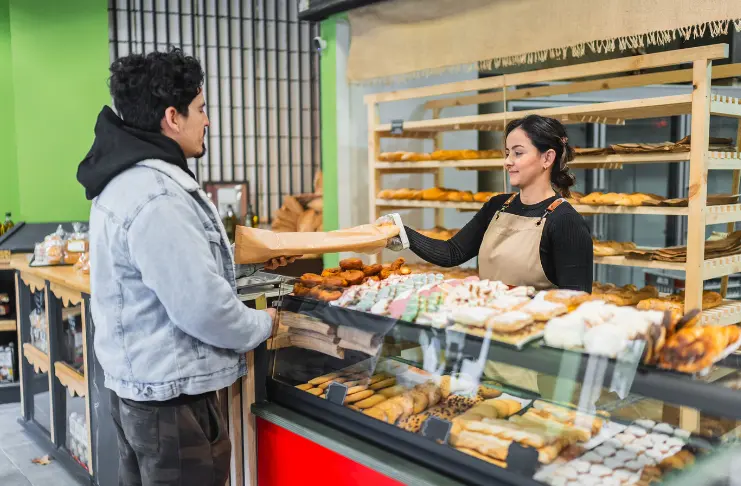
You follow the same prep routine every Monday morning, expecting the same rush as always. The problem is, customer demand will not be the same every time. Holidays, weather changes, and seasonal variations can shift demand, even within a few hours.
Bakery management software helps you forecast demand using historical sales trends and real-time customer data available on your POS software. You can track things like-
- Sales by days, weeks, months, or years
- Demand patterns across weekdays vs weekends, or during holidays
- Bestsellers on the menu
- Customer demand for certain products during certain times of the year
This helps you plan batch production more accurately and avoid both under- and overproduction. If you know which items are likely to be in demand depending on historical patterns, you can simply prioritize prep for them.
Forecasting also improves inventory purchasing because you can align it more closely with actual demand instead of routine estimates.
6. Labor Management
Labor is your second-biggest cost factor in running a bakery, after food. And if you rely on fixed schedules instead of real-time demand to manage staffing, these costs will only increase. Workload at the bakery can fluctuate depending on prep requirements, preorder volume, production timing, and customer traffic.
So why not let automation take care of it? Bakery software simplifies employee management by allowing you to align schedules with demand forecasts. So if the tool predicts higher demand next Wednesday because of a nearby event, you can schedule more kitchen and floor staff.
The system also simplifies workforce coordination through centralized scheduling, attendance tracking, role-based permissions, and outlet-level staff management across locations.
7. Real-Time Reporting and Analytics
Bakery management software connects sales, inventory, production, and labor data into one reporting system, giving you a much clearer view of operational performance. Instead of relying only on end-of-day sales summaries, you can track-
- Weekly, daily, monthly, or periodic sales
- Variance in planned and actual production
- Inventory usage during different periods
- Food and labor costs
- Waste by ingredient or service
This allows you to make faster and more informed decisions. For example, reports can help you see that blueberry cheesecake sells well but contributes less profit margins because of high ingredient costs or production waste.
So you can decide whether to change vendors for cost control or put stricter processes in place to reduce waste.
8. Better Regulatory Compliance
Like any legal business, you may be constantly drowning in documentation across ingredient sourcing, taxation, billing, and food safety regulations. Managing these records manually will become harder as transaction volume and outlet count increase.
Unless you get a bakery management software, the system helps centralize operational records so you can easily track, access, and retrieve compliance-related information.
Many systems also maintain digital audit trails for stock transfers, recipe updates, wastage entries, and sales activity. This reduces dependency on paper records, and you can conduct internal reviews confidently.
If your bakery operates across multiple locations, centralized reporting also simplifies financial consolidation and tax reporting, as you won’t have to maintain separate manual records for every outlet.
9. Enhanced Customer Experience
Customers don’t come to your bakery just for delicious desserts or menu variety. They expect more, and they expect better service on each visit, especially your regulars.
Your loyal customers often expect personalized service, quick reorder support, accurate preorder handling, and timely updates for custom orders.
Bakery management software with built-in CRM capabilities allows you to improve customer satisfaction with access to purchase history, order preferences, birthdays, feedback, and loyalty information in one place.
This makes it easier to-
- Personalize offers for repeat customers,
- Run targeted promotions during festive periods,
- Manage loyalty and rewards programs,
- Encourage repeat business through automated campaigns.
As for the customer? POS integrated bakery software allows quick order punch-in, customization requests, payment processing, and order handling. Safe to say, this significantly improves their interactions with your business.

Questions Bakery Owners Should Ask Before Choosing Management Software
A bakery software with all the latest features, intuitive UI, and tons of reporting capabilities seems like the perfect fit, right? Wrong.
Think about it, the software can offer you centralized kitchen management for multiple outlets or outlet-level control over menu and pricing. But what if you don’t even need them? You’ll only be paying extra for functions that don’t cater to your scale or streamline operations.
Which is why it’s important to ensure the system supports the way your bakery actually operates. So, before making a decision, ask questions like-
- Does it allow you to manage production workflows, or does it mainly focus on sales and billing?
- Does recipe-level tracking update ingredient usage automatically after every sale?
- Do custom cake orders and preorders flow directly into kitchen production schedules?
- Does it offer in-depth reporting across sales, bakery inventory management, wastage, costs, and more, or only show sales summaries?
- Can you track wastage, yield variance, labor costs, and outlet-level performance in real time?
- Will the software allow you to access more functionalities if you expand into multiple outlets or central kitchen production later?
These questions will help you evaluate the bakery management or bakery ERP systems based on operational practicality instead of features alone.
How to Choose the Right Management Software for Your Bakery Business?
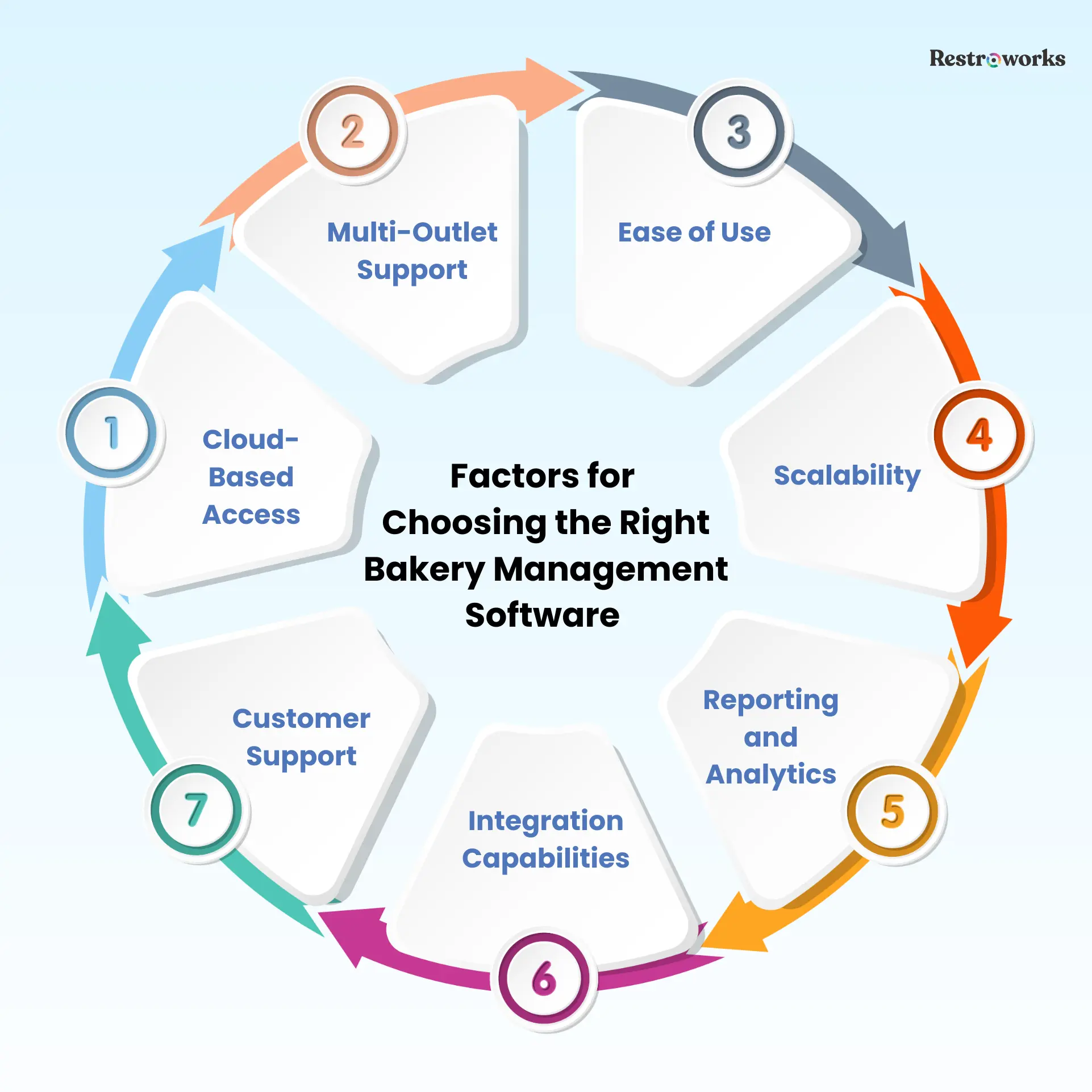
Here are some important factors to consider before choosing a management platform for your bakery business-
- Cloud-Based Access: Cloud-based systems allow you to monitor sales, inventory, reports, and outlet performance remotely without depending on on-premise systems or local servers.
- Multi-Outlet Support: If your bakery operates in multiple locations, the software should centralize inventory visibility, reporting, pricing, promotions, and stock transfers across outlets.
- Ease of Use: A software with an intuitive interface and quick onboarding will simplify training and allow your staff to use the system without complicated workflows.
- Scalability: Your bakery management system should be able to grow with your business. Choose software that can support multiple outlets, central kitchens, higher order volumes, and additional staff without forcing you to switch systems later.
- Reporting and Analytics: Access to real-time reporting and analytics dashboards is a must-have to ensure operational efficiency. With reliable software, you should be able to track sales, food costs, wastage trends, labor costs, and more, effortlessly.
- Integration Capabilities: Your newest tech system won’t be any good if it doesn’t connect with your existing ones. See if the software seamlessly integrates with accounting tools, payment gateways, online ordering systems, CRM platforms, and third-party delivery channels.
- Customer Support: Look for providers that offer onboarding assistance, staff training, reliable customer support, and operational guidance during setup and scaling.
A bakery runs on delicious recipes and happy customers, but that can only happen when the operations are handled efficiently. Manual data entry and coordination can only take you so far before inventory issues, inconsistent production, rising costs, and operational delays start affecting day-to-day performance.
The right bakery management software helps you tackle those issues with better operational visibility and stronger control across orders, production, inventory, staffing, and reporting. As customer expectations and operational demands grow, a centralized system will help you run a successful bakery.