
From being just a luxury to becoming an absolute necessity, the trend has come to stay. The restaurants with an integrated system increase their takeout margins by 30% compared to other restaurants that do not have one, while most consumers are of the opinion that it is better to make an order directly from the restaurant rather than through third-party delivery apps.
Select an online ordering platform that natively integrates with your existing POS to avoid manual entry. Choosing the right online ordering platform is critical for restaurants, as it can significantly impact operational efficiency, customer satisfaction, and drive repeat business. An effective online ordering platform should integrate directly with the restaurant’s POS system to ensure seamless order processing, reduce manual entry errors, and assist restaurant owners, unlike the existing systems that simply do not work in that way.
What You Will Learn:
- Understand how to integrate online ordering with a chain restaurant POS system
- How to streamline operations.
Online Ordering System: Why Chain Integration Is Different
A single location can integrate an online ordering system in an afternoon. All local businesses have to do is create a Google Business Profile, provide customers with a contact to reach out to, and enjoy commission-free ordering. Here, the challenge is different: how to get more customers, but that’s a discussion for another day. A chain cannot, and the mistake many restaurants and their operators make is treating chain integration as simply single-location integration repeated across more sites.
Successful online ordering integration with your POS or large chain restaurant software means every location must reflect real-time menu updates, pricing, payment processing, and inventory levels simultaneously. API rate limits that never surface at one location cause system-wide failures when 50 locations make concurrent requests during lunch service. Franchise compliance requirements often mandate specific POS providers that independent restaurants never encounter. The integration architecture that works for chains must be designed for scale from the start.
Online Ordering Food Service: The Core Technical Problem
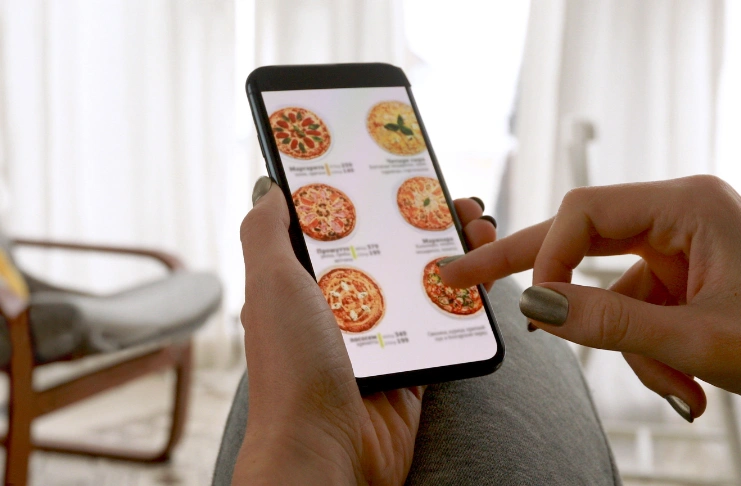
Online ordering work is the next big trend in the food & restaurant industry.
The fundamental challenge of online food ordering at a chain scale is data flow. Every incoming order from every sales channel, mobile ordering apps, branded websites, third-party delivery platforms, must reach the right POS system, at the right location, without manual entry, in real time.
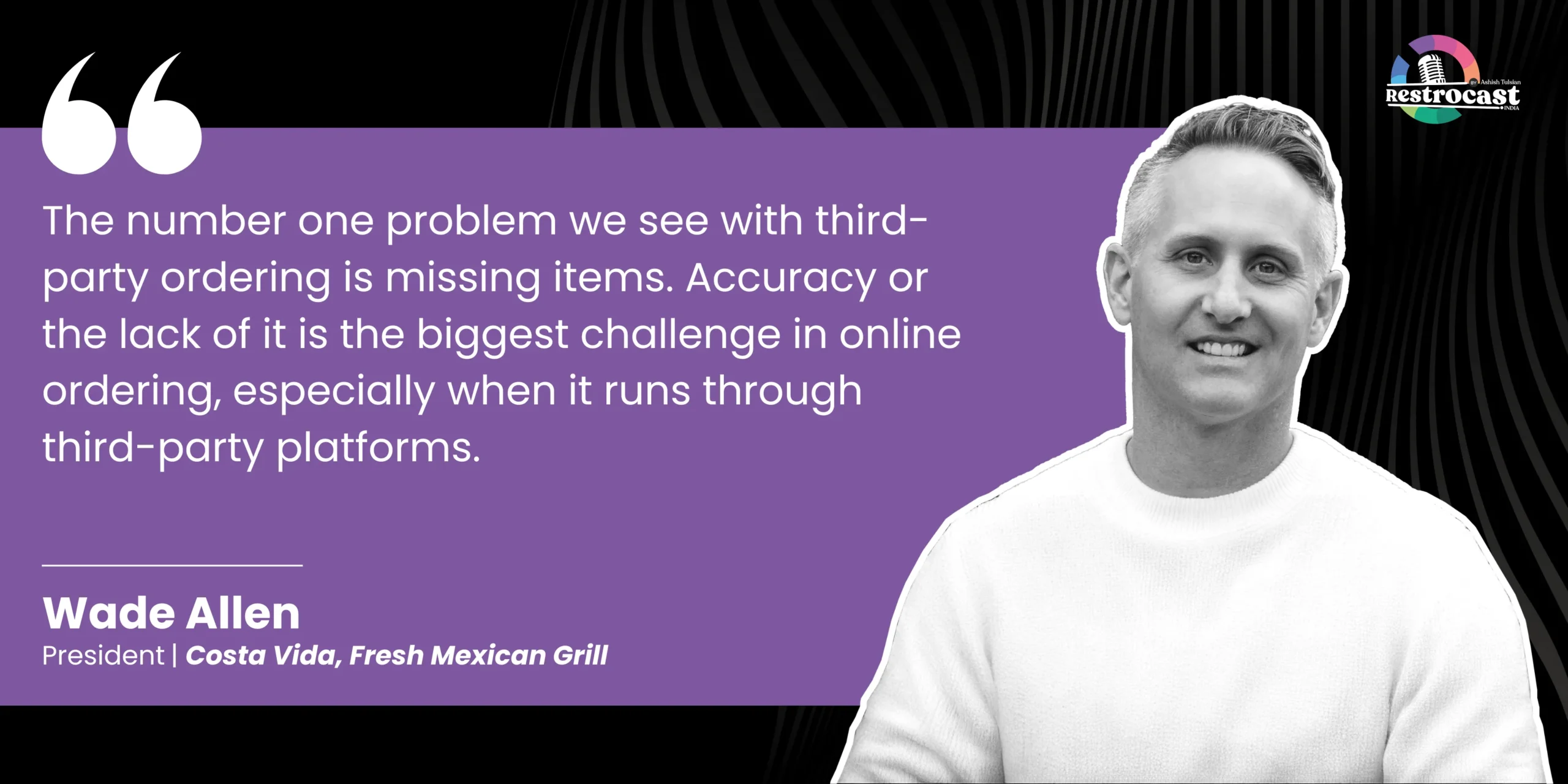
Wade Allen, President of Costa Vida, Fresh Mexican Grill, on the Restrocast Podcast, talks about the biggest challenge of using a third-party online ordering system in the food industry.
Without direct integration, staff or restaurant owners manually re-enter third-party orders into the POS.
INDUSTRY INSIGHT
POS Ordering System: Direct vs Aggregator Architecture
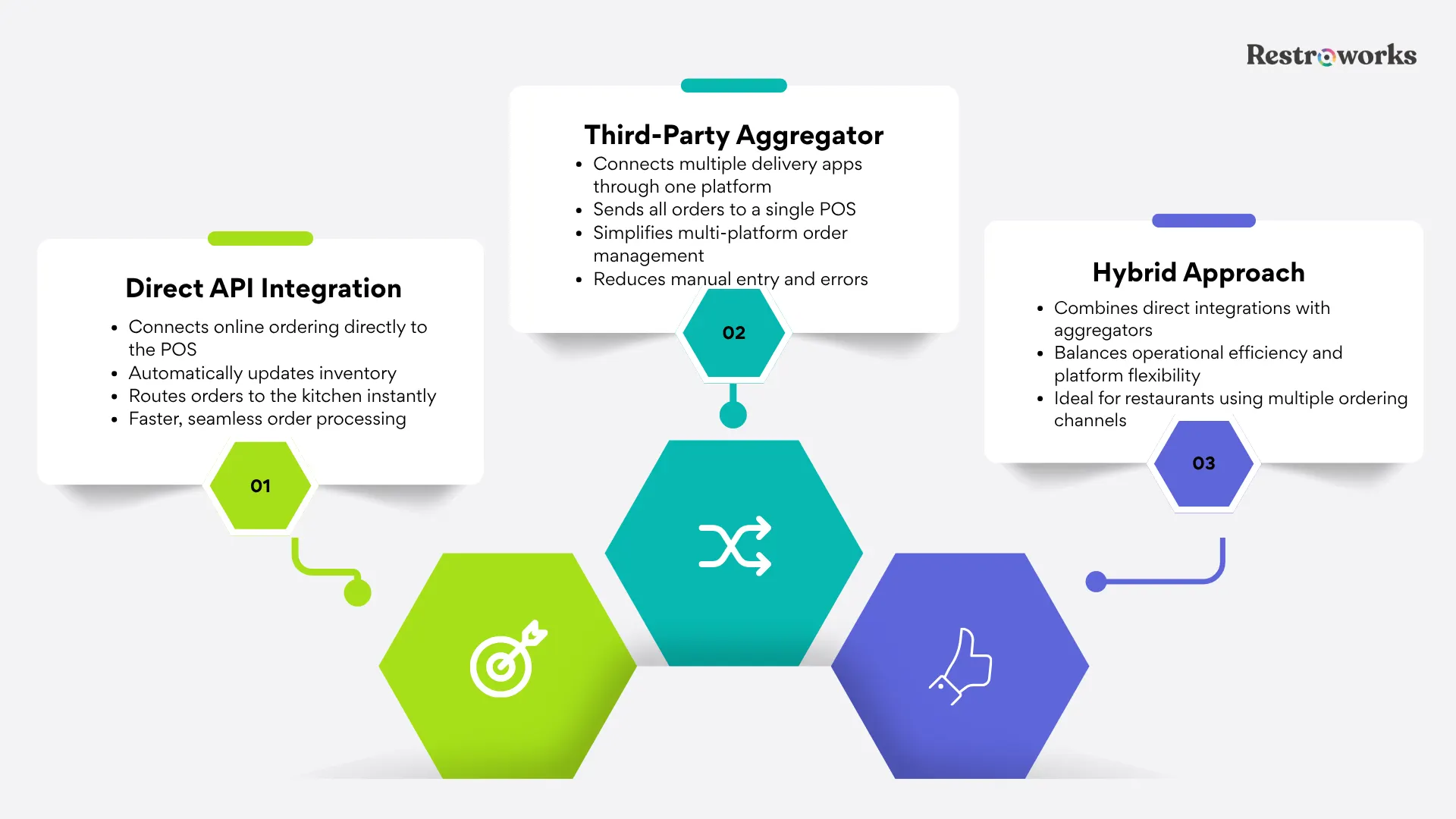
The first architectural decision is whether to use direct API integration, a third-party aggregator, or a combination.
Direct API integration connects your online ordering platform to your restaurant’s POS through a documented API. Orders flow to the point of sale, update inventory levels, payment processing, and route to the kitchen display system (KDS) automatically. Laughing Planet, a 16-location US fast-casual chain, achieved 10.5% digital business growth and a $3.50 average check increase after migrating to Olo with full POS integration: “Olo has allowed our restaurants to enhance their digital offerings and deliver a best-in-class customer experience no matter how people choose to order.”
Third-party aggregators act as middleware, consolidating multiple delivery platforms into a single POS connection.
Mobile Ordering Apps: Direct Channel Ownership
Mobile ordering apps are the highest-value online ordering channel for chains because of the direct revenue and the customer data they generate. Its key features include that when customers order online through your branded app rather than a third-party platform, you own the transaction data, payment processing, and the customer relationship.
When loyalty programs integrate with POS and mobile ordering, restaurants can track individual purchase frequency and customer behavior over time, enabling genuinely data-driven decisions about promotions and menu engineering.
Third-Party Platforms: Managing Third-Party Channels
Third-party delivery platforms generate reach but extract 15 to 30% commission per order on order fulfillment and return no customer data, sometimes no order tracking/order status either. Without integration, each platform requires a separate tablet at each location, separate menu management, and manual re-entry of delivery orders into the POS.
The aggregator model consolidates delivery platforms into a central hub so all incoming orders from all sales channels arrive on a single screen and flow directly to the POS and kitchen display system. For chains where delivery orders represent a significant portion of revenue, direct online food ordering channels, alongside third-party delivery apps, protect profit margins while building the owned customer data asset that third-party apps withhold.
Direct Integration: KDS and Menu Synchronization in Restaurant POS System
When direct integration is functioning correctly, online orders arrive at the kitchen display system exactly as in-store orders do, routed to the right prep station without printed tickets, without manual entry, without delay. Any change made in the POS syncs across every online platform in real time, so customers always see accurate pricing and availability.
Howard Johnson Plaza cut checkout time by 50% through a POS integration with their Opera Cloud PMS, demonstrating that direct integration benefits extend into restaurant operations well beyond order routing.
Restaurant Operations & Operational Efficiency: Multi-Vendor Complexity
Most established chains run multiple POS vendors that operate multiple locations, a reality that single-vendor integration guides ignore entirely. Real-time inventory sync prevents overselling items that are out of stock by automatically deducting online orders from inventory. It also prevents overbuying from vendors and reduces waste, too. A restaurant POS system with online ordering integrates digital sales channels directly into a stable management system, allowing for better control over customer data and reducing manual order entry errors. Research indicates that managing multiple standalone devices for online orders or online management can lead to high human error rates and lost customers, making integrated online ordering systems essential for efficiency. A well-executed online ordering system or a complete restaurant management system can increase efficiency, boost sales, improve customer satisfaction, and keep food costs and management systematic and balanced.
Third-Party Delivery: Reduce Errors & Margin Protection
Out the Dough, a regional QSR chain, achieved a 15% overall revenue increase after switching from a fragmented multi-platform setup to unified POS integration, not by adding delivery zones, but by eliminating the order entry errors and inventory sync failures that were quietly eroding revenue on every shift.
That result reflects what well-executed direct integration actually delivers: not just cleaner data, but real margin protection through reduced labor costs, fewer errors, and better stock count accuracy across all online ordering channels.
Third-Party Apps: The Rate Limit Warning
Enterprise chains regularly discover post-implementation that their integration partner’s API rate limits are insufficient for peak volumes across all locations. Most aggregators publish pricing based on single-location assumptions. Before committing to any online ordering software or aggregator, ask the vendor directly about maximum concurrent transaction volumes and enterprise contract terms. Get those answers in writing before signing anything.
Customer Experience & Customer Loyalty: What Integration Failure Looks Like
When integration is working, customers never think about it. Orders arrive accurately, on time, with no operational friction surfacing in the experience.
When it fails, customer experience degrades immediately. Wrong items, items that appear available in the online menu but are out of stock, delays from orders falling to manual entry, these are all integration failures. A single misconfigured menu sync can push an out-of-stock item as available across hundreds of locations simultaneously until manually corrected. Real-time menu synchronization, automated inventory level updates, and direct KDS routing are the components that protect customer satisfaction and customer trust at a chain scale.
Digital Age: Data as the Competitive Advantage
In 2026, the chains competing effectively are the ones with a unified integration architecture rather than disconnected point solutions.
18-Month Integration Roadmap for Chain Restaurants
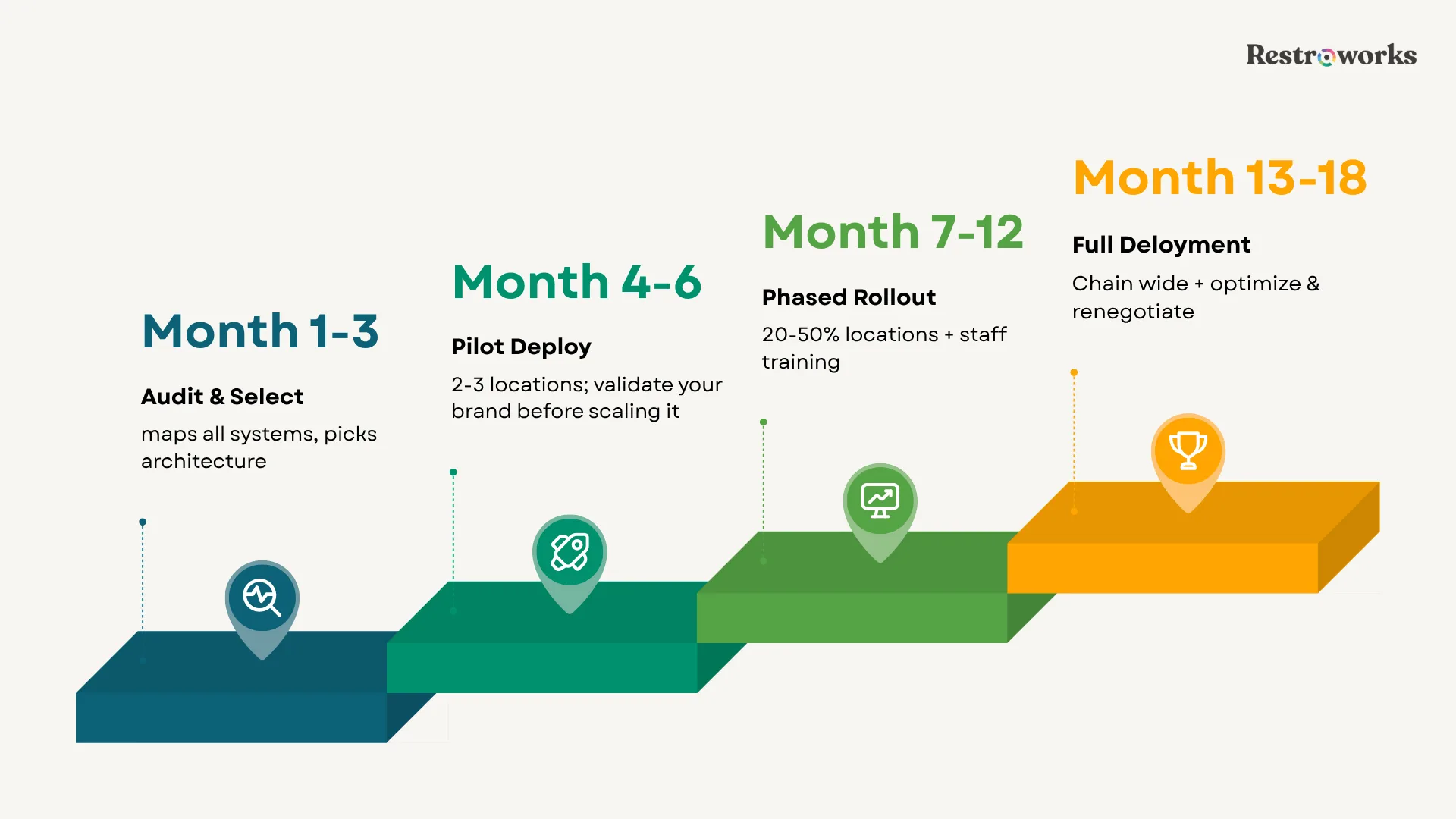
Months 1 to 3: Audit and select the document for every modern POS system, software version, and network configuration across all locations. Confirm franchise agreement requirements on approved vendors. Choose your integration architecture based on transaction volume and verified enterprise API documentation. Identify locations with legacy systems needing migration before integration is possible.
Months 4 to 6: Pilot Deploy at two to three locations only. Validate order flow from all online channels to POS and KDS without manual entry. Confirm real-time menu synchronization. Test peak-hour transaction loads. Measure order error rates before and after. Do not proceed to chain-wide rollout until pilot metrics are validated.
Months 7 to 12: Phased rollout, deploy to 25 to 50% of locations. Build staff training on order handling, cancellations, and outage fallback into core onboarding. Monitor inventory management sync weekly and document failure modes.
Months 13 to 18: Full deployment and optimization. Complete chain-wide deployment. Activate consolidated cross-location reporting. Review channel mix, delivery platform profitability, and menu performance using the integrated data. Renegotiate aggregator contracts based on actual enterprise transaction volumes from full deployment.
Research indicates that nearly 75% of all restaurant traffic now occurs off-premises, highlighting the importance of having a robust POS system that supports online ordering capabilities. A fully integrated restaurant POS system can streamline operations by connecting all parts of the restaurant, from online orders to kitchen display systems, thereby reducing errors and improving efficiency. Centralized menu management ensures consistency across web, mobile, and in-store channels by using the POS as the master source for menu items. Automated synchronization and operational standardization across all chain locations are crucial for successful online ordering integration. Unified systems provide a comprehensive view of chain performance, consolidating sales data from both in-person and digital sources.
Ultimately, POS integration within a chain restaurant operation is an efficiency evolution that dictates just how scalable that brand will be in this new era. Integration, when done right, is about much more than order automation; it allows a business to maintain profitability, boost profits, improve accuracy, and create a seamless integration and easily measured ecosystem out of multiple sales channels. In today’s digital-centric world, where digital orders will increasingly dictate relationships with consumers, integration itself is not merely a backend process but a driver of income.